AI Deployment Skills You Can Prove: Build a Portfolio Artifact, Not a Tool List
A practical way to demonstrate AI implementation work through baselines, evaluation, safety boundaries, operations and handoff rather than a list of model names.
Many technology CVs now contain the same sentence: “Built an AI assistant.” It tells an employer almost nothing about the candidate's ability to ship useful work. Was the assistant a local demo or a production system? What did it replace? How did anyone know it helped? What happened when it gave a wrong answer or the provider failed? A strong portfolio artifact answers those questions in a way another engineer can inspect. This article gives a manageable way to build one without pretending a small personal project is a large enterprise deployment.
A catalog signal that needs qualification
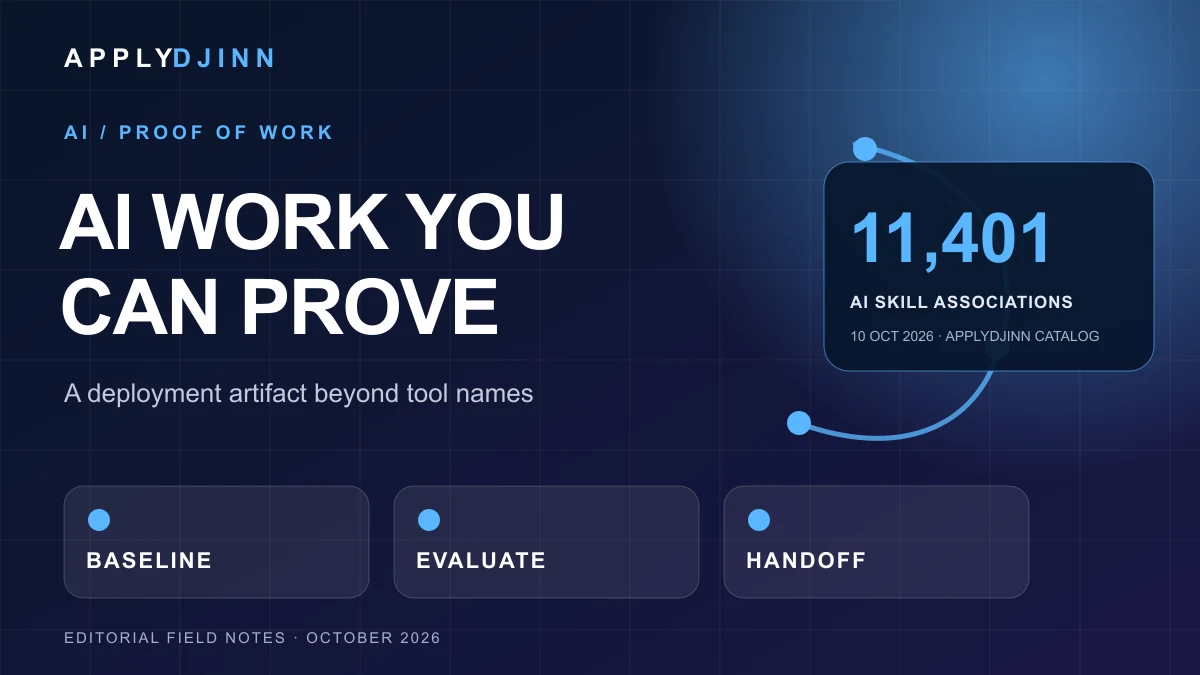
At October 10, 2026, 09:52 UTC, ApplyDjinn observed 23,702 current vacancies at 282 employers across its monitored sources. 13,581 were classified as technical roles. Its normalized requirement index associated the AI skill with 11,401 current listings at 255 employers. That is a very broad label: it can describe a product, customer problem, team context or work a candidate must personally perform. The indexed association is generated from job text and should be checked against each source requisition. It does not mean that 11,401 roles require someone to deploy an AI system.
To turn this number into a useful search, sample roles from several independent employers and sort them by responsibility. Put model evaluation, deployment, data platform, product integration and AI-adjacent business roles in separate piles. For each pile, ask how many source postings actually describe the work you can demonstrate. The employer denominator is helpful because a tag appearing across many organizations has broader reach than a tag repeated in one company's template, but breadth alone still does not establish seniority, salary or a common tool stack.
The portfolio exercise below is deliberately narrower than this large index. It builds proof for one implementation workflow with a baseline, evaluation and operating plan. A candidate applying to a role that only mentions AI as company context should not insert this artifact merely to match a keyword. Use the technology view to see evidence tiers, then let the original job description decide whether the artifact belongs near the top of your application. The counts here are a dated ApplyDjinn catalog snapshot, not a forecast of AI hiring across the labor market.
What the market signal actually says
On October 2, 2026, Anthropic announced Claude Frontier Academy, an educational program focused on moving from AI experimentation to implementation. It describes training, certification and a goal to reach many engineers over time. This is a company announcement about its own program. It is not a count of open jobs, evidence that every employer uses its tools or a promise that a certificate will lead to an interview. The useful signal for a candidate is narrower: employers may ask whether you can take an AI use case past a demonstration and into a controlled workflow.
Use ApplyDjinn's technology evidence and current vacancies to test that signal against actual roles. Search for AI implementation, evaluation, MLOps, platform engineering or developer tooling within your target geography. Open source listings and record what they require. A posting that mentions AI in the company overview should not be treated as proof that the role needs model integration. Look for responsibilities such as evaluation design, retrieval, service reliability, user feedback, security review and measurement of a business process.
Do not build a portfolio around one day's trending keyword. Choose a problem that appears at several independent employers or that you understand from real work. A modest, well-measured support-triage workflow can be more persuasive than an elaborate autonomous agent whose output cannot be checked. The artifact should show your engineering judgment, including where you decided not to use a model.
Select a bounded use case
Pick one repeatable task with clear inputs and a testable output. Examples include classifying incoming support requests into a small, published taxonomy; drafting a response that a human must approve; extracting fields from a known document type; or helping an engineer find a runbook section. Avoid a task that requires access to private production data you do not own. Use public, synthetic or permissioned examples and say which you used.
Write a one-page problem statement. Who currently does the task? How long does it take? What kinds of errors matter? What output is acceptable, and what must be escalated? If you cannot answer these questions, you are not ready to optimize prompts. The baseline could be a rules-based approach, manual work on a sampled set or an existing search interface. It need not be sophisticated, but it must be recorded before judging the model.
Define a failure boundary. A wrong category might create extra work; an invented legal or medical answer could cause serious harm. Those are different risk profiles. For a portfolio, choose a use case where you can demonstrate controls without implying that an unsupervised model should make high-stakes decisions. The NIST AI Risk Management Framework and its Generative AI Profile provide a vocabulary for identifying, measuring and managing AI risks. Use them to make a specific risk register, not to decorate the project with framework names.
Build a dataset that can reveal mistakes
Make a small evaluation set with cases from the workflow. Include ordinary examples, ambiguous examples and examples that should result in “I cannot answer” or human review. Record expected outputs and the reason each example belongs in the set. Keep a separate set for tuning and a held-out set for evaluation; if you revise prompts until every visible case passes, the same cases no longer tell you how the system generalizes.
For each case, capture the input, expected behavior, actual behavior and failure category. Some tasks permit exact-match scoring; others require a rubric or independent human review. Report the denominator. “Ninety percent correct” without the number of cases, definition of correct and error distribution is almost unusable. If the sample is small, say the result is a smoke test, not proof of production quality.
Measure the baseline and the AI approach on the same set. If a simple keyword rule meets the task's tolerance at lower cost and complexity, that is a valid engineering result. If the model improves coverage but invents unsupported details, report both effects. A hiring conversation can then focus on the trade-off rather than on whether you know a model's marketing name.
Make the unsafe path visible
Document what data leaves your application and which provider receives it. Redact secrets and personal data before logging or sending examples to third-party systems. Decide which users can submit text and which tools, files or network destinations the model can access. If you use retrieved documents, state how the system handles a malicious instruction embedded in a document. The OWASP Top 10 for LLM Applications is a useful checklist for prompt injection, insecure output handling and other failure modes; turn each relevant item into a test rather than asserting the app is “secure.”
For an assistant that cites source material, show the exact source passage beside the answer. Check that the answer is supported by the cited passage, not merely that a link is present. If no supporting passage exists, the system should decline or route to review. A clickable citation can be wrong, stale or unrelated. Review the destination domain before users open external links. The same discipline applies to ApplyDjinn's own news: a short publisher excerpt is not an original article and should not be presented as one.
Add a human decision point where the risk warrants it. A generated support reply can be a draft requiring approval. A classification can be suggested with a confidence cue and a way to correct it. Record the corrections so future evaluation includes the cases people found confusing. A demo that always shows the best example conceals the information a team needs to decide whether to deploy.
Show the operational path
The portfolio should include a simple architecture diagram: input, storage, model or retrieval call, validation, reviewer, output and audit log. State the model version or provider settings used during the test. Include a timeout, retry rule and a fallback when the model is unavailable. Avoid unbounded retries that multiply cost and delay. A synchronous user flow may need a shorter timeout than a background batch task. Show what the user sees in both paths.
Track latency, failure rate, cost per completed task and a quality metric after launch. Quality may require sampling and review; it rarely comes from counting API calls alone. Keep cost connected to value. If the system saves two minutes on a task but requires five minutes of human verification, the outcome may be worse. If daily spend grows because irrelevant text is repeatedly sent to the model, describe the correction and the effect on quality.
Version the prompt and evaluation set with the code. When you switch models, re-run the held-out tests and compare error categories. A provider change that improves average score while increasing severe mistakes is not automatically a successful upgrade. If a result changes, make the rollback path clear. Operations evidence is often what distinguishes an implementation project from a weekend demo.
Package the artifact for a recruiter and an engineer
Publish a concise README with the problem, baseline, data permission, architecture, evaluation method, results, limitations and next decision. Include sample inputs and outputs that can be shared legally. Put the deepest implementation details in a linked technical note or repository. A recruiter should understand the problem in a minute; an engineer should be able to challenge the method without asking for a private system login.
Write one CV bullet from the artifact. A defensible form is: “Built a human-reviewed ticket classifier on a permissioned sample; compared it with a rules baseline, measured category errors on a held-out set and added a timeout fallback and review log.” If you have reliable numbers, add them with their denominator. If you do not, leave them out. You will sound more credible than a candidate who claims a large productivity gain from a single favorable example.
Turn this artifact into practice questions about scope, evaluation and incident response after you have built a first version. An answer is stronger when it refers to a failure you observed than when it recites a framework. During applications, match the artifact to the role: a platform position may care most about reliability and cost, while a product position may care most about workflow adoption and human review.
The finished artifact does not have to be large. It has to make the path from user problem to measured behavior inspectable. That means showing a baseline, a bounded dataset, real failure cases, a safety boundary, an operating plan and an honest account of what you still do not know. A hiring manager can use that to assess how you work even if the portfolio uses a different model from the one in their stack.