AI Expectations Meet Real Hiring: What the October Research Means for Your Next Role
New research published on October 16 meets an October 18 ApplyDjinn snapshot: 10,938 listings mention AI, but 4,180 place it in the required tier. A practical guide to task change, evidence, employer concentration and career preparation.

The last few days have produced a useful collision between expectations about artificial intelligence and evidence about actual work. On October 16, Anthropic published research about people's expectations of AI and a separate account of changes inside its own organization. Those are different kinds of evidence. One describes beliefs about a possible future; the other examines one unusually intensive adopter. Neither is a census of employers. For a job seeker, the useful question is which parts of a role are changing, who still owns the result, and what an employer currently asks an applicant to demonstrate.
The cover and the workbench image below are AI-generated editorial illustrations. They do not depict an actual employer, experiment or measured workflow.
What changed in the October evidence
Anthropic's AI expectations study, published October 16, compares an August survey of US adults with staff responses. Employed US respondents expected AI to be capable of performing an average of 28% of their current work hours by 2030; staff averaged 75%. Those are expectations, not observed automation rates or announced staffing plans. The groups also differ in their exposure to the technology and their working environments. A large gap therefore gives us a research question about adoption and experience, rather than a reliable countdown for an individual occupation.
The companion employment study reports that the junior share of technical hires fell from 27% to 9%, alongside greater use of agents. It also describes growing pressure on human attention and greater emphasis on judgment in hiring. These findings concern one company and its organizational choices. They do not establish that AI caused every change, that junior recruitment has ended everywhere, or that the same staffing pattern fits a bank, software consultancy and hospital.
For applicants, the two reports point toward a useful distinction: capability, adoption and employment are separate variables. A tool can become better at a task while a team delays deployment, changes the task, adds review work or expands the amount of work attempted. A CV should show where you can improve that whole process, with a result another person can inspect.
Our October 18 catalog check
We froze a read-only ApplyDjinn catalog snapshot at October 18, 2026, 06:19 UTC. The directory contained 371 employers. The current window contained 22,119 active listing records across 335 employers, of which 12,873 were classified as technical. These are observations of connected sources, not all vacancies in the economy and not completed hires. The window uses a source publication date where available, then first-seen or created time; pinned active records are also included. 2,204 records lacked a source publication date, so the observation window is partly a discovery window.
Within that population, 10,938 listings had an AI skill-evidence entry. Their saved evidence tiers were:
| Saved AI evidence tier | Listing records | Reading the number |
|---|---|---|
| Required | 4,180 | The parser associated AI with a role requirement; inspect the original requirement |
| Supporting | 4,766 | AI provides context or supporting stack information |
| Optional | 1,992 | AI appears as optional evidence rather than a mandatory capability |
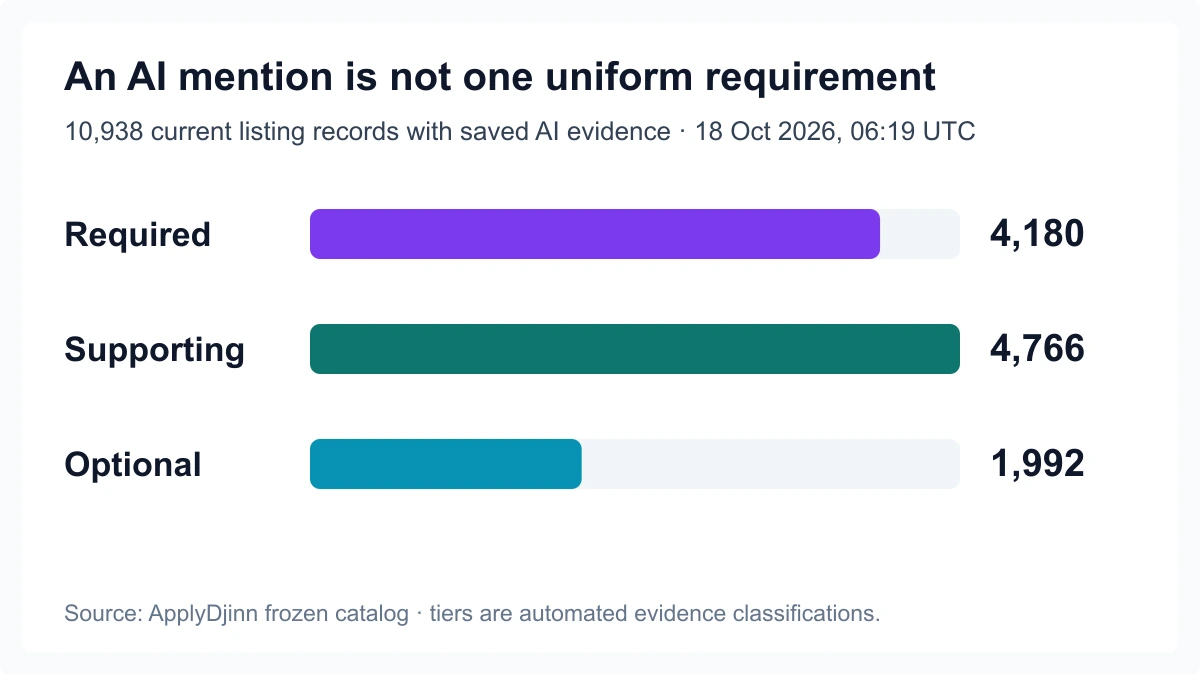
No AI entries in this snapshot were stored in the separate core tier. We therefore describe the qualified group as the 4,180 required-tier records, rather than implying a measured core subset. Evidence tiers are automated classifications, not a manual audit of every sentence. Their value is in making a narrower research starting point visible, with the technology page and original vacancy providing the next checks.
The headline count hides different kinds of work
Only about 38.2% of the AI-mentioned records fell in that required group. Treating all 10,938 mentions as equivalent demand would erase the distinction between implementing a model, selling a product that contains one, and reading an optional statement about new tools. This does not make the other records unimportant. It means they answer a different question.
Of the required-tier group, 2,721 records were classified as technical. The role-family breakdown included 1,297 in software engineering, 551 in data and AI, 519 in sales and customer success, and 497 in operations, programs and services. These are catalog families, not standardized occupational statistics. The combination is still useful: AI-related work in this sample extends well beyond a research-scientist title.
Imagine two candidates opening the same AI filter. An infrastructure engineer should investigate reliability, deployment, permissions and observability requirements. A customer-facing specialist should look for implementation ownership, integration work, domain knowledge and the quality of customer decisions. A generic instruction to “learn AI” would send both toward the same course while concealing the different evidence each role needs.
Employer concentration changes the interpretation
The required group spanned 207 employers, but it was unevenly distributed. EPAM contributed 1,345 records, approximately 32.2% of the group. Excluding that employer leaves 2,835 records across 206 employers. Removing the largest contributor is a useful sensitivity check; it is not a claim that its openings are less real.
Large employers can publish many location variants, recruit across many clients, or have particularly complete source coverage. They can therefore dominate a listing-based measure without representing the same share of new hiring expenditure. When comparing technologies, repeat the comparison with the largest employer removed and read a few individual requisitions. Company profiles help establish which organization supplies the records and which roles fit your location.
This matters for preparation. A technology that appears at many employers can support a broad search; a specialized requirement concentrated in one organization may support a deliberate target-company strategy. Both can be sensible. The choice depends on your existing skills, eligibility and tolerance for a narrower pipeline, rather than the largest badge on a technology card.
Turn an AI requirement into an inspectable task
Start with the verb in the requirement. “Evaluate,” “integrate,” “operate,” “sell” and “research” imply different work. Then identify an input, an output and a failure condition. If a listing says that the role will evaluate a retrieval system, ask which dataset defines success, which errors are expensive and who accepts the release. If it says that the role will help customers adopt AI, ask what happens between a demonstration and a supported production workflow.
A useful preparation note has five fields: the employer's task, the evidence in the listing, an artifact you can show, a limitation of that artifact, and a question for the team. This gives an interview conversation a concrete structure. It also prevents a portfolio from becoming a stack of demos that cannot explain who the user is or how a failure would be found.
The task can be small. A careful evaluation of a document-extraction feature may show more judgment than an elaborate autonomous assistant with no acceptance test. Choose a scope you can finish, measure and describe honestly. Keep private employer or customer data out of public demonstrations, and use a clearly labeled synthetic dataset when real records cannot be shared.

A worked preparation example
Consider a hypothetical support-triage feature. This is an illustrative project, not a measured customer result. The system reads a ticket, proposes a category, retrieves a relevant knowledge-base passage and drafts an answer. The easy demonstration is to show a convincing answer to one ticket. The more useful engineering demonstration is to make the acceptance conditions visible.
Create a small labeled set containing ordinary requests, ambiguous requests and cases that should reach a human. Keep a fixed held-out portion. Compare the assistant with a simple baseline, such as a keyword router, using the same cases. Record category errors, unsupported statements and cases correctly deferred. State how you chose the labels and where a single evaluator's judgment could be wrong.
Then show the operating controls. A support assistant should not silently acquire permission to refund a payment, expose another customer's record or change an account. Separate a proposed action from an authorized action. Demonstrate a failure path, a log another engineer can inspect and a way to return to the previous version. These are proposed portfolio practices, not a checklist that every employer necessarily uses.
The resulting CV statement can describe the system, evaluation set, baseline and remaining error classes. Use real numbers only after you have measured them. An honest sentence about finding an unsupported-answer failure and changing the review boundary is often more informative than a percentage with no denominator.
Junior applicants need a narrower claim, not a louder one
The catalog's required-tier group contained 11 records labeled junior, 57 labeled intern and 970 with unknown seniority. It would be misleading to call those counts a complete junior market. Source language, parser rules and employer coverage all affect the classification; an unknown label cannot be assumed senior or junior. The internal Anthropic study is also not a substitute for searching other employers.
A junior applicant can make a stronger case by showing a finished, bounded contribution and how feedback changed it. Explain the bug you reproduced, the test that failed before the fix and the trade-off you considered. If AI helped, explain what you checked yourself and where it was unreliable. This makes the applicant's contribution visible without claiming sole authorship of every generated line.
For experienced applicants, the corresponding challenge is to show the decision boundary. Explain when you would decline to automate a task, what evidence would change that decision and how an operator would notice a bad outcome. A senior title alone does not demonstrate that judgment; a carefully described production decision can.
Questions worth taking into an interview
Ask which task the team expects AI to change in the next release, rather than asking whether the company “uses AI.” Ask who reviews outputs, how review time is measured and which errors block shipment. Ask whether the team has a representative evaluation set and whether a person can stop or reverse an automated action. These questions reveal work organization as well as technical maturity.
Also ask what the role owns after deployment. Model behavior, source data and user expectations can change independently. A feature that works in a notebook can require monitoring, incident response, customer support and model-change evaluation. If those responsibilities are split between teams, understand the handoff. That is relevant both to evaluating an offer and to deciding which project demonstrates your fit.
Avoid interpreting a polished employer answer as independent proof. Follow it with a request for a concrete example that the team can discuss publicly. A useful account identifies a failure, a decision and an observed result. The same discipline should apply to your own examples.
A practical plan for the coming week
Choose a small set of current roles in one family and geography. Check them at their original employer sources, then separate required, supporting and optional AI statements. Group repeated tasks, rather than counting model names. Note the largest employer's contribution so a source with many variants does not define the whole plan.
Choose one task you can demonstrate with existing skills and one gap worth investigating. Build a bounded artifact, write down its acceptance conditions and test a failure case. Use the evidence to revise your CV and prepare three questions for a real team. Revisit the listings before applying: a source can close a requisition after the snapshot.
The October reports make a persuasive case for examining how work is organized. They do not remove the need to inspect an individual employer's requirements. A useful search moves from a claim about AI, to a specific task, to a verified opening and a demonstrable contribution.
Sources and reproducibility
- The AI expectations gap, Anthropic, October 16, 2026. Survey timing and populations differ from the publication date; responses are expectations.
- How employment is changing at Anthropic, October 16, 2026. An internal company study, with limits on generalization.
- ApplyDjinn read-only snapshot, October 18, 2026, 06:19 UTC. Saved query code and aggregate results accompany this article's repository source. Counts use catalog IDs; location variants and source coverage can affect totals.
- AI technology evidence, current vacancies, methodology and research authorship. Live pages can differ from this frozen observation.