← BlogAI Is Now 61% of Tech Hiring. Here Is What That Actually Means
Market Data7/11/2026By

AI Is Now 61% of Tech Hiring. Here Is What That Actually Means

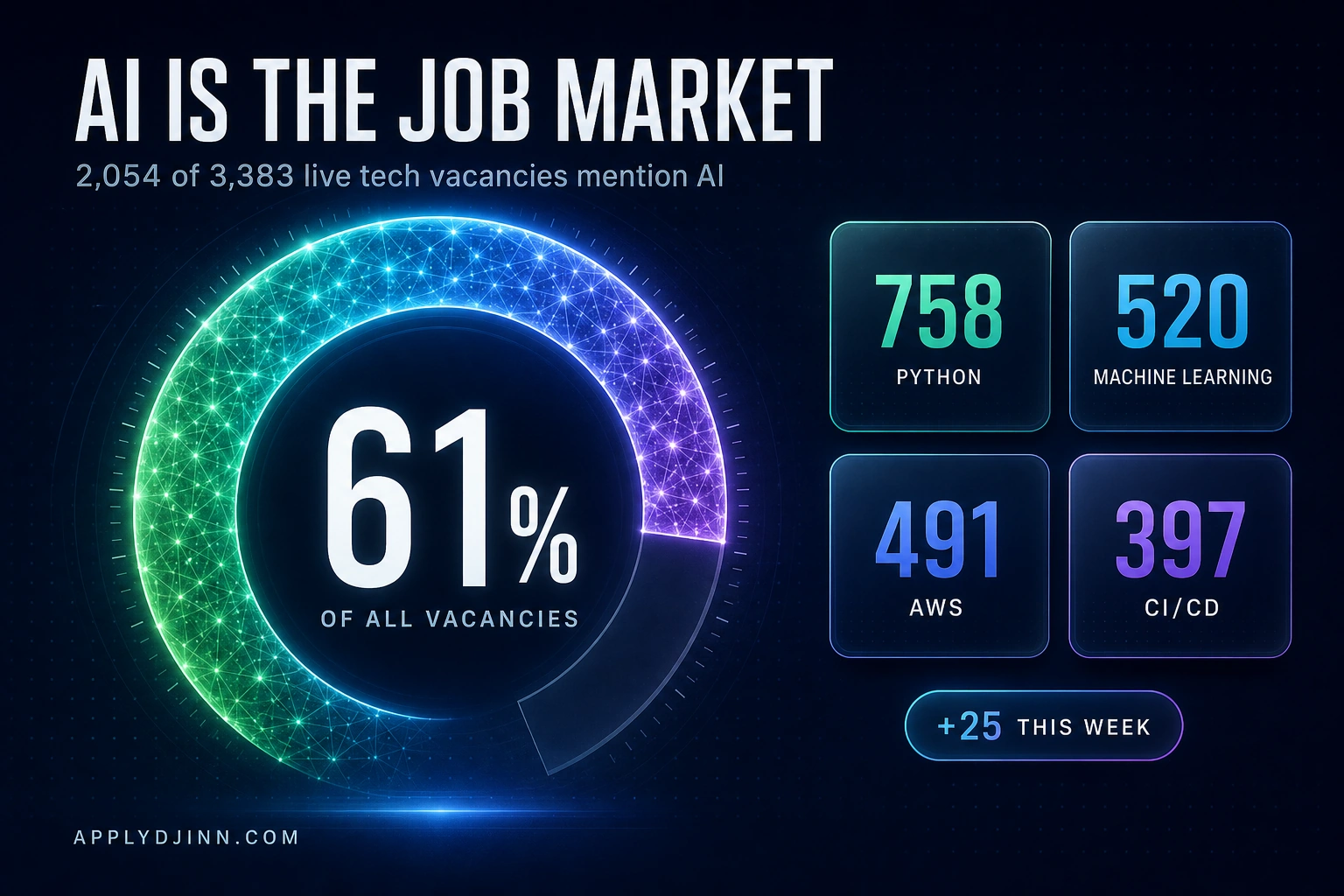
2,054 of 3,383 live vacancies in our catalog mention AI. We looked at what hides behind that number — and what it means for your next role.

Every hiring report this year says the same thing: AI is everywhere. Our live data lets us say it precisely: 61% of all tech vacancies we track — 2,054 out of 3,383 — mention AI in their requirements or description.


But "AI role" has stopped meaning "research scientist". Here is how it actually breaks down.


What counts as an "AI mention"


Before the layers, a word on method. We do not tag a posting as AI because it sits at an AI company. We parse the requirement and responsibility text and count a mention only when a concrete signal appears: "AI", "machine learning", "LLM", "GenAI", "deep learning", "RAG", "AI agents", or a named framework like PyTorch or TensorFlow. A marketing sentence about being "an AI-first company" does not count. So 61% is a floor, not spin — it is the share of postings where AI shows up in the actual work.


The three layers of AI hiring


  • Model-adjacent engineering. The classic profile: AI + Machine Learning + Python is our single largest stack imprint with 151 live roles — and the fastest growing one, +25 new postings this week alone. Deep Learning and PyTorch extend it into 26 more specialized roles. These people touch training, evaluation, and data pipelines.
  • AI product engineering. LLM, RAG, and AI Agents now travel together: AI + LLM + Machine Learning covers 115 roles, AI + GenAI another 103. These are software engineers who ship model-powered features, not train models. Most of the growth in the 61% is here — the job is API orchestration, evaluation harnesses, prompt and retrieval plumbing, and latency budgets.
  • AI infrastructure. The stealth category. MLOps-shaped roles that demand AI plus all three clouds (AWS + Azure + GCP) account for 77 postings, and AI + Python + Kubernetes for 42 more. Nobody writes "MLOps" in the title, but the requirement list gives it away.

  • The competition map


    The share of postings is only half the story; the other half is how crowded each door is. In our tracking, layer 2 (AI product engineering) draws the largest applicant pools — it is the layer that a strong web engineer can reach with a few weeks of study, so everyone reaches for it. Layer 3 (AI infrastructure) has a fraction of the competition for a comparable number of roles, because it demands real production Kubernetes and cloud depth that cannot be crammed. The rarest, least-contested combinations sit where AI meets hardware — the subject of a separate report.


    What did NOT happen


  • Frontend did not disappear. React.js still anchors 173 live roles — but half of the strongest frontend postings now list an AI-related skill as an advantage rather than a must.
  • Python did not become "the only language". It appears in 758 vacancies, and yet Java-centred backend stacks (Java + Kubernetes + Kafka + Docker) still hold 18 dedicated roles, and C++ is having a renaissance driven by inference engines and kernels (more on that in our silicon report).
  • Salaries did not standardize. Only about 3% of postings disclose a range, so "AI premium" remains an anecdote you have to negotiate for, not a number you can look up.

  • A 90-day plan for each starting point


  • You already ship backend or data code. The shortest path into the 61% is AI-adjacent infrastructure: get genuinely comfortable with Kubernetes, go deep on one cloud, and learn how a model is actually served — batching, GPU scheduling, quantization, and cost. You are closer to layer 3 than you think.
  • You are a frontend or full-stack engineer. "AI product engineer" is the fastest-growing hybrid: TypeScript + React plus real LLM-API literacy — streaming, tool calls, evaluation, and retrieval. Build one non-trivial project that survives contact with real users and you are competitive.
  • You are early-career or switching in. Do not start by trying to train models. Start by shipping something that uses one. The market rewards engineers who can make a model useful far more than it rewards another notebook.

  • The one reframe that helps most


    Treat "AI" in a posting as a context, not a skill. The parseable hard requirements underneath are still Python, cloud, distributed systems, and the ability to ship. The teams doing the most interesting AI work are, underneath, just very good software teams. That is good news: the ladder into the 61% is made of skills you can already name.


    Numbers in this article are computed live from 3,383 active postings across 102 companies tracked by ApplyDjin, July 2026.

    #AI#Machine Learning#Python#Career