The AI Skills Shift in 2026: Judgment, AI Literacy and Adaptability Win
Most jobs do not require frontier-model research. They increasingly reward people who can frame a task, use AI deliberately, verify the result and explain the decision.
The phrase “AI skills” has become so broad that it can make a sensible career plan feel impossible. One vacancy asks for Python and model evaluation. Another expects a marketer to use generative AI. A third never names a tool but still assumes that routine research and drafting will be faster than they were two years ago.
The useful question is not whether every worker must become an AI engineer. It is this:
What evidence shows that you can work responsibly and effectively in an AI-shaped job?
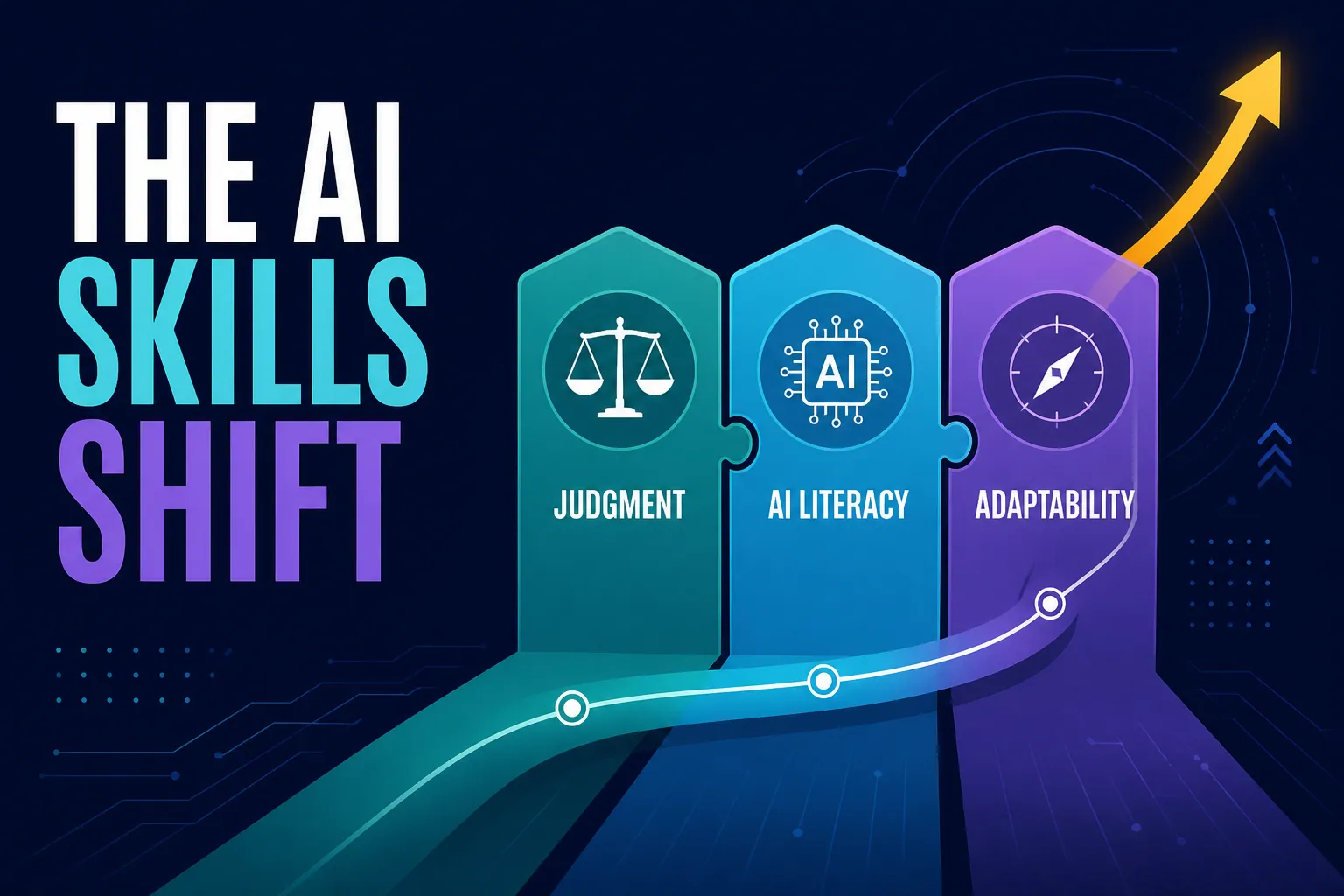
The answer emerging in 2026 is a combination of domain judgment, practical AI literacy, adaptability and proof of outcomes. The tools matter, but they are only one layer.
What the current evidence says
The OECD report AI and skills in the workplace makes an important distinction. A small share of workers need advanced skills to develop AI systems. A much larger group need enough digital, data and AI literacy to use those systems, interpret outputs and recognize where human judgment is still required.
That is a healthier frame than “learn every new model.” Employers do not buy tool familiarity in isolation. They buy safer decisions, faster delivery, better customer understanding, more reliable analysis and less rework.
For job seekers, the practical implication is clear: a tool name in a skills list is weak evidence. A short example of a task you framed, an output you checked and an improvement you measured is much stronger.
The four-part AI capability employers can evaluate
1. Judgment before prompting
Good AI work starts before a prompt is written. Someone must decide what the real problem is, what information matters, what should not be shared and what a successful result looks like.
In a customer-success role, the task may be to identify recurring product friction rather than merely summarize support tickets. In engineering, it may be to isolate a failing boundary condition before asking an assistant for code. In recruiting, it may be to distinguish evidence of job performance from polished résumé language.
This is domain judgment. It cannot be demonstrated by saying “proficient with ChatGPT.” It can be demonstrated by showing how you decomposed an ambiguous problem and defined a checkable outcome.
2. AI literacy during the work
AI literacy means understanding enough about the system to choose an appropriate workflow. It includes knowing that outputs can be fluent and wrong, that context can change results, that sensitive data needs a boundary and that a second source or deterministic check may be required.
The level is role-dependent. A product manager may need to compare research themes without treating generated summaries as source evidence. A developer may need to inspect tests, dependencies and security behavior around generated code. An analyst may need to preserve the distinction between observed data and model-created interpretation.
Explore the technology market to see where explicit AI tools appear, but do not mistake frequency for a universal job description. Read the actual vacancies and note how the capability is used.
3. Verification before delivery
Verification is the transferable skill that turns AI use into dependable work.
- Check factual claims against primary sources.
- Run tests and static analysis on generated code.
- Recalculate important figures outside the model.
- Compare a draft against the original brief.
- Ask what evidence would prove the output wrong.
- Record uncertainty when verification is incomplete.
This is not anti-AI caution. It is professional quality control. The faster a system produces plausible output, the more valuable a clear verification habit becomes.
4. Adaptability after the tool changes
Interfaces, model names and product features change quickly. A durable candidate can transfer a working method to a new tool: define the task, provide useful context, constrain the result, verify it and capture the evidence.
Adaptability also means recognizing when not to use AI. A deterministic calculation, a database constraint or a direct conversation may be the better tool. Employers need people who can make that distinction without turning every problem into a model call.
Replace the tool list with a proof-of-work loop
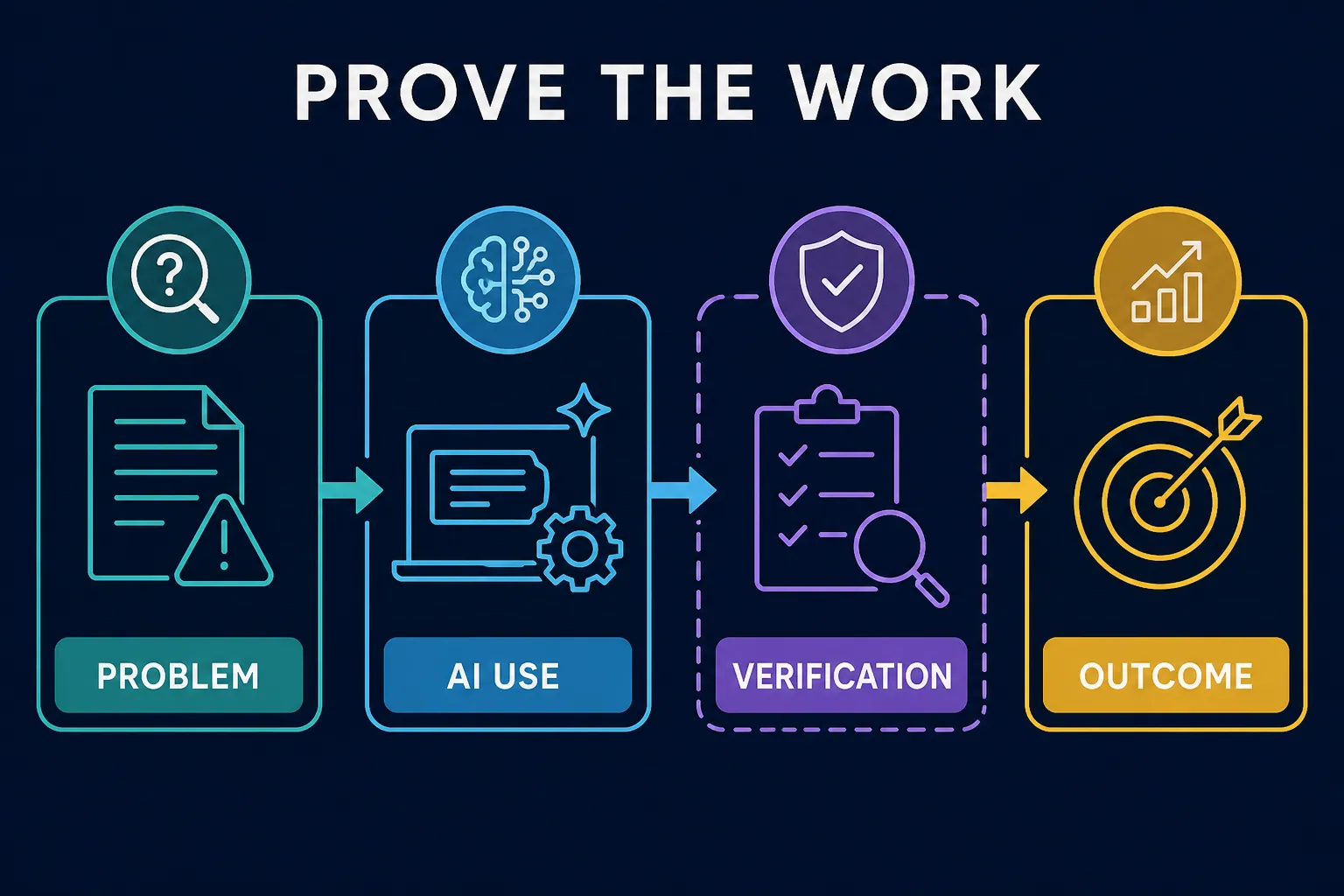
Use this four-step structure in a résumé bullet, portfolio case study or interview answer:
- Problem: What decision, delay or quality issue existed?
- AI use: What part of the workflow did the system accelerate or expand?
- Verification: How did you test facts, code, policy or edge cases?
- Outcome: What changed in time, quality, cost, risk or customer experience?
Weak version: “Used generative AI to write customer emails.”
Stronger version: “Built a reviewed response-drafting workflow for recurring billing questions, grounded each draft in approved policy text, added human approval for account-specific claims and reduced first-draft time by 35% without increasing reopen rates.”
The second statement lets an employer evaluate judgment, implementation, safety and outcome.
How this changes a résumé
Do not create an enormous “AI tools” section. Keep concrete technologies that are genuinely relevant, then place the strongest evidence inside experience and projects.
A useful résumé pattern is:
- one clear AI capability in the summary, tied to your role;
- two or three experience bullets with verified outcomes;
- a small tools line for products you can actually discuss;
- one portfolio link showing process, checks and trade-offs.
The document studio can help turn a raw project description into an evidence-led bullet. Preserve the factual boundary: do not invent a metric because a generated sentence sounds stronger.
How this changes a portfolio
A credible AI portfolio does not need to be a chatbot gallery. It can show a small workflow in your own profession.
For example:
- a finance analyst can show a reconciliation assistant with explicit exception handling;
- a recruiter can show a structured intake and evidence rubric;
- a designer can compare divergent concepts and document accessibility review;
- an engineer can show generated test cases, failures found and fixes verified;
- an operations lead can show a classification workflow with escalation rules.
Include the input boundary, evaluation criteria and one failure case. A perfect demo proves less than a well-explained correction.
How this changes an interview answer
When asked about AI, resist the urge to recite products. Tell a compact story:
“I used the system for the high-volume first pass, kept the source material attached, checked the risky claims against the original record and routed exceptions to a person. The first version failed on this edge case, so I changed the evaluation and measured the result again.”
That answer communicates agency. You are not claiming that the model “did the work.” You are showing that you designed and owned the work.
A 30-day learning plan
Week 1: Map the work
Choose one recurring task in your target role. Write its inputs, decisions, risks and definition of done. Browse current companies and vacancies to see how employers describe the underlying outcome.
Week 2: Build a bounded workflow
Use one AI tool for one part of the task. Keep sensitive data out. Save the prompt or configuration, but focus on why each constraint exists.
Week 3: Evaluate it
Create ten to twenty representative examples. Define pass/fail checks. Record where the system is unreliable and what requires human review.
Week 4: Publish the evidence
Turn the result into a one-page case study: problem, workflow, verification, result and limitations. Link it from a tailored résumé and use it in interviews.
What not to claim
Avoid statements such as “AI expert” when the evidence is a few casual prompts. Avoid implying that a generated output was independently researched. Never place confidential employer or customer data into a public model to create a portfolio sample.
Specificity is safer and more persuasive:
- which task;
- which boundary;
- which checks;
- which outcome;
- which limitation.
The practical takeaway
The AI skills shift is not a command for everyone to become a model builder. It is a shift in how professional capability is demonstrated.
Keep your domain expertise. Add enough AI literacy to choose and constrain the tool. Make verification visible. Practice transferring the workflow when the product changes. Then show the result as evidence, not as a list of fashionable names.
Use the ApplyDjinn match analysis to compare that evidence with current roles, and read the public methodology to understand how role fit, core skills and supporting skills remain separate. AI can widen the workflow; judgment still decides whether the work is good.