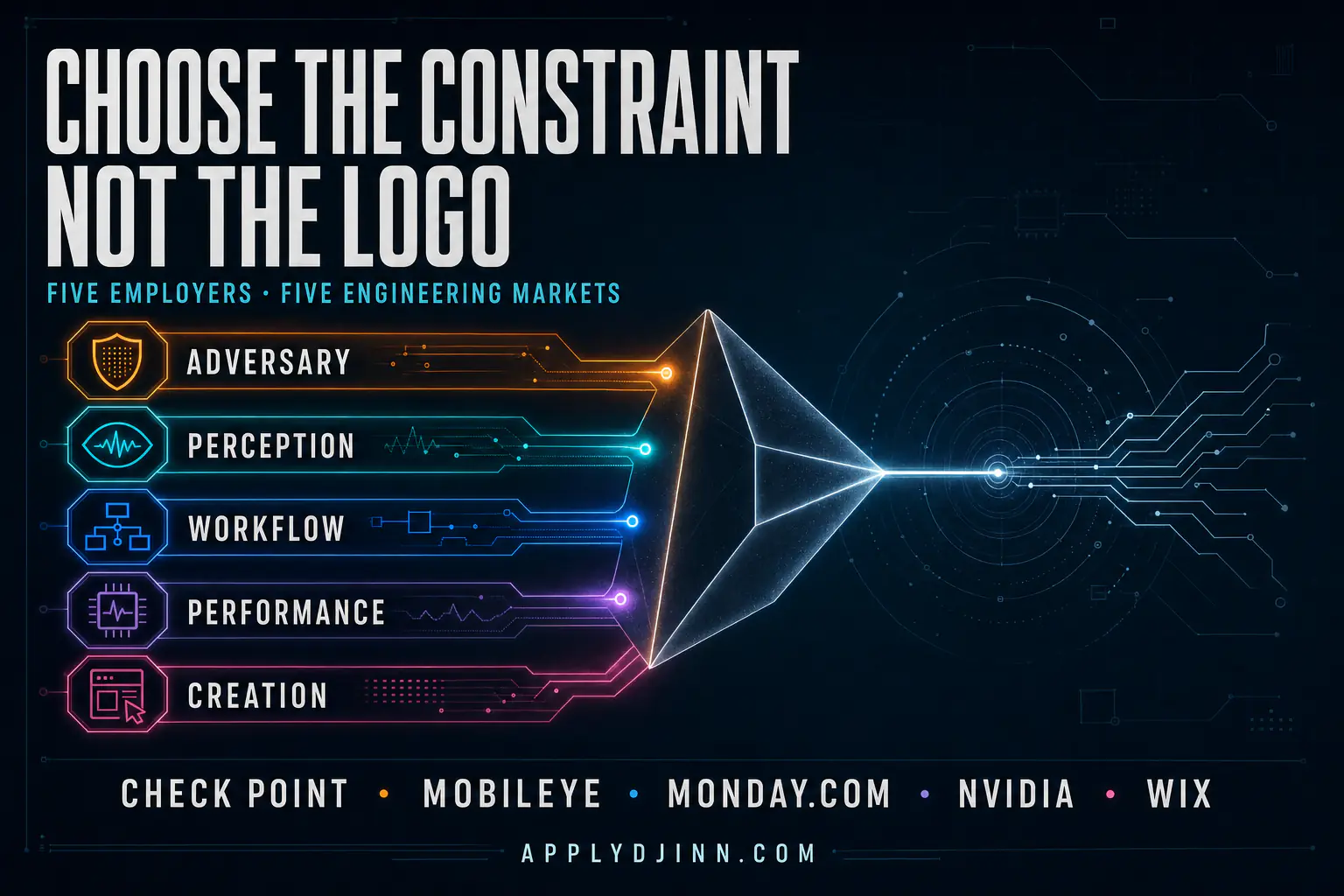
Choose the Constraint, Not the Logo: Five Famous Employers, Five Engineering Markets
Check Point, Mobileye, monday.com, NVIDIA and Wix are familiar names, but their roles reward different evidence. A practical guide to choosing by system constraint instead of brand prestige.
A famous logo is useful social proof. It is a terrible career category.
Candidates often place Check Point, Mobileye, monday.com, NVIDIA and Wix into one mental folder: large technology employers with substantial Israeli talent footprints. Then they send roughly the same résumé to all five.
The products make that strategy fail.
Each company is built around a different dominant constraint. Check Point assumes an adversary is actively looking for a boundary mistake. Mobileye has to turn imperfect sensor evidence into decisions under real-world latency and safety constraints. monday.com lets many kinds of organizations reshape workflows without breaking a multi-tenant platform. NVIDIA makes performance emerge across silicon, systems software and developer tooling. Wix hides a large technical surface behind a product that creators and businesses must be able to use.
Those constraints change what “strong engineering” means. They change the failures a hiring team fears, the stories it trusts and the portfolio evidence that travels.
The constraint map
| Employer | Dominant constraint | Expensive failure | Evidence that carries weight |
|---|---|---|---|
| Check Point | Adversarial systems | A trusted boundary fails silently | Threat model, detection logic, incident analysis, secure-by-default design |
| Mobileye | Perception under physical uncertainty | A rare edge case reaches the road | Error analysis, latency budget, validation strategy, safety-oriented debugging |
| monday.com | Flexible multi-tenant workflows | Customization destroys predictability | Product experiment, platform boundary, observability, scalable data decision |
| NVIDIA | Performance across layers | The bottleneck moves somewhere unseen | Profiling, memory/concurrency analysis, benchmark design, systems optimization |
| Wix | Power without exposed complexity | Capability becomes unusable or unreliable | User-outcome metric, extensibility decision, performance and accessibility work |
This is not a ranking. There is no universally “hardest” column. The question is which failure mode you can already reason about—and which one you want to learn deeply.
Check Point: assume the system is being tested by an opponent
In ordinary product engineering, a feature succeeds when the intended path works. In security, the unintended path is often the product.
That makes Check Point a market for evidence about boundaries: authentication, identity, network policy, cloud posture, endpoint behavior, detection quality and the operational response after a control fires. A candidate story becomes stronger when it includes the attacker model, the observable signal, false positives and what happens when the control is wrong.
“I implemented authorization” is a task. “I found where tenant isolation could fail, added a policy boundary, instrumented denials and tested bypass cases” is security evidence.
Search current Check Point vacancies →
Mobileye: measure the edge case, not only the average case
Mobileye sits where algorithms, embedded systems, mapping, data, validation and automotive production meet. The difficult part is not merely achieving a good result in a clean dataset. It is understanding what the system does when the scene is rare, the sensor is noisy, the compute budget is fixed and a failure has physical consequences.
Candidates from machine learning should show error taxonomy, dataset gaps and evaluation under distribution shift. Candidates from embedded or systems work should make timing, memory, determinism and debugging constraints visible. Candidates from backend infrastructure should connect data pipelines to the quality of the model or map they enable.
The transferable sentence is not “I worked on AI.” It is “I knew which error mattered, how we detected it and what trade-off changed the outcome.”
Search current Mobileye vacancies →
monday.com: make flexibility safe at scale
A work platform succeeds because different teams can bend it toward different processes. The same flexibility creates the engineering problem: configuration, automation, integrations and permissions must remain understandable inside a shared platform.
For monday.com, strong evidence connects product behavior to platform behavior. Show how a feature was instrumented, how an experiment changed a decision, how a data model survived new use cases, how an integration failed safely or how a team protected reliability while shipping quickly.
A polished feature demo is useful. A stronger artifact includes the adoption metric, the operational signal and the boundary that kept one customer workflow from surprising another.
Search current monday.com vacancies →
NVIDIA: find the bottleneck across layers
At NVIDIA, performance is rarely owned by a single layer. Silicon, interconnect, firmware, compilers, runtimes, libraries, distributed systems and workloads can all move the limit.
The best candidate evidence therefore has a measurement spine. State the baseline, workload, profiler, hypothesis, change and result. Explain why the optimization did not merely move cost somewhere else. If the work involved concurrency, memory, networking or accelerators, show the model you used to reason about throughput and latency.
You do not need access to hyperscale hardware to demonstrate this habit. A careful benchmark on modest hardware is more persuasive than a dramatic speedup with no controlled comparison.
Search current NVIDIA vacancies →
Wix: keep the platform powerful without exporting its complexity
Wix serves creators, developers and businesses through one broad web platform. Its engineering challenge is not only feature volume. It is keeping creation, commerce, marketing, extensibility and infrastructure coherent for people with very different technical depth.
Relevant evidence connects system decisions to a human outcome: faster publishing, a clearer editing interaction, safer extension points, better page performance, more reliable commerce or lower support burden. Accessibility, observability and backwards compatibility matter because product complexity eventually reaches the user.
“I improved load time by 30%” becomes stronger when it explains which user journey changed, how the result was measured and which regressions were prevented.
Search current Wix vacancies →
A five-step application test
Before applying to any recognizable employer, run the same test:
Open the live searches side by side: Check Point, Mobileye, monday.com, NVIDIA and Wix. Read ten descriptions before choosing a title. Repeated failure language—latency, isolation, safety, scale, adoption, reliability—reveals the actual market.
You can also move outward through the full company catalog or begin with the vacancy search and follow the constraint across employers.
Method and limits
ApplyDjin reviewed the companies' first-party career surfaces and current catalog descriptions on July 17, 2026. This article deliberately avoids a raw vacancy leaderboard: the employers use different ATS systems, update at different speeds and differ enormously in global size. A count would mostly measure company scale and source coverage, not career fit.
The five constraint labels are an editorial architecture lens, not employer-defined departments. They are meant to improve job-search decisions, not describe every team inside a company.
The practical conclusion is simple: prestige may get a résumé opened, but matching the system constraint is what makes the application coherent.