Company News, Search Interest and Hiring: Read the Signals Without Inventing a Story
A source-first method for reading company coverage, Google Trends, prediction markets, share prices and vacancies as separate signals before making a job-search decision.
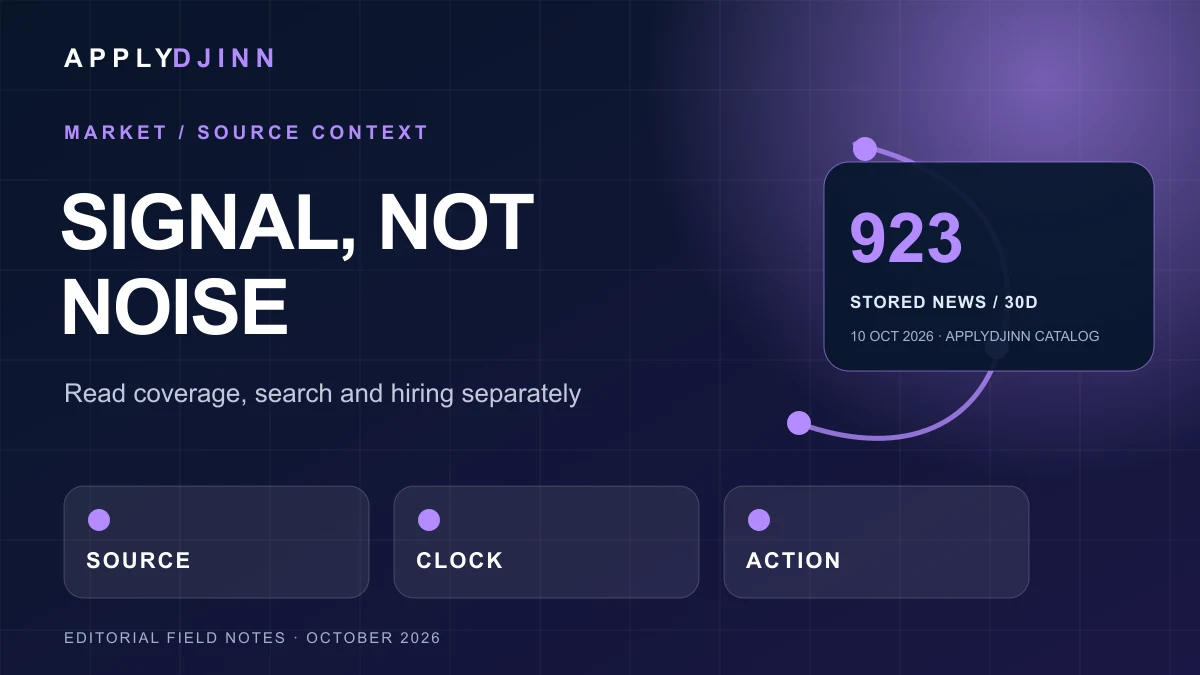
A company can trend in search on the same day it announces a product, appears in a market question and posts several jobs. It is tempting to join those events into one simple story: “interest is rising, so this employer must be growing.” The conclusion may be wrong. Each signal has a different source, population, clock and incentive. A candidate deciding where to apply needs a way to use the information without pretending it measures headcount. This article presents a practical reading method for ApplyDjinn's news, company profiles, trends and vacancy catalog.
Coverage is itself a signal about the instrument
In ApplyDjinn's production snapshot at October 10, 2026, 09:52 UTC, the directory contained 316 companies. During the preceding 30 days, the saved news table contained 923 source-published items covering 86 companies: 852 official items across 81 companies and 71 independent items across 9. Some companies appear in both sets, so the company subtotals must not be added. These are records from connected sources, not a census of everything published about each employer. A zero in the news monitor can reflect source coverage, timing or a parsing gap as well as a quiet company.
The other instruments have still narrower saved coverage. Across all stored observations, ApplyDjinn had 19 Google Trends rows for 10 companies, 102 Polymarket rows for 13 companies, and share-price snapshots for 73 companies. These are different time windows and units; they cannot be combined into a single population denominator or a “company momentum score.” A Google Trends row is not a job. A market question is not a forecast made by the employer. A share price is unavailable for many private firms. The right interface should show what is stored, the source and the observation period before ranking anything.
This uneven coverage changes how you read a blank card. If a company has no independent mention in our table, do not conclude that independent journalists have never covered it. Check the publisher's site and the company's own newsroom, then decide whether the missing record is material to your decision. Conversely, 70 saved stories about one company may include multiple posts on the same announcement; volume should be paired with distinct sources and actual subject relevance. The methodology provides context for catalog observations; this article freezes the figures above so a later feed expansion will not silently rewrite their meaning.
Identify the object before interpreting its movement
An employer's official blog post is a statement by that employer. An independent news article is reporting by an outside publisher. A search-interest series is a relative measure of queries in a selected geography and period. A prediction-market contract expresses trading around a narrowly worded outcome. A share-price move is a financial-market observation for a listed security. A vacancy is an advertised role observed at a source. These objects do not share a unit, and a common company name does not make them interchangeable.
The first line of your note should therefore say what the signal is: “Company announcement about a new product,” “independent coverage of that announcement,” “seven-day search-interest change in Israel,” or “three source-published roles on a specific careers page.” The label prevents a chart from silently changing meaning as it moves from a company page into a summary. If a datum lacks its source or time window, do not use it to rank employers.
In ApplyDjinn, open the news monitor and select the company you are investigating. Separate official updates from independent mentions. An official source may provide accurate details of its own announcement while emphasizing the parts it wants readers to see. Independent coverage may add context or challenge the claim, but it can also quote the same press release. Two articles repeating one release are not two independent confirmations.
Check the destination and publisher. A company name in a story about a competitor might be a passing mention rather than the subject. A news card can only show the portion licensed or supplied by its source; a short preview should not be treated as the complete article. Follow the verified source link when available and distinguish what ApplyDjinn summarized from what the publisher actually said. If the original cannot be checked, mark the claim as unverified rather than filling the gap with a plausible explanation.
Put all observations on a common calendar
Record the publication date of the original story, the time ApplyDjinn first observed it and the date you are making a decision. A press release from last month may appear in a feed today after a source is connected. It is new to the catalog, not necessarily new to the market. A hiring graph may use daily snapshots, while Google Trends may show an index over seven days. A stock chart may show closing prices, which do not line up with hourly news events. Put the clocks in your note before comparing shapes.
If a company's search interest spikes, ask what else happened that week. A product release, outage, lawsuit, sports sponsorship, earnings call or viral social post can all change queries. Search interest does not identify who searched or whether they were customers, applicants or journalists. A seven-day relative index is especially sensitive to the selected country and term. A change in the company name's ambiguity or the comparison set can alter the plotted scale. Do not call a rising index “market demand for engineers.”
If a Polymarket question mentions the company, read the exact resolution terms and deadline. A contract may be about a product announcement, regulation or a public statement rather than the company's revenue or hiring. Market price is not an audited probability of a career outcome. Liquidity, wording and who trades can matter. For a job seeker, the question may point to a topic worth researching; it does not justify replacing current job evidence with a speculative score.
For a public company, a share-price move can provide context for investor expectations but does not tell you what its recruiting team will do next week. Price can move with broad markets, interest rates, earnings guidance or factors unrelated to the specific office or team. A private company has no public share price. Showing “not available” for such a company is better than inventing a proxy. A candidate should ask the employer about the team's budget and role, not infer it from a line chart.
Treat hiring evidence as a separate layer
Open the vacancy catalog and filter by the company, location and role you would actually consider. Count distinct source requisitions where possible. Several location variants can refer to one role. Check whether a listing is current by the site's observation rule, then open the employer's source page. “Current” helps navigation; it is not a guarantee that an offer is available or that the company has increased net headcount.
For a trend comparison, separate newly published, first observed, updated and removed or archived vacancies. A parser catching up after a gap can make first-observed counts jump without any change in the employer's posting behavior. An edited job description can create update activity without a new role. A removed posting can mean a hire, cancellation, feed failure or a changed URL. You need more evidence before assigning a cause.
Employer breadth and team concentration matter. A company with a large worldwide catalog may still have only one role matching your location and specialty. A small firm with four directly relevant local roles may be a better search target. If you are evaluating a specific opportunity, ask what the team is building, what the role owns and how the vacancy fits the budget. Those questions are more decision-relevant than an aggregate corporate rank.
Use a source table instead of a single blended score
For each company, write one row per signal: source, what it measured, observed period, uncertainty and a candidate action. A product announcement might prompt a question about the affected team. A search spike might prompt a check for a known event. An independent article might prompt a closer reading of a strategy claim. A live vacancy prompts a role-fit check and possibly an application. Keeping the actions separate prevents one exciting chart from overwhelming a weak job fit.
Consider a hypothetical company that posts an AI launch, receives extensive independent coverage and sees search interest rise. Its visible vacancies stay flat. The defensible statement is that attention increased around the launch and the observed hiring footprint did not show a matching rise in this period. It is not defensible to say the launch “created hundreds of jobs.” The opposite can also happen: a team quietly adds roles with little news. News coverage is not a prerequisite for a useful application.
A second example: several news publishers mention a cybersecurity firm after a major incident at a different company. The firm appears in stories because experts quoted it, not because it announced hiring or experienced an incident itself. Without source classification, a “hot company” dashboard could mislead a candidate into treating cross-mentions as company-originated announcements. Read the sentence in which the company appears and distinguish subject, source and quoted observer.
Decide what would change your search plan
Before browsing charts, write the decision you are trying to make. “Should I spend two hours researching this employer?” needs a lower evidence threshold than “Should I decline an offer from another company?” For the first, a credible role plus relevant product context is enough to investigate. For the second, verify offer terms, team scope and risk directly; public signals are supporting context. A chart should not become a substitute for due diligence.
When a signal is missing, do not assume the absence is meaningful. An empty news tab can mean no recent source publication, a feed that is not connected, a coverage gap or a parsing problem. A short stock history can begin only when snapshots were first collected. The correct product behavior is to label the available coverage and its start date. The correct reader behavior is to look at official employer channels and the source vacancy before drawing a conclusion.
Keep an evidence log with links and dates. One week later, review which expectations were confirmed. Did the supposed expansion produce relevant roles? Did a source correction change the story? Did the company update the requisition location? This is a lightweight way to calibrate your own reading. It also gives you better interview questions: “I saw your team announced X; is this role connected to the deployment or a separate platform effort?” That is more useful than telling an interviewer the company has a high AI score.
ApplyDjinn can put news, search interest, market questions and vacancies within reach of one company profile. The value is in comparison, not a fabricated causal chain. Label each source, align the clocks, check the role at its origin and state what the evidence can support. If you cannot explain why a signal would change your next action, enjoy the chart, but do not let it decide your application strategy.