The Degree Filter Has a Side Door: What “Equivalent Experience” Means in Tech Hiring
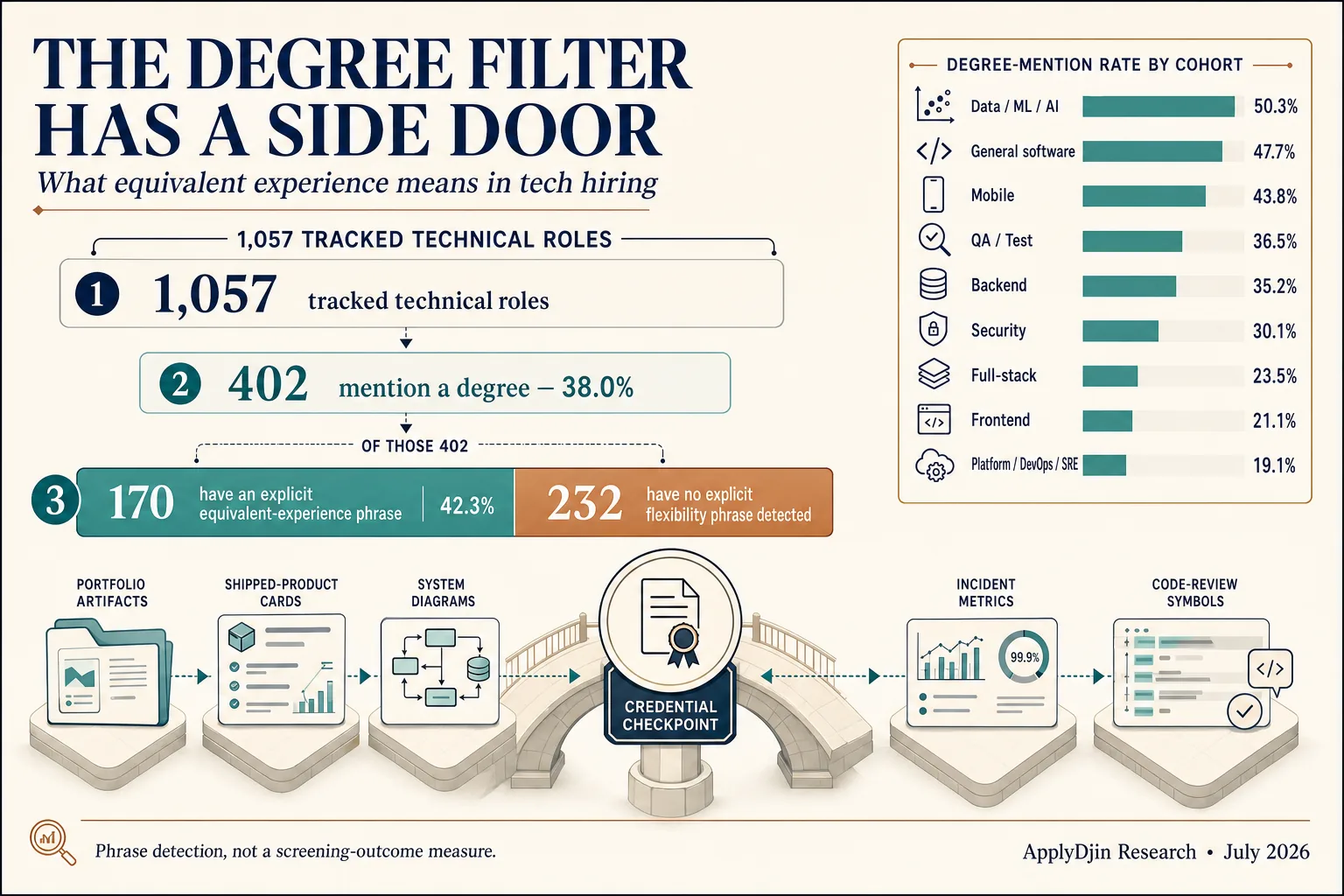
Across 1,057 tracked technical roles, 402 mention a degree and 170 explicitly name equivalent experience. The phrase is a side door—but candidates still need evidence that fits through it.
A degree requirement can look like a locked gate. In many technology job descriptions, however, the same sentence contains a side door: or equivalent experience.
That phrase is more than boilerplate. It tells an applicant that the employer is willing to consider another form of evidence in place of the named credential. It also exposes an important distinction in hiring language: a degree can be a preferred signal, a proxy for specific capabilities or a formal requirement. Those are not the same thing.
ApplyDjin analyzed its current snapshot of 4,387 active roles. Of those, 4,386 had descriptions that could be examined. We then isolated 1,057 roles with tracked technical titles and looked for two things: language mentioning a degree and explicit phrases offering experience as an alternative.
The result is a market that is neither credential-free nor uniformly credential-driven.
Among the 1,057 tracked technical roles, 402 mention a degree: 38.0%. Of those 402 degree-mentioning roles, 170 include an explicit equivalent-experience phrase: 42.3%.
The other 232 do not contain a flexibility phrase detected by our method. That does not mean all 232 impose a hard degree requirement. It means only that their published descriptions do not explicitly state the alternative in language our phrase detector recognizes.
That distinction matters. A job description reveals part of a hiring process, not all of it.
The funnel behind the headline
The data is easiest to understand as a sequence of increasingly specific filters:
Two findings stand out.
First, most tracked technical roles—62.0%—do not mention a degree at all. That does not prove education never enters the hiring decision, but it does mean the credential was not important enough to appear in the public description.
Second, when a degree is mentioned, an explicit experience alternative appears in more than two out of five cases. The side door is not rare. It is a recurring part of technical hiring language.
The practical implication is not that credentials have disappeared. It is that a large share of employers already describe competence as something that can be demonstrated through more than one route.
Degree language changes by technical cohort
The overall 38.0% rate conceals large differences between disciplines:
Data, machine learning and AI roles have the highest degree-mention rate. General software follows closely, while fewer than one in five Platform, DevOps and SRE descriptions mention a degree.
These rates do not tell us why a team includes or omits a credential. They do reveal different documentation habits and selection signals across technical specialties. A candidate can encounter a meaningfully different credential landscape simply by moving from data engineering to platform engineering, even when both positions demand substantial technical depth.
There is also a second dimension: what happens after a degree is mentioned.
Flexibility is conditional, not universal
Among degree-mentioning roles, the share with an explicit equivalent-experience phrase also varies:
These percentages use a narrower denominator: only roles in each cohort that mention a degree. They are not a share of every job in the cohort.
General software combines a high degree-mention rate with the highest explicit-flexibility rate. Its descriptions often name a credential, but just over half of those descriptions also name an alternative.
Data, ML and AI roles mention degrees most frequently, yet only 37.2% of those mentions contain detected equivalent-experience language. Platform, DevOps and SRE is almost the inverse: degree language is uncommon, but when it appears, explicit flexibility is comparatively frequent.
Frontend and full-stack roles mention degrees relatively infrequently. Their conditional flexibility rates are also low, but that does not necessarily make the fields more restrictive: most roles in those cohorts never introduce a degree into the description in the first place.
This is why a single statistic such as “percentage of jobs accepting equivalent experience” can mislead. The market contains at least two separate questions:
A cohort can be light on degree language but rigid within the few descriptions that include it. Another can mention degrees frequently while routinely providing a substitute pathway.
What “equivalent” asks a candidate to prove
Equivalent experience does not mean that any amount of time in a technical job automatically replaces any credential. It means the employer has left the equivalence test open.
A degree often functions as a compact signal for several possible attributes: exposure to foundational concepts, completion of long-form work, structured learning, analytical practice or familiarity with a domain. The job description rarely identifies which of those attributes the team actually values.
Applicants without the named degree therefore face a translation problem. They must convert experience into evidence that answers the likely intent behind the requirement.
A useful pattern is requirement → capability → evidence:
The strongest evidence is concrete. “Five years of experience” is a duration. “Owned a service migration while preserving availability and reducing operational load” is evidence.
Equivalent experience is therefore not merely a waiver. It is an invitation to demonstrate the underlying capability through another route.
What can count as evidence
The right evidence depends on the role, but six forms travel well across technical hiring:
Certificates and courses can support the story, but they rarely replace the story. The evidence becomes persuasive when it shows application, scope and judgment.
A decision framework for applicants
Candidates often treat any degree mention as a binary instruction: qualified or unqualified. The data supports a more careful reading.
1. Classify the exact wording
Place the description into one of four buckets:
The first two categories provide the clearest path. The third requires judgment. The fourth deserves more caution, especially if the application form enforces the condition.
Do not silently upgrade an unqualified mention into a hard rule. Conversely, do not rewrite explicit mandatory language into a preference simply because the rest of the role looks attractive.
2. Measure fit without the credential line
Review the responsibilities and technical requirements separately. Can you provide strong evidence for the central work? Do you match the system type, technical domain and level of ownership? Is the gap concentrated in one credential, or spread across several essential capabilities?
A candidate who lacks the degree but strongly matches the actual work has a different case from one who lacks both the degree and the core experience.
3. Build an equivalence brief
Before applying, write three proof points:
These proof points can appear in a résumé summary, cover note, portfolio case study or recruiter conversation. They should make the alternative legible without sounding defensive.
4. Apply with calibrated confidence
Explicit equivalent-experience wording is a direct signal to proceed when experience fit is strong. A preferred degree is also not a prohibition.
A degree mention without detected flexibility is ambiguous. The 232 roles in our technical cohort cannot be classified as hard filters from text alone. Some may be strict, some may be flexible in practice and some may use inherited language that was never carefully calibrated.
The description can inform the decision. It cannot reveal every screening rule, recruiter judgment or hiring-manager exception.
A writing framework for employers
The same ambiguity creates costs for hiring teams. If equivalent experience is acceptable but unstated, qualified candidates may self-select out. If a degree is genuinely necessary but described casually, recruiters may receive applications that cannot advance.
Employers can improve the signal by answering four questions before publishing a role.
What outcome does the credential predict?
Name the capability rather than defaulting to the proxy. If the role needs statistical reasoning, systems fundamentals, domain research or formal technical writing, say so.
What evidence can replace it?
If professional work, military training, an apprenticeship, open-source contribution or another path can demonstrate the capability, define acceptable evidence in plain language.
Is the degree required, preferred or simply familiar?
Those labels should reflect the actual selection process. A description should not say “required” if the team routinely makes exceptions, and it should not say “preferred” if an automated or policy gate rejects every applicant without it.
Does the application workflow match the description?
A role that welcomes equivalent experience should not force candidates into a degree-only answer structure. The application form, recruiter rubric, interview loop and published wording need to describe the same path.
A clear requirement might say: Bachelor’s degree in computer science or equivalent practical experience demonstrating systems fundamentals, production software delivery and technical problem solving.
An even stronger version explains what will count: We evaluate equivalent experience through demonstrated ownership of production systems, architectural decision-making and the ability to explain technical trade-offs.
That language turns a vague exception into an assessable route.
How the phrase detection works
This analysis measures published text, not each employer’s private hiring policy.
We first identified active roles with tracked technical titles. Within those descriptions, we detected degree-related language including references to a bachelor’s, master’s, doctorate or degree. We then searched degree-mentioning descriptions for explicit alternatives such as “equivalent experience,” “equivalent practical experience,” “degree or equivalent” and closely related constructions.
Phrase detection has limits. A description may express flexibility in wording outside the patterns. It may communicate the alternative elsewhere in the application. A recruiter may accept experience even when the public description is silent. Conversely, an explicit phrase does not guarantee that every form of experience will be judged equivalent.
Cohorts use one tracked technical-title classification per role and differ in size. Their rates are directional market signals, not certainty about an individual vacancy.
Most importantly, the 232 degree-mentioning technical roles without a detected flexibility phrase should be labeled exactly that: no explicit flexibility phrase detected. They should never be relabeled as “degree required.”
The real filter is evidence clarity
Degree language remains meaningful, but it is far from universal. Only 38.0% of the 1,057 tracked technical roles mention a degree. Among those that do, 42.3% explicitly describe experience as an alternative.
The side door is already built into a substantial share of technical job descriptions. The challenge is that neither side always labels it clearly.
Candidates need to translate experience into evidence of the capability a credential is supposed to signal. Employers need to state whether the credential is a requirement, a preference or one of several acceptable proof paths.
Equivalent experience works best when it is treated neither as empty boilerplate nor as a universal exemption. It is a different method of qualification—and it becomes useful only when both sides can see how the equivalence will be judged.
Method: phrase detection across 4,386 descriptions from 4,387 active roles at 116 employers in the ApplyDjin catalog on July 13, 2026. The focused cohort contains 1,057 tracked technical-title roles. Degree and flexibility phrases are reported separately; absence of a detected flexibility phrase is not evidence of a hard screen.