Entry-Level Jobs in 2026: AI Is Moving the First Rung, Not Removing It
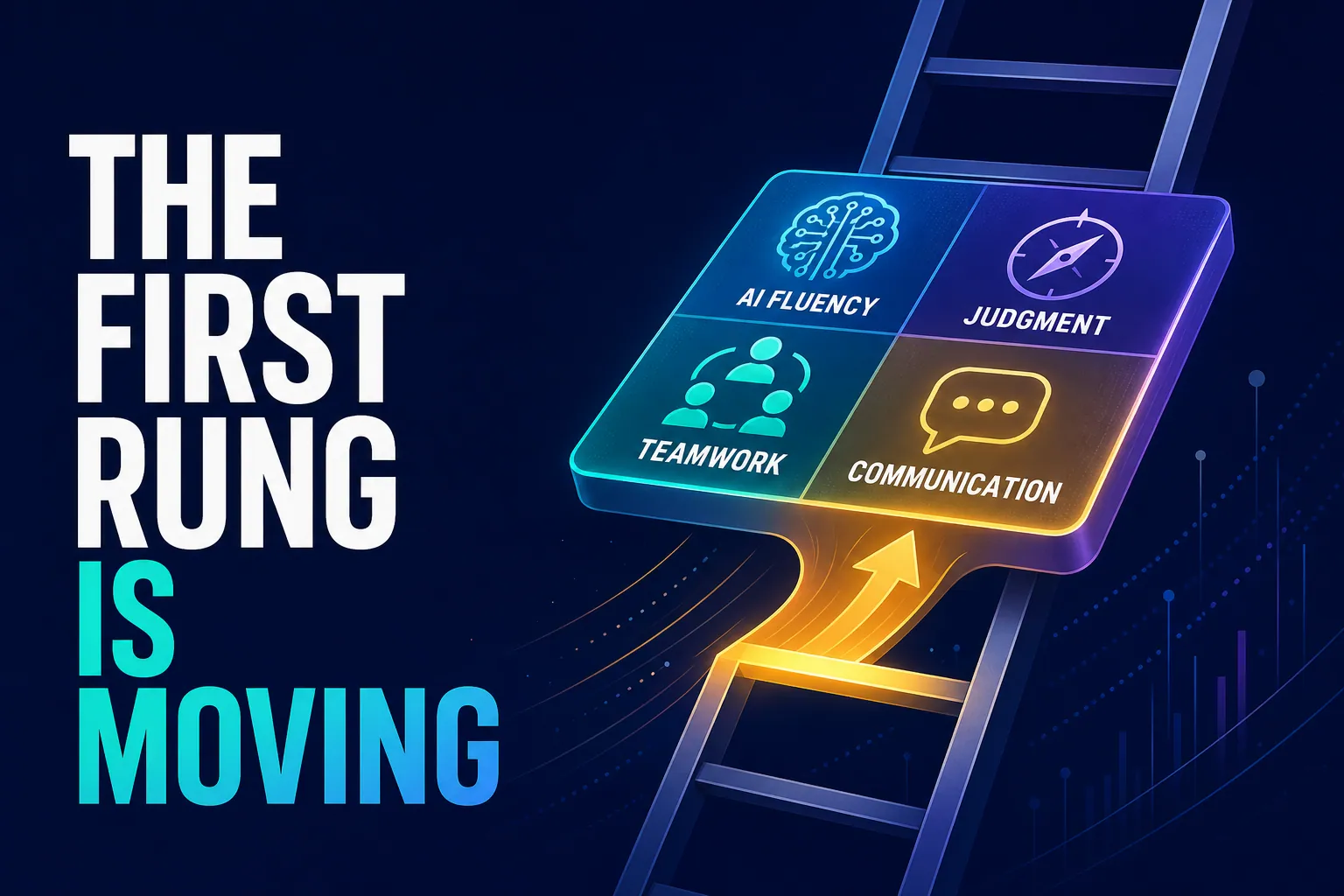
The first job increasingly asks for evidence that used to appear later: independent judgment, AI-assisted delivery, communication and a portfolio that proves the work.
The most anxious version of the 2026 career story says that AI is deleting entry-level work. The real picture is more complicated—and more useful for someone trying to get hired.
Some routine tasks are being compressed. At the same time, employers still need people who can learn a domain, collaborate, check work and grow into larger responsibility. The first rung has not vanished. It is moving upward.
That shift changes what “entry level” means. A degree or a list of course projects may open the conversation, but employers increasingly want visible evidence that a candidate can use modern tools without surrendering judgment.
The current hiring signal is mixed, not hopeless
The NACE Job Outlook 2026 Spring Update reports expected growth in hiring for the Class of 2026 and a sharp increase in employer demand for AI-related skills. Its broader employer research continues to emphasize teamwork, problem solving and communication alongside technical capability.
PwC’s 2026 Global AI Jobs Barometer finds faster growth and a substantial wage premium in jobs requiring AI skills. It also describes a rise in senior human-skill requirements for entry roles exposed to AI.
OpenAI’s modeling of AI and job transition similarly focuses attention on redesigned work and the importance of pathways into occupations, not only on a binary count of jobs “created” or “destroyed.”
These sources use different methods, so their numbers should not be blended into one forecast. Together they support a practical conclusion: entry routes still exist, but passive credentials are weaker signals than evidence of judgment, collaboration and useful output.
What moved upward on the first rung
From task completion to task ownership
An employer may once have assigned a junior worker a tightly specified first draft. Now an AI system can often produce that draft. The human contribution begins one step earlier and ends one step later:
- understand the request;
- identify missing context;
- choose a workflow;
- produce or guide the first pass;
- verify the result;
- communicate trade-offs;
- improve the process.
This is not senior-level mastery. It is bounded ownership. A junior candidate can demonstrate it in a small project.
From tool exposure to tool judgment
“Used Copilot” or “used ChatGPT” is common and difficult to evaluate. Employers learn more from the sentence that follows: what did you ask it to do, what failed, how did you check it and what outcome improved?
The distinction is especially important in software, data and content roles, where plausible output can hide defects. A junior person who runs tests, checks sources and asks for review is often safer than a candidate who merely produces more material.
From private coursework to public evidence
Coursework still matters, but a hiring team cannot infer your individual contribution from a group assignment title. Transform one project into a compact case study.
Show the original problem, your decisions, an artifact, a measured result and a limitation. The artifact can be code, an analysis, a design decision, a sales research brief, a support workflow or an operations dashboard. The format matters less than the clarity of ownership.
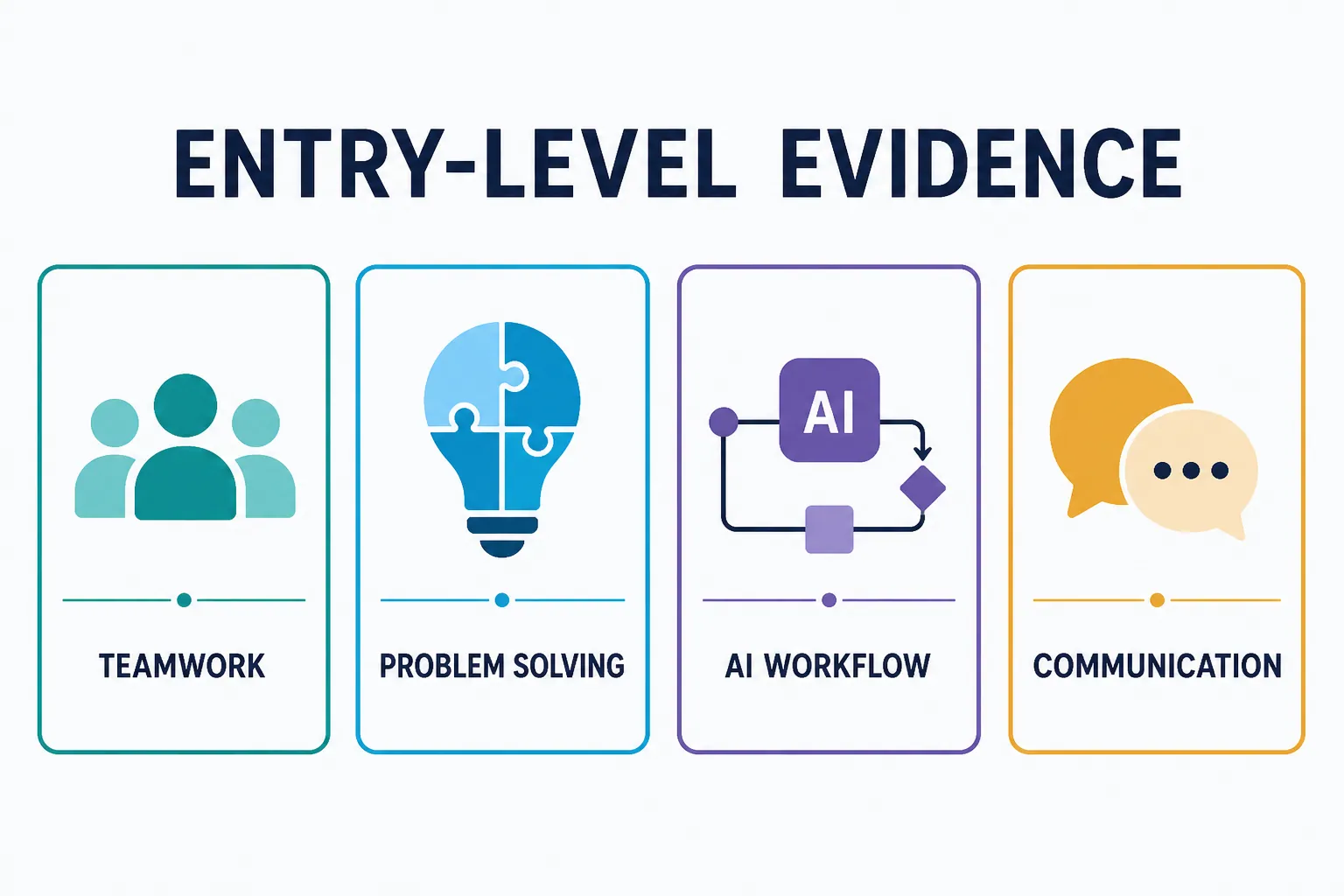
Four forms of entry-level evidence
1. A shipped artifact
Build something small enough to finish. A working tool with three real users is often more persuasive than an ambitious platform that never reached a usable state.
For technical roles, browse the stack patterns and choose one coherent combination rather than collecting disconnected technologies. For nontechnical roles, browse vacancies and identify a repeated outcome such as customer retention, campaign analysis, recruiting coordination or process quality.
2. A verification trail
Include tests, source notes, acceptance criteria or review steps. If AI helped, show where. If it failed, show the correction. This demonstrates that you understand the difference between generating output and delivering dependable work.
3. A collaboration story
Entry-level candidates are often evaluated on how they receive feedback and work across boundaries. Document one example where another person changed your approach: a user test, code review, stakeholder interview or mentor critique.
State what you believed first, what evidence changed your view and what you did next. That is adaptability made concrete.
4. A clear explanation
Can you explain the project to someone outside your specialty? Communication is not presentation polish alone. It is the ability to connect a technical or analytical choice to a customer, business or safety outcome.
How to rewrite common junior résumé bullets
Weak: “Created a web application using React and AI.”
Stronger: “Built and deployed a React scheduling tool for a five-person volunteer team; used AI to draft edge-case tests, manually verified date handling and reduced weekly coordination time from about 40 minutes to 10.”
Weak: “Analyzed customer data in Python.”
Stronger: “Cleaned 12,000 anonymized support records in Python, grouped repeat-contact themes, checked a generated classification sample by hand and surfaced two onboarding issues for the project team.”
Weak: “Good communication and teamwork.”
Stronger: “Ran four user interviews, summarized conflicting needs, changed the onboarding flow after review and documented the trade-off for the next contributor.”
Do not invent production scale for a student project. Honest scope plus strong reasoning is better than inflated impact.
A portfolio that can be reviewed in ten minutes
Hiring teams are busy. Use a predictable structure:
- Context: Who had the problem?
- Goal: What observable outcome mattered?
- Your contribution: What did you own?
- AI role: Where did automation help?
- Checks: How did you verify quality?
- Result: What changed?
- Next step: What remains incomplete?
Place the strongest evidence near the top. Link the repository, design, notebook or artifact. If the work contains private information, create a sanitized reconstruction and explain the constraint.
Search for apprenticeship, not only “junior”
Many useful first roles are not titled “Junior.” Look for teams and vacancies with signs of learning infrastructure:
- clear ownership boundaries;
- code or work review;
- onboarding documentation;
- paired delivery;
- rotational exposure;
- managers who describe growth expectations;
- a realistic distinction between required and preferred skills.
Use the companies directory to compare active hiring footprints, then open the source vacancy. A famous brand is not automatically the best learning environment. A smaller team with review discipline may provide a stronger first two years.
Interview for the moved first rung
Prepare three stories:
- a task you completed with incomplete instructions;
- an AI-assisted result you verified and corrected;
- feedback that changed your decision.
Keep each story evidence-led. Describe the situation, your action, the check and the outcome. If the result was mixed, say so. Mature self-correction is a positive signal, especially for an early-career candidate.
Ask employers how junior work has changed with AI. Useful questions include:
- Which tasks are now automated, and which are still learning opportunities?
- How is AI-assisted work reviewed?
- What does a strong first 90 days look like?
- Who provides feedback, and how often?
- Which skills distinguish someone ready for the next level?
The answers reveal whether the company is redesigning a career ladder or merely expecting entry-level pay for senior-level independence.
A practical 60-day plan
Days 1–15: choose one target
Pick a role family, not “anything in tech.” Read 20 current descriptions and record repeated outcomes, skills and proof expectations. Use the technology trends as context, not as a substitute for vacancy reading.
Days 16–35: finish one evidence project
Constrain the scope. Use a real or realistic user, define acceptance criteria and ship. Keep a short decision log.
Days 36–45: verify and explain
Add tests or review, measure the outcome and write the ten-minute case study. Create a focused résumé in the document studio.
Days 46–60: run a narrow application loop
Apply to roles with a plausible learning path. Track which evidence earns conversations. Adjust the presentation before abandoning the target.
The practical takeaway
AI is changing the first rung by compressing some starter tasks and increasing the value of judgment around them. That is a real challenge, especially for candidates who expected credentials alone to create an entry path.
It is also actionable. Choose a clear target, ship a bounded artifact, make verification visible, explain your contribution and search for teams with real learning infrastructure.
The goal is not to pretend you already have five years of experience. It is to prove that you can enter a modern workflow, learn quickly and take responsible ownership of the next small piece.