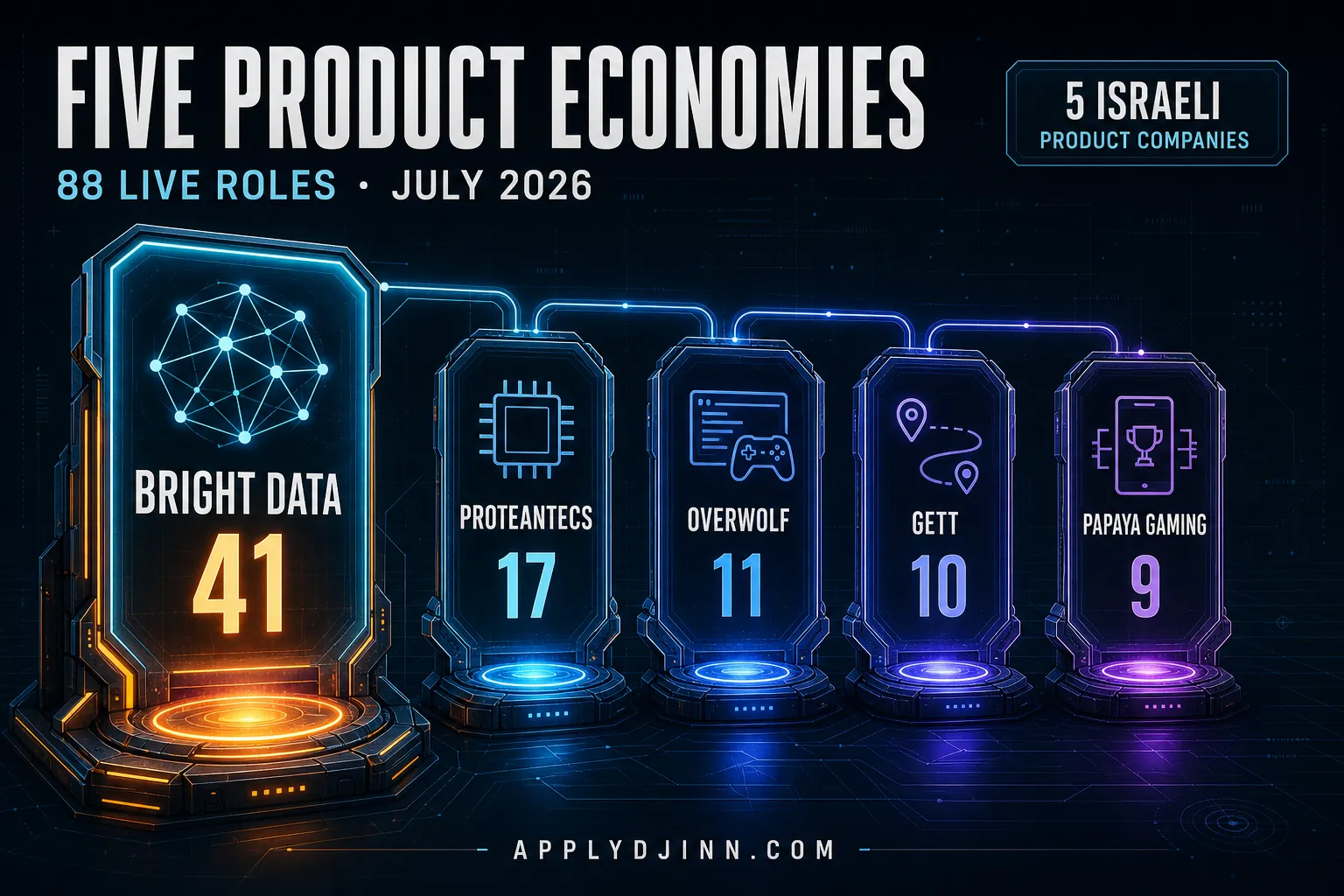
Five Product Economies, 88 Open Roles: Where Israeli Tech Is Hiring Next
Bright Data, proteanTecs, Overwolf, Papaya Gaming and Gett expose five different product economies—and 88 live openings across their first-party career feeds.
A technology job search becomes more useful when companies are grouped by the economic problem their products solve, not only by the programming languages in their descriptions.
On July 16, 2026, ApplyDjin checked five live first-party Comeet feeds from Israeli-founded product companies: Bright Data, proteanTecs, Overwolf, Papaya Gaming and Gett.
Together, the feeds exposed 88 open roles worldwide. The companies operate in five very different product economies: web data, semiconductor intelligence, gaming creators, mobile competition and business mobility.
The variety matters. “Israeli tech” is not one labor market. Each product economy rewards a different combination of engineering constraints, domain fluency and customer understanding.
The live board
Open the complete vacancy search to combine company, skill, category, work-format and location filters.
Bright Data accounts for 46.6% of this snapshot, but its board is geographically broad. The other four feeds are smaller and more concentrated around Israeli product and engineering teams. The counts should therefore guide navigation, not serve as a ranking of company quality.
Bright Data: turning the public web into infrastructure
Bright Data has 41 live roles in the snapshot. Its business sits underneath a growing share of the AI and analytics economy: collecting public web data reliably, structuring it and delivering it at operational scale.
That creates work across backend JavaScript, data systems, AI, security, compliance, customer delivery and enterprise sales. The technical problem is not merely “scraping.” It includes distributed collection, blocking resistance, data quality, governance, observability and the cost of operating large request volumes.
Candidates should emphasize systems evidence: throughput, failure recovery, data validation, anti-abuse controls, distributed debugging or pipelines that turn messy inputs into dependable products.
Search current Bright Data openings →
proteanTecs: software inside the semiconductor lifecycle
proteanTecs exposes 17 live roles. Its platform analyzes telemetry from advanced electronics to understand health and performance from manufacturing through field operation.
This is a deep-tech lane where software, machine learning and physical design meet. Current role families include C++, circuit design, DevOps, machine-learning algorithms, VLSI verification and product management.
Candidates coming from software should make hardware constraints visible: limited observability, physical variation, performance budgets and the cost of a wrong inference. Hardware candidates can strengthen their story by showing automation, data analysis and how design decisions are validated after fabrication.
Search current proteanTecs openings →
Overwolf: infrastructure for gaming creators
Overwolf has 11 live roles. The company's customers are not only players; they include the creators and businesses building apps and mods around PC games.
That two-sided ecosystem changes the product challenge. The platform has to serve developers, support distribution and monetization, maintain trust with game communities and operate reliably inside performance-sensitive environments.
Useful application evidence can come from SDKs, developer experience, marketplaces, desktop software, Go services, community products or monetization systems. A candidate who can explain both the creator workflow and the end-user impact has an advantage.
Search current Overwolf openings →
Gett: operational software meets the street
Gett lists 10 live roles, all located in Tel Aviv in the checked feed. Its B2B platform coordinates transportation across organizations, passengers, taxi fleets and local operating rules.
Mobility products connect software to real-world supply. Availability, dispatch, payments, service quality and business applications have consequences outside the screen. The board spans application security, analytics, product, IT, operations, marketing and customer-facing work.
Candidates should show how they worked with operational uncertainty: changing demand, external partners, live incidents, location data or workflows that cannot simply be retried later.
Search current Gett openings →
Papaya Gaming: data-driven mobile competition
Papaya Gaming exposes 9 live roles, eight of them labeled Tel Aviv when the feed was checked. Its hiring surface includes game products, economy design, data, production and technical leadership.
Mobile gaming combines creative judgment with continuous measurement. Retention, competition design, live operations, fairness and monetization are product-system concerns, not separate departments.
Strong candidates can demonstrate a closed learning loop: what player behavior was observed, which hypothesis followed, what was shipped and how the result changed the next decision.
Search current Papaya Gaming openings →
Choose a product economy before choosing a title
The same title can describe very different work across these companies.
A backend engineer at a web-data platform reasons about distributed collection and adversarial conditions. At a creator platform, the focus may shift to APIs, ecosystem reliability and monetization. In mobility, external supply and live operations dominate. In semiconductors, software has to respect physical constraints. In gaming, product feedback arrives through player behavior at scale.
Before applying, ask four questions:
This approach produces a better application than copying every keyword from a posting. It connects your experience to the reason the company hires the role at all.
Five companies and 88 openings are not a complete market map. They are five clear doors into very different parts of Israeli technology—and every door above links directly to the live search.
Methodology: ApplyDjin fetched the public first-party Comeet feeds for Bright Data, proteanTecs, Overwolf, Papaya Gaming and Gett on July 16, 2026. The feeds returned 41, 17, 11, 9 and 10 published positions respectively, totaling 88. Counts are worldwide feed totals and a point-in-time snapshot; locations and openings can change.