The Five-Year Wall: How Tech Hiring Compressed the Career Ladder
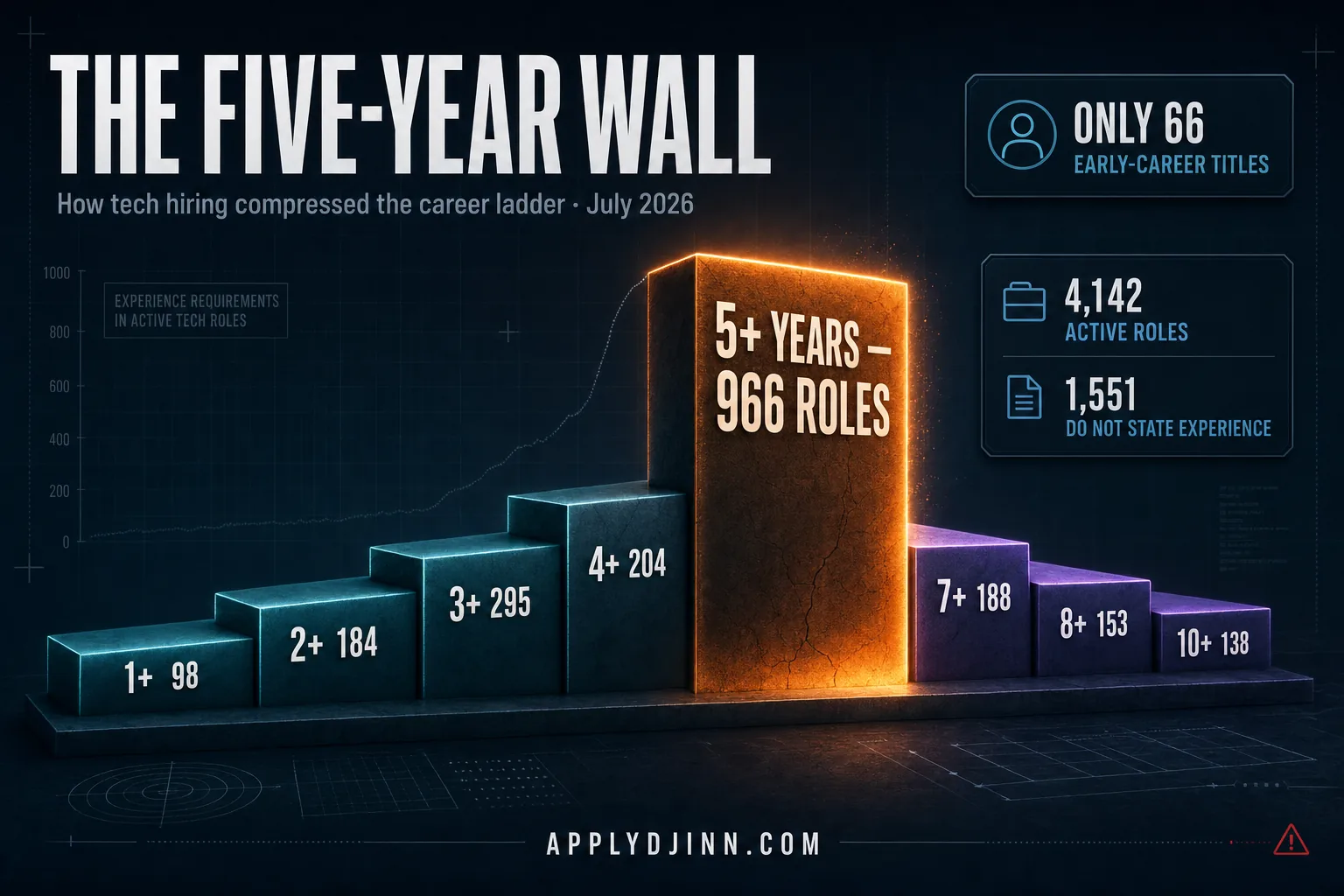
Among 4,142 live roles, 966 explicitly ask for 5+ years while only 66 titles signal an early-career opening. The missing middle is not imagined — but years are a proxy candidates can learn to decode.
There is a wall in technology hiring, and employers have helpfully labeled it 5+ years.
In our current set of 4,142 active technology roles, 966 explicitly request five or more years of experience. That single bucket is larger than the 1+, 2+, 3+ and 4+ buckets combined. Only 66 active titles explicitly signal junior, entry, graduate or internship territory.
The visual is dramatic because the market is dramatic: a gradual career ladder has been compressed into a high first ledge. Companies still want future senior engineers. Far fewer postings show where those engineers are supposed to begin.
This report explains what the wall measures, what it hides and how a candidate can climb it without pretending that three years are five.
The numbers, with the denominator visible
Experience language is messy, so the honest starting point is completeness.
The title-based picture points the same way. We find 840 titles with “Senior” or “Sr.” signals, 327 with “Lead,” 146 with “Staff” and 72 with “Principal,” compared with 66 obvious early-career titles.
Our normalized seniority classifier is stricter than title matching. Of 1,854 roles it can classify confidently, 1,267 are senior and 86 are junior: 14.7 senior roles for every junior role. Another 209 are middle, 161 manager, 97 principal and 34 architect.
This is not the whole labor market. It is the active vacancy market in the companies we track. But it is large enough to confirm what candidates feel: the visible doorway is much narrower at the bottom than the room behind it.
Why five years became the default answer
Five is not a magical threshold in human development. It is a compressed risk label.
When a hiring manager writes “5+ years,” the team may be trying to buy several different things at once:
Years are attractive because they are cheap to write and cheap to filter. They are also a noisy proxy. Two engineers can spend five calendar years accumulating radically different evidence. One may own production systems, incidents and migrations; another may repeat the same narrow year five times.
The best hiring teams know this. Their postings pair the number with scope: “led a migration,” “owned a service,” “designed distributed systems” or “mentored engineers.” The weaker postings use the number as a substitute for deciding what the job requires.
How the ladder became compressed
Several forces push the market toward ready-made seniors.
Teams became smaller and more leveraged
Cloud platforms, managed services, open-source frameworks and AI tools let a compact team ship what once required a department. That raises output per engineer, but it also means each seat carries more surface area. A team of six has less room for a role that cannot yet own a slice of production.
Hiring moved away from apprenticeship
Many companies say they value mentorship while staffing plans assume immediate independent output. Mentorship is treated as a cultural benefit rather than capacity that must be budgeted. When deadlines tighten, the junior requisition is often the first one rewritten as mid-level.
The cost of production mistakes increased
Software now touches payments, identity, healthcare, security and AI-mediated decisions. The perceived cost of a novice mistake is high. Companies respond by demanding experience, even when better review, staging and system design would manage the risk more effectively.
Titles inflated while scope blurred
“Senior” can mean five years at one company, ten at another and “the only engineer on this feature” at a startup. Staff and lead titles have also spread across very different responsibility levels. Candidates face a market where the title ladder looks precise but the underlying scope is not standardized.
Applicant volume rewarded blunt filters
A popular posting can attract hundreds of applications. Years become an easy automated screen because evaluating evidence takes time. The filter persists not because it perfectly predicts performance, but because it cheaply reduces volume.
None of these forces proves that companies should hire only senior people. Together they explain why the wall remains even when leaders complain about a senior-talent shortage.
The missing middle
The most damaging part of the pattern is not the scarcity of internships. It is the weak transition between learning and ownership.
A healthy ladder contains progressively larger scopes:
The compressed market often advertises step four while offering little public entry at steps one and two. Candidates respond by inflating titles, counting education as experience or mass-applying to jobs whose scope they cannot yet demonstrate. Employers then see noisy applicant pools and raise the filters again. The wall reinforces itself.
What “5+” should mean to a candidate
Do not read a year count as either a commandment or meaningless wishful thinking. Translate it into evidence.
Ask five questions:
1. Is the number repeated or incidental?
If the opening summary, minimum qualifications and application form all repeat five years, it is probably a hard filter. If the number appears once while responsibilities describe achievable scope, it may be shorthand rather than policy.
2. What risk is the team trying to transfer?
A five-year requirement beside on-call, security, migrations or customer architecture signals operational risk. A five-year requirement beside an ordinary feature list may be title calibration or applicant filtering.
3. Which requirements are direct and which are proxies?
“Designed event-driven systems” is direct evidence. “Five years of microservices” is a proxy for that evidence. Address the direct requirement in the résumé even if the calendar number is slightly short.
4. Is the gap one dimension or the whole role?
Four years instead of five, with strong evidence across the stack, is a reasonable application. Eighteen months and no production ownership for a role asking for architecture, mentoring and incident leadership is a different job.
5. Can a human see the evidence in ten seconds?
Recruiters cannot infer scope from a technology list. “Built a Kafka service” is weak. “Owned a Kafka ingestion service processing 40M events/day; cut recovery time from 50 to 12 minutes” gives the proxy something concrete to yield to.
A strategy for each side of the wall
If you have zero to two years
Optimize for environments that can actually absorb learning, not merely brands with many openings.
The goal is not to imitate a senior résumé. It is to show unusually low risk for an early-career hire.
If you have two to four years
This is the most frustrating zone because many candidates already perform mid-level work while filters still read five.
You do not need to claim five. You need to make four years look like four years of accumulating scope rather than four repetitions of a first year.
If you have five or more years
Passing the filter is not the same as differentiating.
The wall can hide a ceiling. Ask what decisions the role owns after the first six months.
What a credible evidence portfolio contains
A portfolio for an experienced role does not need beautiful screenshots. It needs inspectable judgment.
Include:
These artifacts convert “years” into the thing employers hoped years would guarantee.
What employers can do instead
The five-year wall is not only a candidate problem. It is a pipeline design problem.
Companies that want a durable talent market can:
The organization that hires only finished seniors is consuming a resource someone else trained. That can work for one company. It cannot work as the design of an industry.
The wall is real, but it is not perfectly solid
The data does not support empty reassurance. Early-career openings are scarce, explicit five-year requirements dominate, and the classified market leans heavily senior.
It also does not support automatic self-rejection. More than a third of active roles state no clean experience minimum, titles are inconsistent and years remain a proxy for evidence. Candidates close to the threshold can win by making scope unmistakable. Candidates far from it need a deliberate first environment, not a larger volume of identical applications.
The most useful response is neither “apply to everything” nor “obey every number.” It is to understand what risk sits behind the number and build proof that answers it.
Five years is a wall because hiring systems made it one. Evidence is where the doors are.
Method: 4,142 active postings at 111 companies in the ApplyDjin catalog, July 13, 2026. Experience counts use normalized explicit requirements and exclude 1,551 roles without a clean minimum. Seniority figures use a stricter classifier; 2,288 roles remain unclassified. Title signals overlap and are descriptive, not a universal job-level taxonomy.