Is That Tech Job Still Open? A Practical Vacancy Freshness Check
Understand source-published, first-seen and last-checked dates; confirm the employer's requisition; and avoid wasting application time on stale or misleading listings.
A job card can look fresh because it appeared in a search result today. That does not prove the employer posted it today, still accepts applications or is hiring in your location. Job aggregators, company sites and applicant-tracking systems expose different timestamps. Sometimes a parser discovers an old requisition for the first time; sometimes a source updates a page without changing the underlying role. This guide explains how to read those clocks and make a quick decision about whether a vacancy deserves an application.
How often the clocks disagree in our catalog
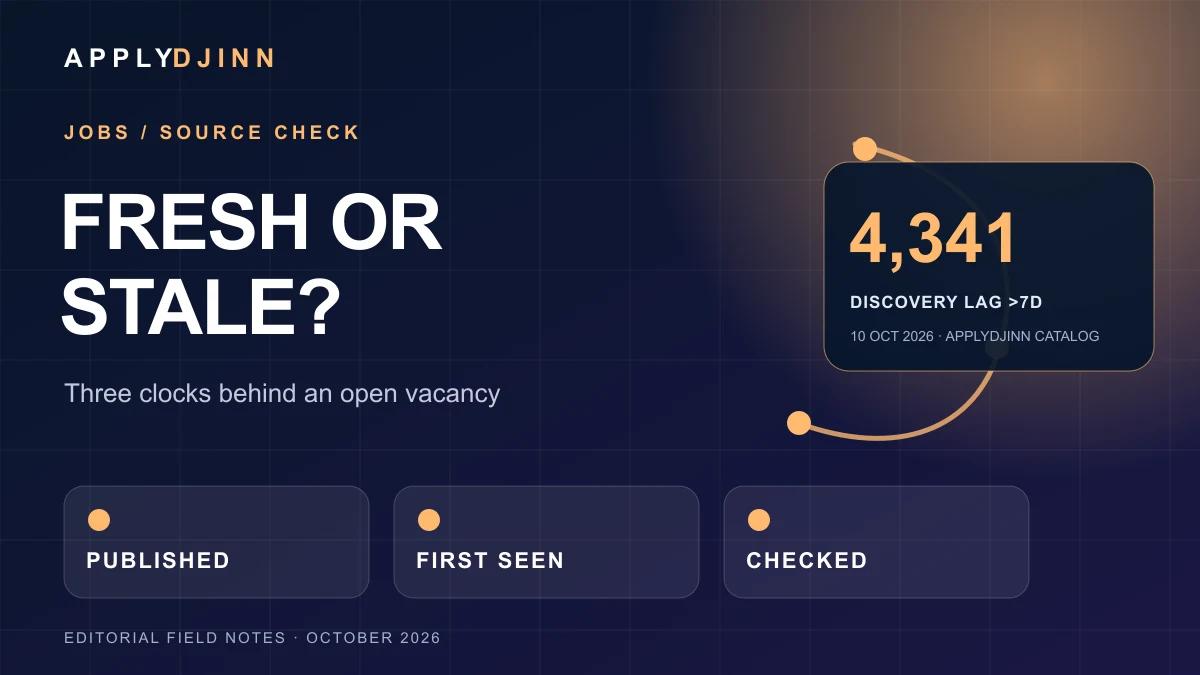
An ApplyDjinn read-only snapshot at October 10, 2026, 09:52 UTC found 23,702 active listings in the current 30-day window at 282 employers. Of those, 1,941 had no source-published date, so the site's current-window rule fell back to first-seen or created time for those records. Among the 21,761 current listings with both a source-published and first-seen date, 4,341 were first seen more than seven days after the source date. That is roughly one in five of that date-complete subset. It is catalog discovery lag, not evidence that the employer created a job on the day our parser found it.
The same snapshot contained 82 current records with descriptions shorter than 100 characters. That small group deserves a source check before a candidate relies on a generated summary or skill tag. A short stored body can result from a sparse source feed or an extraction failure; it does not prove the employer's own posting is empty. Some records also lacked a salary bound: only 6,024 of the 23,702 current listings had either a minimum or maximum salary field in the normalized vacancy table. Missing pay data is not a zero salary and should not be filled with an inferred number.
These figures are not a promise that today's vacancy list still has the same counts. Source pages, crawler coverage and status change. They do show why a freshness badge should be read alongside the actual dates and the source. If you are building a personal shortlist, sort on the source-published clock where available, identify newly discovered older records, and treat a thin description as a reason to visit the employer's page. The methodology explains the current-window rule and its limitations.
Know which date you are looking at
The source-published date is a date supplied by the employer or its hiring system, when available. It may be a date of initial publication or a later date set by the source after an edit. The first-seen date is when ApplyDjinn first collected that listing. It records catalog discovery, not necessarily creation of a job. The last-checked date says when our collection process last inspected the source or feed. A successful check gives some evidence that the record was still present then; it does not guarantee a human recruiter reviewed applications at that moment.
A fourth concept is display status. A site's “current” bucket is a rule over dates and source state. It helps you narrow a catalog, but it should not be read as a direct statement from the hiring manager. An “archived” bucket may contain roles removed at the source or roles outside the site's current window. A role can move between buckets for reasons other than a change in hiring demand. Always consider the rule and open the origin before spending time on a tailored submission.
Use the vacancy search to find roles, then inspect the detail card for the published and checked times. If the source supplies no publication date, avoid guessing one from the first-seen time. If a job was first seen yesterday and its source date is months old, it was a new discovery for ApplyDjinn, not necessarily a new employer posting. This distinction is essential when a new company parser is added: thousands of jobs can enter the catalog on one day while the employer's hiring activity remains unchanged.
Check the source in a short, repeatable order
First, follow the employer's official application link. Does the destination resolve, and does it show the same title and requisition ID? If the site redirects to a general careers search, search the ID there. If the specific role cannot be found, mark the listing uncertain and spend only a limited amount of time searching for an updated equivalent. A cached catalog page cannot submit an application on behalf of a missing source role.
Second, check location and work authorization. A catalog may normalize “Remote — United States” under remote, but that does not mean the role accepts applicants in Israel, Ukraine or every US state. The employer's posting may also list several office options that share one requisition. Read its own permitted locations and ask a recruiter when the wording is ambiguous. Do not let a broad filter become a promise of eligibility.
Third, inspect whether the role has enough substance to evaluate. A credible posting should at least explain the work, qualifications and application route. Some legitimate employer systems omit compensation or work-model details, so missing one field is not automatically a scam. But if the title is the only useful text, you cannot tell whether you fit. Search the official career site or contact the employer before generating a long customized CV. The FTC's job-scam advice is useful when the destination or recruiter asks for money, sensitive data or an unusual communication channel.
Fourth, record the URL, ID and date you checked. If you later see the same role under a changed slug or city, you can decide whether it is a repost, a distinct requisition or a duplicate presentation of the same job. A personal application log prevents you from spending repeated effort on a role you already applied to. It also gives you the source information needed to follow up without confusing the recruiter.
Understand why a role can be “open” but unproductive
A posting can remain visible after a team has a strong candidate, while a recruiter processes the last applications. It can remain visible because the hiring system did not close it promptly. A continuously open pipeline role may accept candidates for future openings. A large company may list one position in several locations. None of these cases can be distinguished from the card alone. A stale-looking date is a reason to check, not proof that the employer is acting in bad faith.
Similarly, a newly published date may reflect an edit or repost. The title, role ID, responsibilities and location can help identify continuity. If a job keeps reappearing, ask whether the employer has multiple openings or is restarting a search. A repeat posting might mean growth, turnover, administrative republication or a difficult-to-fill role. Avoid choosing one explanation without direct evidence.
When deciding between two roles, prefer the one whose source you can verify and whose requirements you can meet, even if the other displays a newer badge. A role you cannot legally perform in its stated location is not made useful by a fresh timestamp. A role with a clear hiring manager and a current requisition may be worth applying to even if it was first posted several weeks ago.
Separate parser quality from employer activity
ApplyDjinn collects listings from many employer systems. One source may supply full descriptions and explicit dates; another may provide sparse metadata. A parser can fail to extract a body even when the source page contains it. That is a data-quality issue in the catalog, not evidence that the employer published an empty job. If a detail page shows only a title and tags, open the source and report the missing description. Product teams should repair the source parser and backfill the affected records rather than instructing candidates to infer the requirements.
A failed fetch also should not silently count as a closed vacancy. The source might be temporarily unavailable, rate limited or have changed its markup. Confirmation of removal should follow a defined rule with retries or another source check. Conversely, keeping an old record current forever because the parser failed is misleading. A trustworthy catalog separates “last observed present,” “failed to check” and “confirmed absent” when the data allows it.
This distinction matters for trend charts. Suppose a crawler recovers after a week and imports 700 older jobs. A graph of first-seen listings rises sharply. A graph of source-published listings may not. Calling the rise 700 new employer openings would be an error. When you use trends or a company profile, look for the metric label and source coverage before interpreting the shape. A change in the instrument can produce a change in the measurement.
Use freshness to allocate effort, not to panic
Make three queues. Act now contains source-verified roles with a clear fit and an active application path. Investigate contains promising roles with an ambiguous date, location or source redirect. Skip for now contains roles that have disappeared at the source, require a location you cannot meet or lack enough information to judge. Limit time in the investigate queue. It is easy to spend a day trying to prove that one old posting exists while several clear roles go untouched.
For an act-now role, tailor the first page of your CV to the advertised work and submit through the official destination. Do not delay a clear application while waiting for a perfect market analysis. For an investigate role, search the exact ID on the official career site, then decide. If you find a replacement role, apply to the new ID and update your log. If you do not, move on and revisit only if a recruiter confirms it is active.
Use freshness information carefully when contacting a person at the company. “I saw requisition 1234 and checked that it is still on your career site today” is precise. “Your catalog shows a surge in hiring” may be an overstatement caused by newly connected feeds or multiple location variants. The first sentence opens a useful conversation; the second asks someone to defend a measurement they did not create.
A two-minute source checklist
Before each serious application, answer seven questions: Is this the employer's official domain? Does the requisition ID still exist? Does the title match? Is the role available in my location and work model? Do the requirements give me a plausible fit? What are the source-published and last-checked dates? Have I already applied to this ID or a true duplicate? If one answer is unknown, write that down rather than converting uncertainty into a yes.
After you apply, preserve the exact source link and confirmation. A later redirect does not erase what you saw at submission time. If you receive a suspicious follow-up, verify it through the official company channel before sharing identity documents or payment information. The FTC's recent warning on job scammers reinforces that a convincing-looking offer is not itself verification of the sender.
The central lesson is simple: freshness has several clocks. The date a site discovered a job, the date an employer says it published it and the date the source was last checked each answer a different question. Use them together to decide where to investigate, then let the current employer requisition decide where you actually apply. That is a more reliable use of job data than treating a bright “new” label as a guarantee.