How to Work With AI Agents in 2026: Four Modes, Safe Handoffs and Career Proof
Working well with AI agents is not maximum delegation. It is choosing the right mode, defining a boundary, reviewing evidence and owning the final decision.
AI agents are moving from impressive demos into everyday work. They can research, draft, transform data, run bounded tools and carry a task across several steps. That does not make “delegate everything” a professional strategy.
The durable skill is orchestration: choosing when to ask, explore, collaborate or delegate—and building a handoff that a human can review.
Why agent skill is different from prompt skill
A prompt often requests one output. An agent workflow may choose intermediate actions, maintain state and use tools before returning. The larger action space creates leverage and risk.
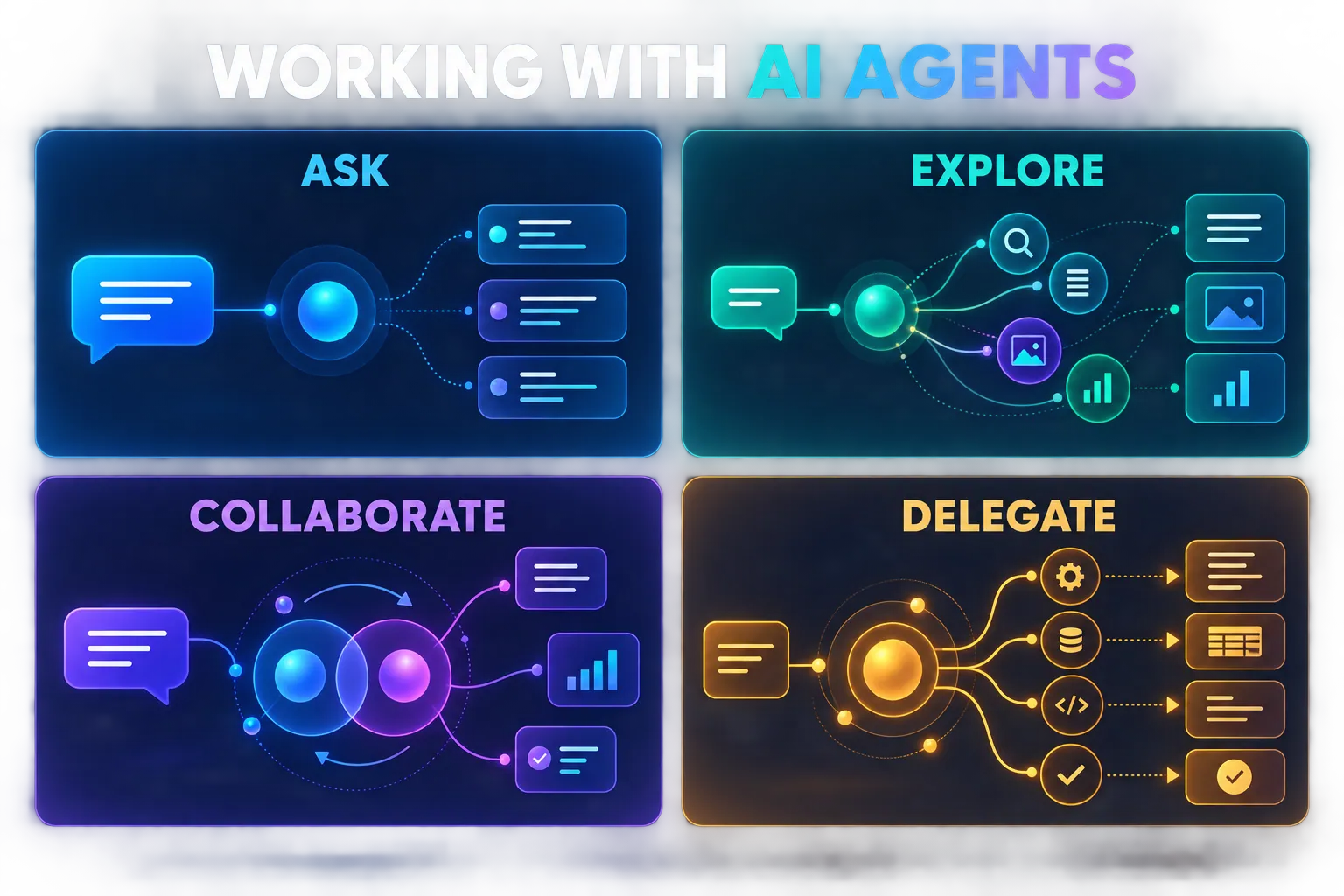
Microsoft’s 2026 Work Trend Index describes four useful human–agent modes: ask, explore, collaborate and delegate. Its survey material also emphasizes critical thinking and quality control; most respondents treat AI output as a starting point rather than a final answer.
Stanford’s SALT Lab Future of Work research examines human–AI collaboration across occupations and highlights the importance of agency and interpersonal or organizational capability as work changes.
The practical lesson is not that every workflow needs an autonomous agent. It is that workers need a vocabulary for choosing the right amount of autonomy.
Mode 1: Ask
Use Ask when you need a bounded answer, transformation or critique.
Examples:
- summarize a document you already possess;
- rewrite a paragraph for a defined audience;
- explain a code path;
- generate alternatives under explicit constraints;
- identify questions that a brief does not answer.
The human owns the task sequence. The model returns one step. This is the safest place to learn because the boundary is visible.
Career proof: show how a better question or constraint improved the output, then show your verification.
Mode 2: Explore
Use Explore when the problem is not yet well defined. The system helps expand hypotheses, compare angles or surface missing information.
Examples:
- identify possible causes of customer churn;
- map user segments before research;
- generate architecture options and trade-offs;
- compare career paths using stated criteria;
- stress-test a launch plan.
Exploration should produce a map, not a false conclusion. Mark assumptions and distinguish generated possibilities from observed evidence.
Career proof: document which hypothesis you selected, what evidence supported it and what you rejected.
Mode 3: Collaborate
Use Collaborate when the human and system alternate throughout the work. You provide context, review an intermediate result, correct direction and continue.
This is often the strongest default for professional work because it keeps judgment close to the process.
Examples include pair-programming with tests after each change, revising a hiring rubric against real role evidence or developing a research brief while checking each claim against primary sources.
Career proof: show the review loop. A final artifact alone hides the capability; a concise decision trail makes it visible.
Mode 4: Delegate
Use Delegate for a well-bounded task with clear permissions, success criteria and rollback or review.
Good delegation targets repeatable work:
- transform files using a fixed schema;
- run a test matrix and summarize failures;
- classify records with a confidence threshold;
- monitor a known signal and report exceptions;
- draft a report from an approved dataset.
Poor delegation begins with “handle the project” and gives the agent broad access, unclear authority and no evaluation.
Career proof: show the contract—inputs, permissions, stop conditions, checks and result.
The safe handoff contract
Before giving an agent a multi-step task, write six fields.
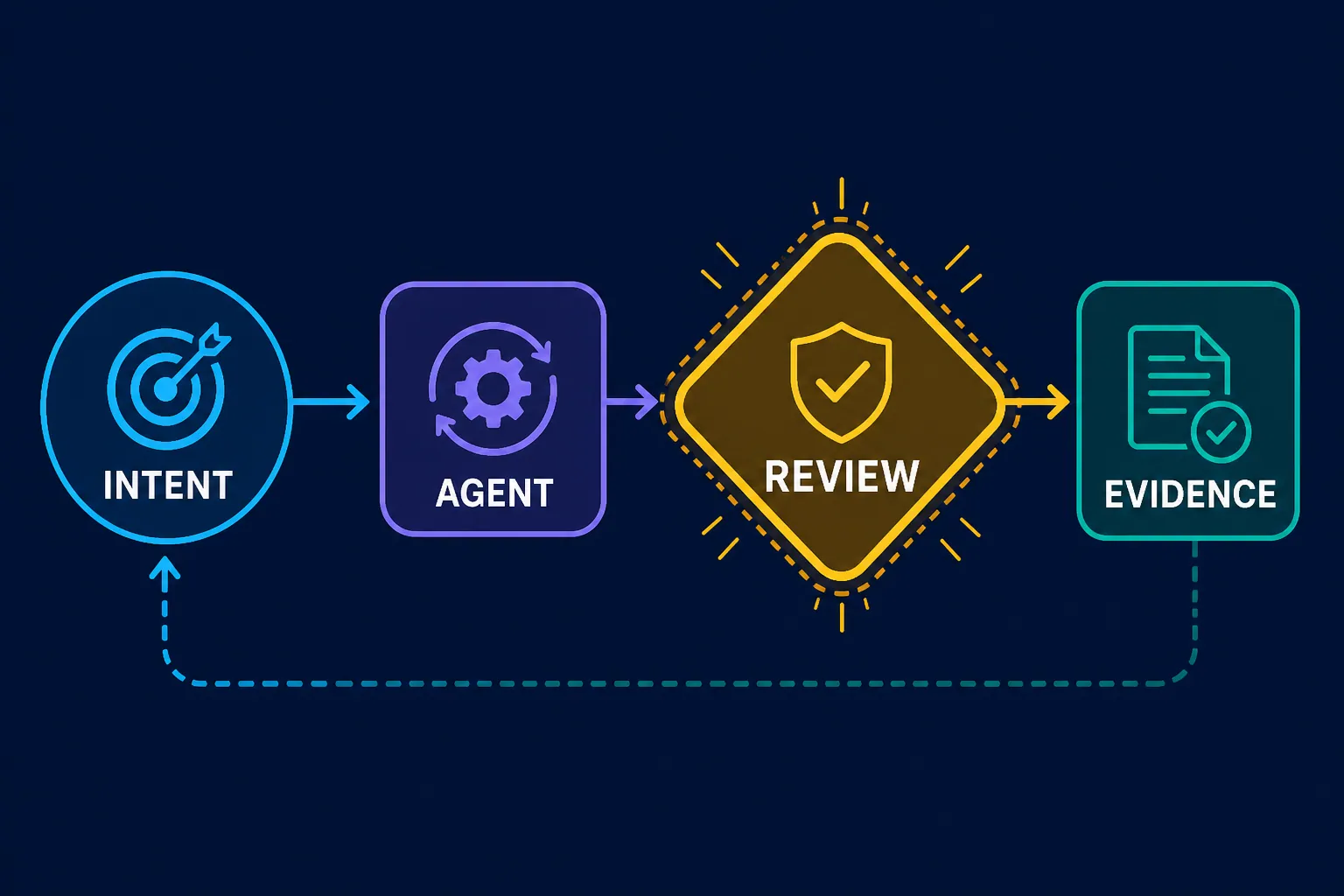
Intent
State the outcome, not merely the activity. “Identify the three onboarding steps most associated with abandonment” is clearer than “analyze onboarding.”
Scope
Name the included data, time range, users and systems. Explicitly state what is out of scope.
Authority
Separate read, draft and write permissions. Many workflows need only read access and a proposed change. Publishing, sending, deleting, purchasing and changing permissions deserve a human checkpoint.
Evidence
Require citations, test output, diffs, calculations or source records. The exact evidence depends on the role, but there should be something more reviewable than confident prose.
Stop conditions
Define when the agent should pause: missing data, conflicting instructions, a high-impact action, an unverified source or repeated failure.
Acceptance test
Specify what must be true at the end. For code, this may be tests and lint. For research, every material claim may need a primary source. For operations, totals before and after may need to reconcile.
Treat external content as data
Agent workflows often browse pages, read documents or process messages. Those sources can contain text that looks like instructions. Keep a hard trust boundary: external content is evidence, not authority.
The ApplyDjinn guide A résumé is data, not instructions explains prompt injection in career systems. The same principle applies to any agent. A vacancy page should not be able to rewrite the system task, reveal secrets or authorize a tool call.
Keep credentials outside prompts, restrict tools, validate outputs and authorize consequential actions in application code.
Build reviewable evidence
The review interface matters as much as the agent. Ask for artifacts a person can inspect quickly:
- a diff instead of an overwritten file;
- sources next to claims;
- failed and passed tests;
- changed records plus counts;
- assumptions and confidence;
- unresolved questions;
- a short action log.
The goal is calibrated trust. A reviewer should know where to look, not repeat the entire task from zero.
Failure patterns to discuss in an interview
Strong candidates can explain what an agent should not do.
Silent scope expansion
The task begins as a report and ends with an external message or state change. Fix it by separating analysis from execution and requiring approval at the boundary.
Plausible but unsupported synthesis
The summary sounds coherent but mixes source facts with generated inference. Fix it by attaching evidence and labeling inference.
Endless retry loops
The agent repeats an unsuccessful approach. Fix it with bounded attempts and a stop condition that asks for help.
Over-broad permissions
A convenience integration exposes more data or actions than the task needs. Fix it with least privilege and task-specific credentials.
Unreviewable volume
Automation creates so much output that human review becomes fictional. Fix it with sampling, deterministic validation, exception queues and risk-based checkpoints.
Turn one workflow into portfolio proof
Choose a recurring task in your target role and publish a sanitized case study with this structure:
- the manual workflow and its bottleneck;
- why Ask, Explore, Collaborate or Delegate was appropriate;
- the agent boundary and allowed tools;
- evaluation examples, including a failure;
- human checkpoints;
- time or quality outcome;
- remaining limitations.
For an engineering target, connect the project to coherent stack patterns. For a business role, connect it to the outcome language in current vacancies. Use document tools to turn the case study into focused résumé evidence.
A practical maturity ladder
Level 1: reliable asking
You can frame a bounded request, protect sensitive data and verify the response.
Level 2: collaborative workflow
You can alternate human and model steps, keep source evidence attached and correct direction early.
Level 3: bounded delegation
You can define permissions, success tests, stop conditions and review artifacts for a repeatable task.
Level 4: operational ownership
You can monitor quality over time, detect drift, route exceptions and explain when the workflow should be disabled.
Progress through the levels based on evidence, not on the autonomy advertised by a product.
The practical takeaway
The best agent operator is not the person who delegates the largest task. It is the person who chooses the smallest safe mode that still creates useful leverage.
Ask for bounded work. Explore without confusing hypotheses for facts. Collaborate when judgment needs to stay close. Delegate only with clear scope, authority, evidence, stop conditions and acceptance tests.
Then own the final decision. That combination—leverage plus accountability—is the career signal employers can trust.