The Build Center and the Market Edge: How Israeli B2B Companies Scale
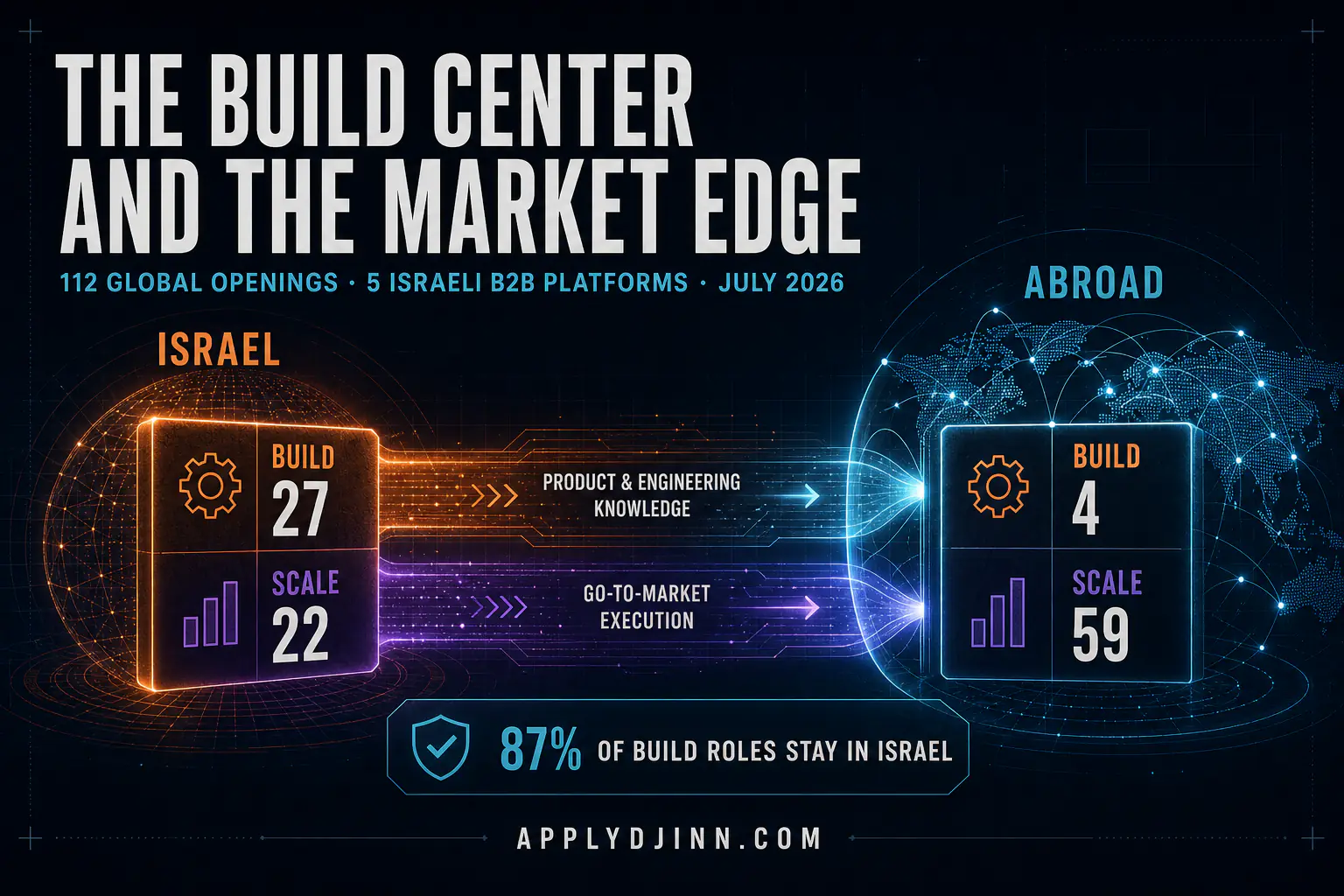
Across 112 worldwide openings at Tipalti, Datarails, Kaltura, DealHub and Earnix, 27 of 31 product-building roles were in Israel while 59 of 63 roles abroad sat in scale-and-operate functions.
A software company can distribute code from one place. It cannot distribute trust, onboarding, regulation, implementation and customer context the same way.
That difference is visible in the full hiring map of five Israeli-founded B2B platforms. ApplyDjin read every published role worldwide in the first-party ATS feeds for Tipalti, Datarails, Kaltura, DealHub and Earnix on July 17, 2026.
The feeds contained 112 open roles worldwide. We classified 31 as product-building work: engineering, R&D, product, security and one explicitly titled applied-AI scientist. The other 81 roles sat in the machinery that takes a product into a market: onboarding, customer operations, sales, marketing, finance, compliance and business operations.
The revealing result is not the 31-to-81 split by itself. It is where those two kinds of work sit.
| Hiring surface | Build the product | Scale and operate it | Total |
|---|---:|---:|---:|
| Israel | 27 | 22 | 49 |
| Outside Israel | 4 | 59 | 63 |
| Worldwide | 31 | 81 | 112 |
Israel held 87.1% of the product-building roles. Outside Israel, 93.7% of openings were in scale-and-operate functions.
This is the handoff economy: the product core remains concentrated, while the organization grows around the places where customers, regulations and revenue live.
A company does not become global when its website gains a country menu
It becomes global when work crosses a handoff.
A product decision becomes an implementation constraint. A payment feature becomes a compliance process. A forecasting model becomes a conversation with a finance team. A video platform becomes a procurement, security and adoption problem. A pricing engine becomes a change-management project inside a bank or insurer.
Those handoffs explain why a business-software company can have a compact engineering center and a much wider labor map. The code may be centralized; the uncertainty is not.
The five feeds make that pattern unusually clear:
The counts will move. The operating model is the durable signal.
There are two different career markets inside the same company
Candidates often search B2B software as if every opening were a variation of “SaaS.” The hiring map suggests a better distinction.
The build center rewards depth
The product-building side values evidence that survives technical scrutiny: system design, data models, reliability, security boundaries, model evaluation, production debugging and the ability to make trade-offs explicit.
For these roles, a useful portfolio artifact is not a polished landing page. It is a decision record. Show the constraint, the alternatives, the measurement and the failure you prevented.
Start with the company pages for Tipalti, Datarails, Kaltura, DealHub and Earnix, then compare the language used by adjacent engineering and product teams. Repeated nouns reveal the real platform boundary better than a generic technology list.
The market edge rewards translation
The scale-and-operate side is not “non-technical work around the product.” It is where the product collides with another organization.
Customer onboarding turns APIs and configuration into a live workflow. Compliance operations turns abstract controls into repeatable evidence. Solutions and customer-success roles turn product capability into adoption. Marketing and sales roles translate technical differentiation into a buying decision.
Strong evidence here is a handoff made measurable: time-to-value reduced, implementation risk removed, a complex account rescued, a regulated workflow documented, an integration made repeatable or customer feedback converted into a product decision.
Search the live cohort directly: Tipalti vacancies, Datarails vacancies, Kaltura vacancies, DealHub vacancies and Earnix vacancies.
Read the role by the handoff it owns
Job titles hide the most important part of B2B work. “Customer Success Manager,” “Product Manager,” “Support Engineer” and “Implementation Manager” can sit at very different distances from code, revenue and operational risk.
Before applying, answer four questions from the description:
Those answers tell you what the employer is buying. They also tell you which part of your experience belongs at the top of the application.
What this snapshot does—and does not—show
This is a five-company first-party ATS snapshot, not an estimate for all Israeli technology companies. The cohort is deliberately narrow: established B2B platforms whose products enter finance, revenue, video and insurance workflows.
“Build” includes engineering, R&D, product, security and the explicitly titled applied-AI scientist. “Scale and operate” includes every other published department. Department labels are employer-defined, so the categories describe the hiring surface rather than the exact daily work of every person.
The scraper configs ingest the complete worldwide feeds; there is no Israel location filter. The reproducible script is `scripts/report-business-platform-handoff-2026.mjs`. Counts are a point-in-time signal and the linked searches update as the source boards change.
The conclusion is not that product work belongs only in Israel or that customer work belongs only abroad. Four product-building roles were already outside Israel, and 22 scale-and-operate roles were in Israel. The useful conclusion is sharper: global scale creates a second labor market around the handoffs that code alone cannot cross.