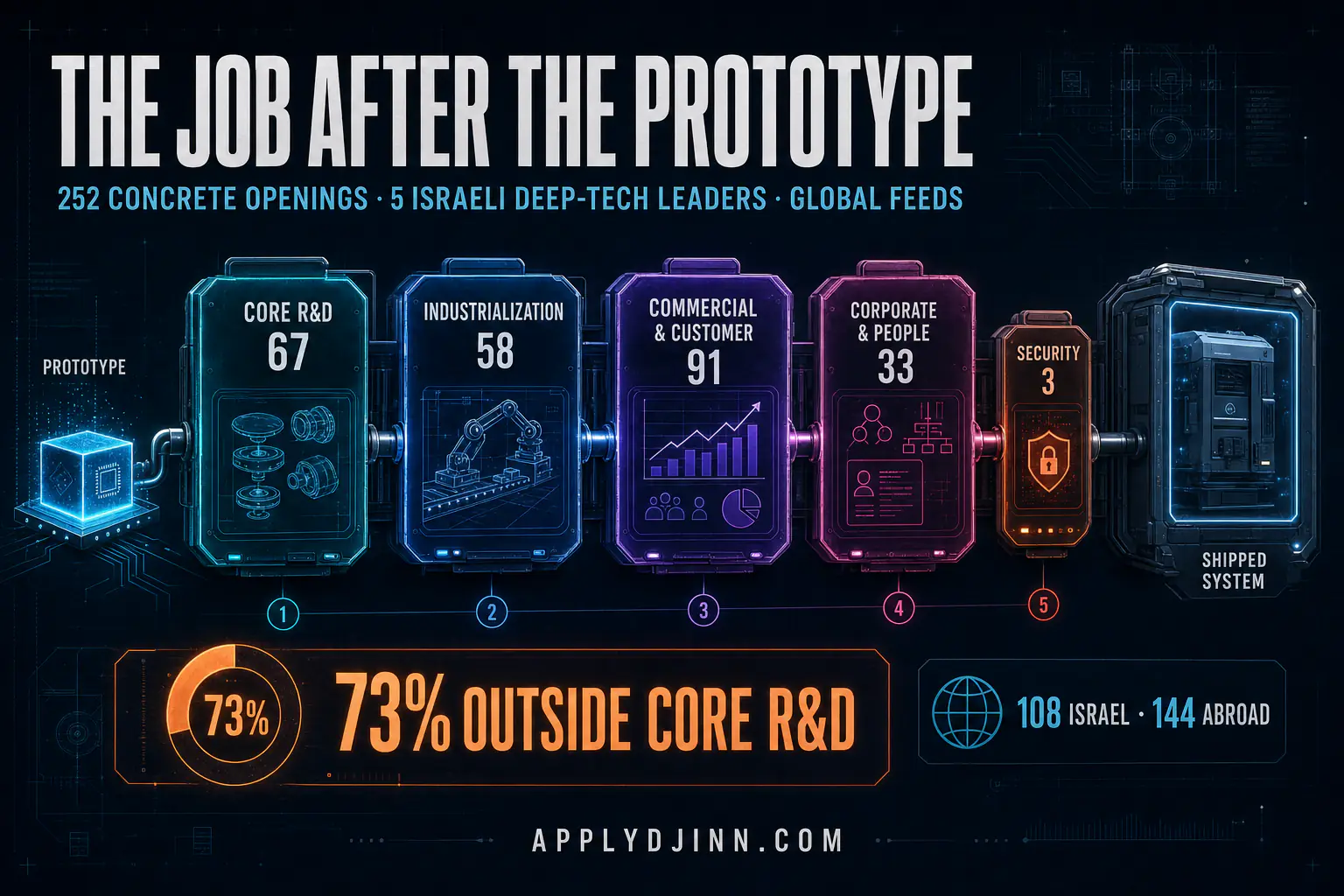
The Job After the Prototype: 73% of Deep-Tech Openings Are Outside Core R&D
Five global ATS feeds from SolarEdge, Nova, Camtek, Innoviz and Arbe contained 252 concrete openings. Only 67 were core R&D; 185 were the work of industrializing, selling, supporting and operating physical products.
The prototype gets the photograph. The product creates the jobs.
In software, a prototype can sometimes become a product through deployment and iteration. In deep tech, the distance is longer. A chip must survive fabrication and validation. A sensor must be calibrated against a physical world that refuses to stay clean. An energy system must be manufactured, qualified, installed, diagnosed and supported. Every handoff creates work that disappears inside the phrase “R&D company.”
ApplyDjin read the complete worldwide first-party Comeet feeds for five established Israeli deep-tech employers on July 17, 2026: SolarEdge, Nova, Camtek, Innoviz and Arbe.
The scrapers do not filter for Israel. They ingest every published role in every location.
The feeds returned 256 published entries. Four were generic application pools rather than concrete jobs—three unsolicited-application entries at Nova and one “did not find a suitable position” entry at Camtek—so the editorial cohort contains 252 concrete openings.
Only 67 roles, or 26.6%, were in core R&D. The other 185, or 73.4%, were the system required to turn invention into something repeatable, supportable and sellable.
The lifecycle behind 252 openings
| Product lifecycle | Openings | Share |
|---|---:|---:|
| Commercial & customer | 91 | 36.1% |
| Core R&D | 67 | 26.6% |
| Industrialization & operations | 58 | 23.0% |
| Corporate & people | 33 | 13.1% |
| Security | 3 | 1.2% |
Industrialization and operations were nearly as large as core R&D: 58 versus 67 roles. Commercial and customer work was larger than either.
This is the job after the prototype. It begins where a laboratory result meets yield, reliability, supply chain, field conditions, a customer site and a revenue commitment.
The missing middle is industrialization
Technology coverage often presents a false binary: research on one side, sales on the other. The 58-role industrialization layer shows what that framing misses.
Across the feeds, this layer includes quality and reliability, production engineering, NPI, test, integration, supply chain, battery systems, manufacturing engineering, data-center hardware and technical operations. These roles ask a different question from core R&D.
R&D asks: Can this work?
Industrialization asks: Can this work repeatedly, at the required cost, after thousands of handoffs and under conditions we do not control?
At SolarEdge, the distinction appears in ATE, reliability, production engineering, battery test and hardware-integration work alongside embedded, ASIC and hardware R&D. Search every current SolarEdge role →
At Nova, engineering and research sit beside production, manufacturing engineering, supply chain, applications and a large service organization distributed around semiconductor customers. Search every current Nova role →
Camtek shows the same bridge at a smaller scale: R&D is joined by operations, logistics and customer support around inspection and metrology systems. Search every current Camtek role →
Innoviz and Arbe have smaller feeds, but the lifecycle is still visible: LiDAR and radar engineering connect to operations, testing, business and customer-success work. Search Innoviz roles → · Search Arbe roles →
The lesson is not that R&D matters less. It is that invention captures only one failure mode. A product can be technically novel and still fail because it is difficult to manufacture, validate, integrate, explain or support.
Israeli companies, global operating systems
The full-feed geography makes the company-selection rule clear: these are leading Israeli companies, not Israel-only vacancy boards.
Of the 252 concrete openings, 108 were in Israel and 144 were abroad. That means 57.1% of the hiring surface was outside Israel.
The split was not random:
The center builds a large part of the technical core; the edge places people near fabs, manufacturers, installers, partners and customers.
That edge is physical. 203 of 252 roles were on-site, 48 hybrid and only one remote. Globalization here does not mean location-independent work. It means a distributed operating footprint tied to laboratories, production sites and customer environments.
Search for the seam, not only the title
Candidates often miss deep-tech roles because they search only for familiar software titles. The more useful openings sit at seams between disciplines.
Try search language that names the handoff:
Then open the company and vacancy pages together:
A title can be misleading, but the handoff is usually visible in the description. Look for the object that changes state, the team that receives it and the failure that triggers escalation.
Build evidence for the failure mode
A generic portfolio says what you built. A deep-tech portfolio should show what you made reliable.
For core R&D, show the model, design or algorithm and the constraint that shaped it. For industrialization, show a test strategy, yield improvement, root-cause analysis or repeatability gain. For applications and customer work, show how you translated an ambiguous field problem into a reproducible technical fix. For operations, show the control loop: signal, threshold, intervention and outcome.
Even a software-only project can provide this evidence. Add fault injection. Measure latency tails instead of averages. Document a hardware or API boundary. Track a failure across logs and versions. Build a small calibration or validation harness. The point is to demonstrate that you can reason after the happy path ends.
Method, concentration and limits
The lifecycle groups normalize employer-defined departments. “Core R&D” covers engineering and named R&D departments. “Industrialization & operations” covers quality, production, manufacturing, supply chain, test, integration and operational groups. “Commercial & customer” covers sales, marketing, applications, service, support and customer success. Corporate, people and security functions are reported separately.
All 252 concrete openings map to one group. The complete calculation is reproducible with `scripts/report-israeli-deep-tech-hiring-2026.mjs`.
This is a five-company ATS snapshot, not a census of Israeli deep tech. SolarEdge and Nova account for 203 of 252 openings, so the distribution reflects their scale. Department names are proxies for lifecycle position, not perfect descriptions of daily work. Counts will change as the first-party feeds change.
The conclusion survives those caveats: deep-tech employment is not concentrated at the moment of invention. The larger labor system appears after the prototype, where technology has to become dependable in the world.