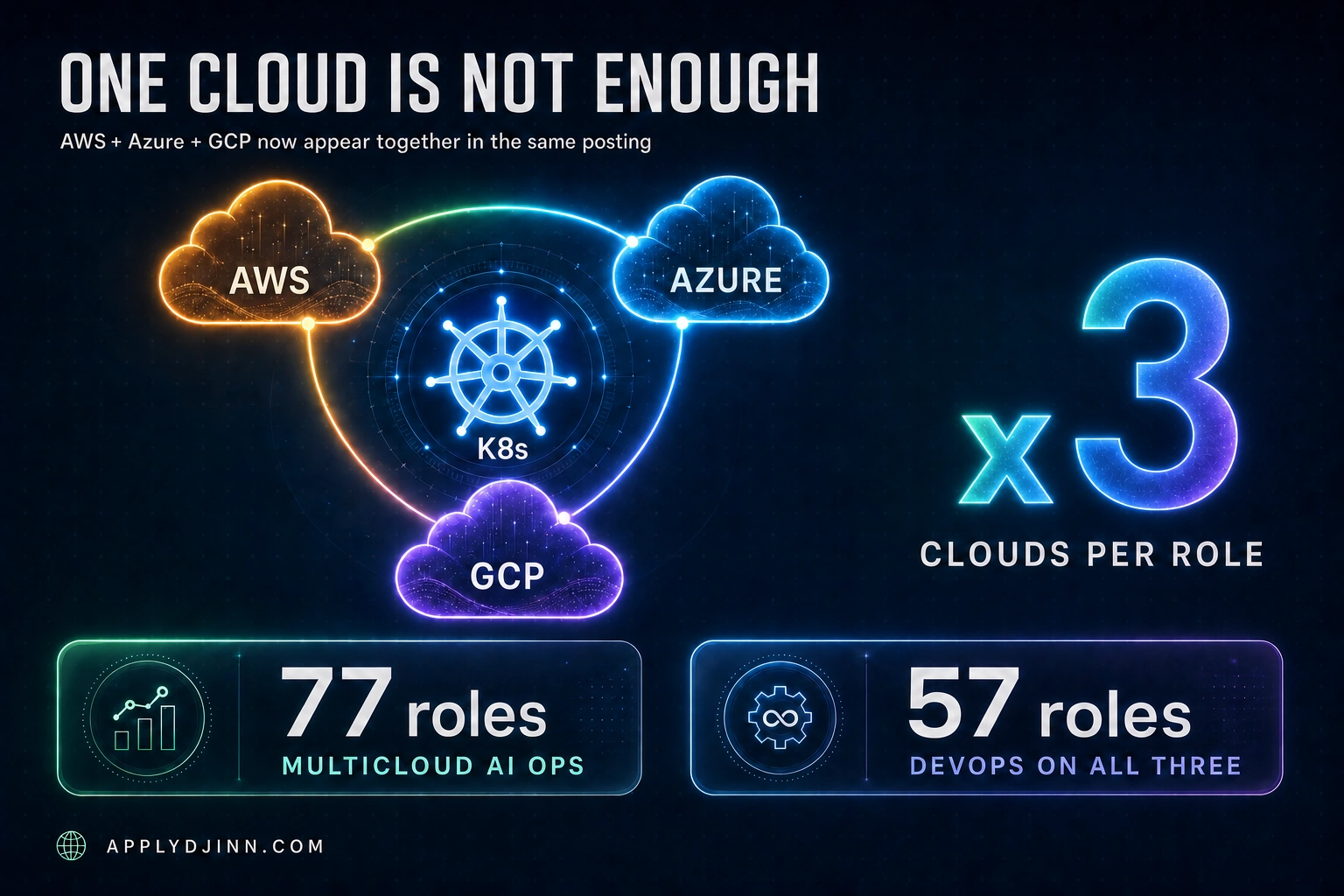
For a decade, "pick one cloud and go deep" was solid career advice. Our stack-mining data says that era is ending: the most common infrastructure imprint in live postings is AWS + Azure + GCP — all three, in one role.
The numbers
77 live roles combine AI with the full AWS + Azure + GCP triad — the largest ops-shaped stack in our catalog.
57 DevOps roles demand AWS + Azure + GCP + Kubernetes together, up 2 postings this week.
AWS still leads individually at 491 mentions, ahead of Azure and GCP on their own — but the fastest-growing pattern is not any single cloud, it is the combination.
Kubernetes appears in 356 postings and has quietly become the neutral layer that makes multicloud survivable.
Why this is happening
AI workloads follow GPU capacity. Teams train where the quota is. When one provider is out of the accelerators you need, you move the job, not the deadline. This alone forces model-serving engineers into at least two clouds.
Enterprise deals dictate deployment targets. If your customer runs on Azure, your "AWS-native" product suddenly is not. Sales closes the deal; engineering inherits the second cloud.
Acquisitions arrive pre-clouded. Every acquired team brings its own provider. Consolidation is expensive and slow, so "temporarily multicloud" becomes the permanent state.
Kubernetes made it cheap enough. Once the platform is K8s-shaped, the marginal cost of the second cloud drops from a rewrite to a Terraform module and a new node pool.
The translation layer, decomposed
"Multicloud skill" is vague. In practice these postings are testing four concrete competencies:
Orchestration that hides the provider. Managed Kubernetes on each cloud (EKS, AKS, GKE) plus the discipline to keep provider-specific glue at the edges.
Infrastructure as code. Terraform (or Pulumi) is non-negotiable — it is the only sane way to describe the same system three times.
Identity and networking models. IAM, VPC/VNet, and private connectivity differ per cloud; knowing where they map and where they do not is the actual senior skill.
CI/CD that deploys anywhere. CI/CD shows up in 397 postings; multicloud raises the bar from "deploy to prod" to "deploy to whichever prod the customer bought".
A learning path that maps to postings
If you already know one cloud deeply, do not start over on a second console. Instead: learn Kubernetes until you can debug it under pressure, learn Terraform until you reach for it by reflex, then study the translation table — for each primitive you know on your cloud (identity, load balancing, object storage, secrets), learn its equivalent and its gotchas on the other two. That table, not a second certification, is what turns one-cloud experience into access to 130+ of these roles.
When one cloud is still the right call
Multicloud is a requirement, not a virtue. Plenty of excellent teams are single-cloud on purpose, and interviewers respect a candidate who can say why: lower operational surface, deeper use of managed services, and one security model to reason about. The skill the market rewards is not "runs everything everywhere" — it is the judgment to know when portability earns its cost and when it is just complexity with a nicer name.
What it means for engineers
The valuable skill is no longer "AWS certification" — it is the layer above the clouds: Kubernetes, Terraform, CI/CD, and the judgment to keep the differences contained.
Interviewers increasingly ask "how would you make this portable" rather than "which service does X".
The strongest answer is rarely "abstract everything". It is "abstract the 20% that changes, and use each cloud's best managed services for the rest". Say that, and you sound like someone who has actually run multicloud rather than read about it.
Based on closed frequent-itemset mining over 3,383 active postings, ApplyDjin, July 2026.