Security Engineering Demand: Turn a Skill Tag into Evidence of a Verified Fix
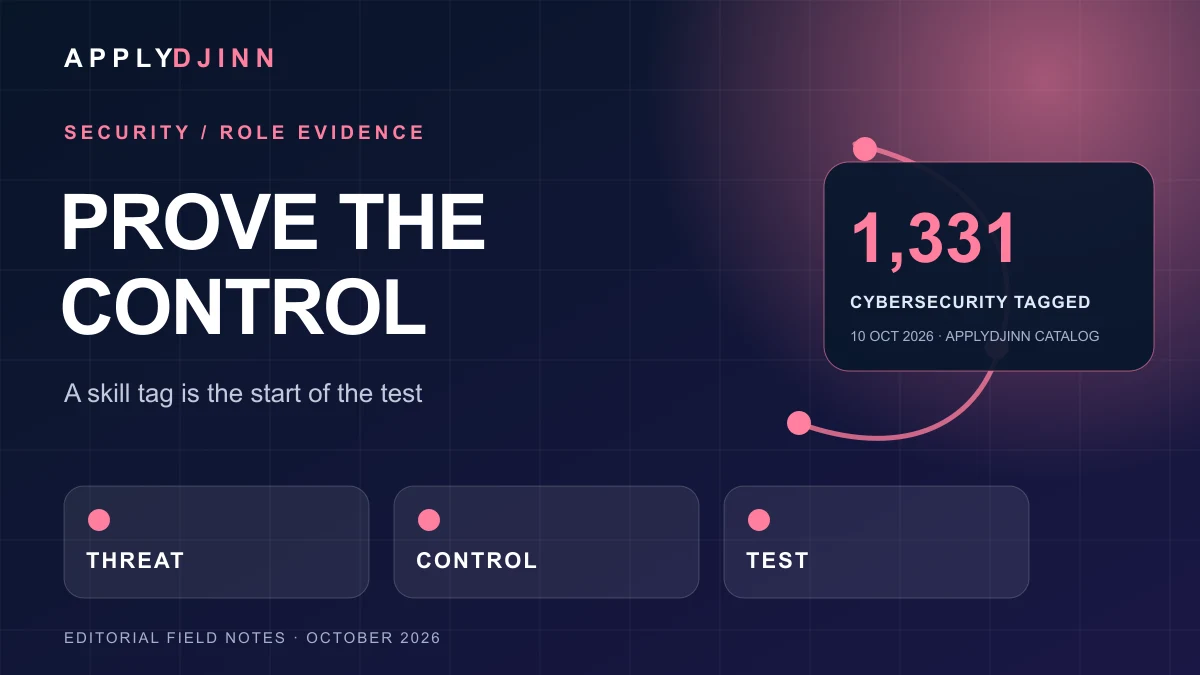
ApplyDjinn found 1,331 current vacancies associated with a cybersecurity requirement at 99 employers. Here is how to qualify that signal and prepare concrete security work samples.
A security skill can appear in a vacancy because the engineer will own a control, because the product serves security teams, or because every employee is expected to follow a policy. Those are not equivalent opportunities. The useful question for a candidate is whether the role asks them to identify threats, build defenses, test a fix or operate a response. ApplyDjinn can show where the word appears; the employer's source description shows the work. This article uses a dated catalog measure to turn a broad signal into a specific portfolio and interview plan.
The observed signal and its limits
At October 10, 2026, 09:52 UTC, ApplyDjinn's current 30-day catalog contained 23,702 active vacancy records at 282 employers. Its normalized requirement index associated the Cybersecurity skill with 1,331 current records at 99 employers. This is a candidate-retrieval signal generated from job text, not a verified claim that every one of those employers is recruiting a dedicated security engineer. A role can mention security as a product category or a supporting responsibility. The count also depends on which company sources ApplyDjinn monitors.
The 99-employer figure matters differently from the 1,331 role count. It shows the association is not confined to one publisher, but it does not say how deep the requirement is at each employer. If several hundred records come from a global provider's template, they may represent many locations or adjacent teams. Before deciding to study a tool or change a CV headline, use the live technology view and vacancy search to sample actual source requisitions from different organizations.
Treat the index as a sampling frame. Pull a few roles from application security, a few from platform security and a few where security appears only in a general company paragraph. For each, underline the sentence that names the work the person will own. If you cannot find one, mark the role as ambiguous rather than adding it to a “security engineering demand” total. The site-wide 1,331 is useful for finding candidates for that review; the reviewed subset is what should inform a personal learning plan.
The site's “current” window is based on source-published date where available, falling back to first-seen or created date, with editorial pins as an exception. A newly observed older job can be current by one clock and stale by another; a source edit can change the wording without creating new headcount. Use the source link and date as part of the evidence. The October figures are a frozen observation, not a live forecast of security hiring.
Split security roles by the work they own
Read ten relevant postings and sort them by responsibility. Application security often asks for code or design review, vulnerability analysis and developer collaboration. Cloud or platform security can focus on identity, secrets, deployment boundaries and configuration. Detection engineering may emphasize telemetry, alert quality, investigation workflows and false-positive costs. Product security may span threat modeling, customer requirements and secure release decisions. Incident response requires operational judgment under uncertain evidence.
These categories overlap, and a small team may ask one person to cover several. Still, a candidate should not present the same evidence for all of them. An incident postmortem shows a different skill from implementing object-level authorization. A successful vulnerability disclosure does not by itself prove you can build a maintainable fix. A list of tools may show exposure but not judgment. Ask what deliverable the role owns during its first six months.
Use a matrix with four columns: source requirement, actual failure or control implied, your direct experience and evidence you can share. Mark where you have an adjacent example. For a gap, choose a practice task that produces a small, inspectable artifact. If the role requires detection tuning, create a log sample and explain precision, recall and investigation cost. If it requires secure development, build a vulnerable demo, fix it and include a regression test.
Make one threat model small enough to inspect
Start with an ordinary workflow: a signed-in user opens a document belonging to their organization. Draw the request path from browser to API, identity service, authorization check, database and object storage. Identify what an attacker can control: their own account, a document ID, a URL or a request header. Identify what they cannot control in the assumed model. This boundary prevents a threat model from becoming a generic list of everything that could ever go wrong.
Choose one abuse case. For example, a user changes an object ID and retrieves another tenant's file because the API checks authentication but not ownership. State the asset, unauthorized action, precondition and potential impact. Then choose a control at the right boundary: verify access to that specific object for that tenant on every read and write path. A client-side hidden button is not a sufficient control. Least-privilege storage access can limit the blast radius if the API check fails.
Write a test that fails before the fix and passes after it. Include a valid owner, a different tenant, guessed IDs, list and download endpoints, cached responses and a service account with broader permissions. Describe how you would check logs for evidence of prior abuse without exposing another user's document in the test report. A portfolio artifact with this failure path, fix and verification is more convincing than a claim that you know “zero trust.”
The NIST Secure Software Development Framework can help organize how security work enters a release process. It does not prescribe a single interview answer. Use it to ask concrete questions: who owns the control, how is it tested in CI, how is a new developer taught the boundary, and what happens if the test fails before release?
Distinguish preventing, detecting and recovering
Prevention blocks an unauthorized action at the time it is attempted. Detection tells a team that a suspicious or harmful action may have happened. Recovery restores a safe state and helps affected people. A strong answer covers all three when the risk demands it. The authorization test prevents cross-tenant access; an access-denial metric and audit event help detect probing; a documented response path covers a discovered historical exposure.
Not every event deserves a page. Alerting on every denied request may overwhelm a small security team. Define a signal tied to the abuse pattern, such as repeated cross-tenant access attempts by one account, and check how many false positives it produces. Protect user privacy in the logs. If an alert includes raw document content or full credentials, the monitoring system can create a second incident while trying to detect the first.
For an incident story, state what was known at each point. “We had elevated denial rates” is an observation. “An attacker exfiltrated records” is a conclusion requiring evidence. Explain the containment option, its effect on legitimate users, how the team verified it and what later review changed. Do not inflate the outcome because an interviewer may ask what logs or samples support it.
Show secure delivery rather than a scanner screenshot
An automated finding is a prompt to investigate. The role may be to triage whether the vulnerable dependency version is deployed, whether the affected code path is reachable and whether a temporary mitigation is safer than an immediate breaking upgrade. A scanner screenshot alone does not show that decision. Build a short case study with version inventory, exposure analysis, chosen mitigation, rollout plan and residual risk.
For a portfolio project, include the configuration or code that enforces the control, a small test and a release note. Keep keys and live credentials out of the repository and screenshots. Explain how the team would rotate a compromised secret and confirm the old one no longer works. CISA's Secure by Demand guidance is useful context for asking whether secure defaults and maintainable controls reach the buyer; it is not evidence that your own demo is production-safe.
Consider user cost as well as attacker cost. A login rate limit that blocks a shared office IP may reduce malicious requests and lock out legitimate applicants. A restrictive permission model may keep data safe but make necessary work impossible. Describe how you test false positives, provide a recovery path and monitor the effect on real users. A security engineer who can state this trade-off is more useful than one who proposes every possible block.
The case study should also state what you deliberately did not test. A local demo might prove object authorization for ordinary API requests while leaving administrator delegation, queued jobs or legacy exports outside scope. Note those boundaries and the next tests you would run. This makes the artifact easier to review and harder to mistake for a complete production assessment. If the example comes from paid work, remove customer identifiers, secrets and internal architecture that you are not allowed to share; a reconstructed public demo can show the same reasoning.
Turn the artifact into an interview answer
Practice a scenario of cross-tenant access, a compromised dependency or abusive login traffic aloud. Start with the asset and actor, then the abuse path, control, test and operational follow-up. Ask a peer to interrupt when you use a broad phrase such as “secure the API.” Replace it with the exact check and the case that proves it.
Prepare one story where you did not immediately ship the most sophisticated control. Explain the evidence that supported a simpler fix, how you bounded the risk and when you would revisit it. Security work is full of constrained decisions. A realistic answer describes an owner, a rollout and a residual risk. If you did not have authority to make the final call, say what you recommended and who decided.
When applying, put the most relevant security artifact near the top of the CV and connect it to the source requisition. A platform-security role may value the tenant boundary and deployment gate; a detection role may value the triage metric and false-positive analysis. Do not claim that a normalized cybersecurity tag makes you a fit for every role in the 1,331-record snapshot. Use the tag to find jobs, the source to understand them and your verified work to earn the conversation.
The strongest end product is small: one threat model, one abuse case, one implemented control, one regression test and one honest operational note. It gives an interviewer enough material to probe how you think. The broad market count gives a reason to search; the artifact gives a reason for a particular team to take your application seriously.