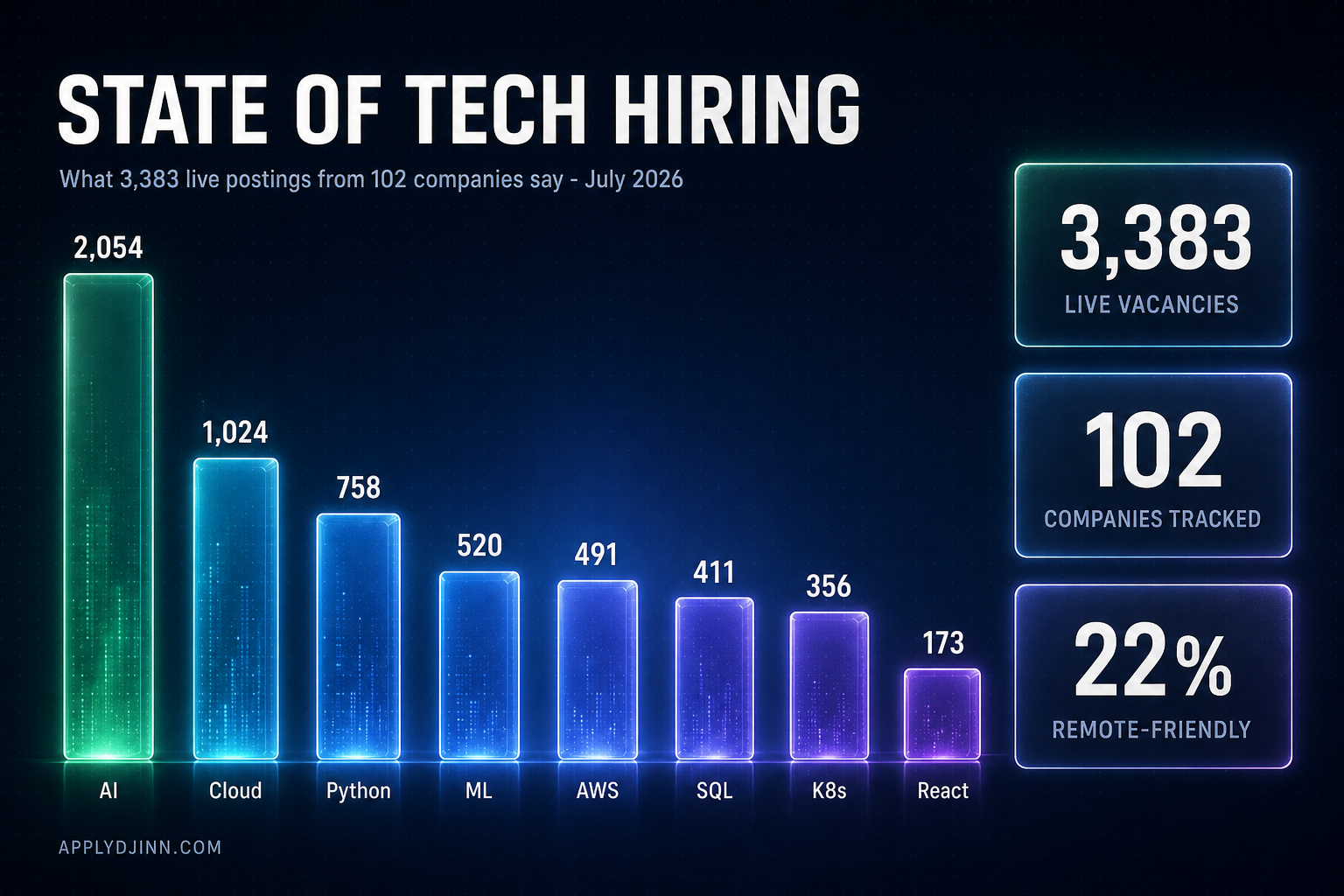
State of Tech Hiring, July 2026: What 3,383 Live Postings Say
102 companies, 718 technologies, 22% remote. The full mid-2026 snapshot of the tech job market — from FAANG to Israeli cybersecurity.
This is our first full market snapshot, computed live from every posting we track. No survey answers, no self-reporting — just what companies actually publish when they need engineers.
The headline numbers
Technology demand, ranked
The long tail matters too: 718 technologies means the median company is hiring for a genuinely broad stack, and niche skills — Verilog, DFT, InfiniBand — punch far above their raw counts because so few candidates have them.
Stack imprints: professions, not keywords
Mining postings for skills that always travel together gives us 24 stable "imprints" — de-facto job profiles that no one wrote down but everyone hires for. The five biggest: AI Engineer (AI+ML+Python, 151 roles), AI Product Engineer (AI+LLM+ML, 115), GenAI Engineer (103), Multicloud AI Ops (77), and DevOps on all three clouds (57). Reading the market as imprints rather than keywords is the difference between "I know Python" and "I match the AI Engineer profile" — the second is what actually gets you shortlisted.
The remote reality
The remote number is the one most people get wrong. At 22% and flat, remote is neither the future nor dead — it has settled. Fully remote roles cluster in two places: senior infrastructure and platform work, where autonomy is assumed, and companies without a local office in a given market. Everything else has converged on hybrid. If you are optimizing for remote, target the infrastructure imprints; they carry the highest remote share in our data.
Security never sleeps
Israeli cybersecurity remains a market of its own: SentinelOne, Wiz, Cato Networks, Armis, Axonius, BigID, Silverfort, Pentera, and Checkmarx together keep hundreds of security postings live, with Cloud Security + Cybersecurity forming its own stable stack imprint. What makes this cluster distinctive is depth over breadth — these teams ask for fewer technologies per posting but far deeper mastery of each, and they pay for it. For an engineer with genuine security fundamentals, it is one of the least-commoditized corners of the whole market.
Who is hiring most
Demand is not evenly spread. The largest single sources of live postings in our catalog are the hyperscalers and the AI labs, but the most concentrated demand — many roles for a narrow, high-bar profile — comes from the security and infrastructure companies. For a job seeker that distinction is strategic: the big names offer volume and variety; the specialists offer less competition per role if you fit their exact shape.
What we are watching next
How this report is made
Every figure here is derived from live postings, re-parsed hourly, with skills extracted from requirement text rather than self-reported tags. That is why our numbers sometimes disagree with survey-based reports: we are measuring what companies ask for, not what engineers say they know. The two are rarely the same, and the gap between them is where the opportunities hide.
ApplyDjin tracks postings hourly across 102 companies. All figures in this report are from live data, July 11, 2026.