A Large Job Count Can Hide a Narrow Market: Count Employers as Well as Vacancies
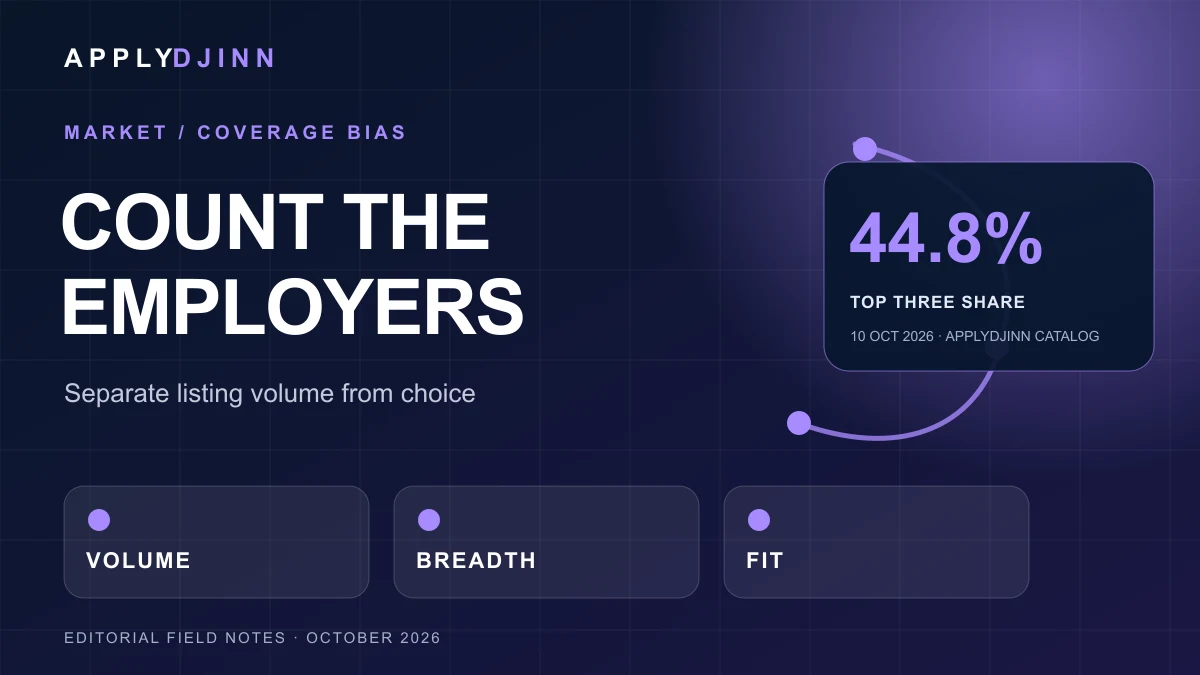
Three employers supplied 44.8% of ApplyDjinn's 23,702 current listings in an October 2026 snapshot. Learn how to separate posting volume, employer breadth and personal role fit.
A job market dashboard often leads with the largest number it can show. That number can be accurate and still answer the wrong question. If one employer posts thousands of roles, the catalog looks broad even when most candidates are choosing among a much smaller set of independent employers. A skill can appear in hundreds of listings because one company's template repeats it. A city can look active because a single multinational lists many teams there. To make a job-search decision, compare listing volume with employer breadth, unique requisitions and fit.
What the October snapshot contains
At October 10, 2026, 09:52 UTC, ApplyDjinn's current-market view included 23,702 active listings from 282 employers. The largest three employers in that observed set were EPAM with 4,292, Amazon with 4,152 and Google with 2,163 current records. Together they accounted for 10,607, or about 44.8%, of all current records in this specific catalog snapshot. The company directory contained 316 companies overall. These figures describe ApplyDjinn's monitored sources and freshness rule, not the share of all technology jobs in any country.
“Current” follows the site's 30-day source-published or observation window for active records, with editorial pins as an exception. Some source requisitions have multiple location variants. Different company feeds have different coverage and update behavior. A feed added tomorrow could change the 44.8% share without any of the three employers changing their hiring plan. That is why the number belongs with its timestamp, denominator and source definition.
The live companies directory lets you inspect current employer footprints. A ranking by open roles is useful when you want to find a large hiring organization. It is less useful when you want to know how many different employers need a skill or whether your preferred location has options outside one company. For that question, count distinct company IDs, source requisitions and relevant role families after filtering.
Three denominators for three different questions
The listing count answers how many current catalog records match your filter. It can reflect multiple teams, cities, seniority levels or variants of a similar role. The employer count answers how many tracked organizations published at least one matching record. It is a rough measure of independent pathways, though companies in one corporate group may not be fully independent. The candidate-fit count is the number of source-verified roles you can realistically perform in an acceptable location and level. That last number is personal and cannot be read directly from a site-wide headline.
Consider a technology appearing in 500 records at three employers versus 300 records at 60 employers. The first might signal a deep specialty at a few large buyers. The second might signal a skill that travels across more organizations. Neither is automatically better. If you want to build an enduring career option, breadth can matter; if you are targeting one domain and have strong proof, depth at a few employers may matter more. The point is to know which pattern the numbers describe.
Role families have the same issue. A large employer may publish software, sales, operations and finance jobs simultaneously. A candidate for a backend position should not treat the whole employer count as the number of backend paths. Filter to the work, then to location and level, and only then compare employers. The role overview and technology evidence can narrow the field before you invest in applications.
The catalog had 13,581 technical roles in the current window, but even that narrower denominator spans different disciplines and seniority levels. A practical search should keep its own smaller denominator: roles whose source text matches your work and whose location rules you can meet. Write the criteria before reading the first page. Otherwise the highest-volume employer can set the definition of “relevant” by sheer repetition, and the shortlist will look larger than the set of applications you can credibly make.
Do not turn a repeated phrase into market demand
Large applicant-tracking systems often reuse job-description fragments. A company-wide paragraph about AI, cloud or security may appear in many unrelated positions. Counting raw mentions can make that term look like a requirement. ApplyDjinn attempts to classify technology evidence, but every extracted tier can be wrong on a particular posting. Read source descriptions from several employers to see whether the term appears in responsibilities, required qualifications, optional qualifications or general company context.
The October snapshot had 11,401 current records associated with the normalized AI requirement index across 255 employers. That broad association does not mean all those jobs need model deployment. It is an example of why the employer count is necessary but still insufficient. A useful next step is to inspect a balanced sample: several roles from one large source, several from medium sources and several from distinct small sources. Write down the actual work behind the term. If it varies dramatically, do not market yourself to every role using a single AI headline.
If your learning plan relies on a technology-demand chart, record both the number of matching employers and how much the biggest employer contributes. A rising total with stable or falling breadth can mean deeper recruitment at an existing buyer, changed templates, or coverage shifts. It does not prove a broad market trend. A skill that appears as an explicit requirement in different role families may be portable, but inspect the competence being asked for before treating the word as portable evidence.
A better shortlist built from employer breadth
Choose a target: for example, senior platform engineering in Israel with a feasible commute. Filter the vacancy catalog by that target. Export or note the employer, source requisition ID, title, location and date you verified it. Deduplicate obvious location variants. Now group by employer and mark whether you have one role, several distinct teams or repeated versions of one role. This turns a page of cards into an opportunity map.
Look at the first ten employers, not just the first ten results. The first ten cards may all belong to one high-volume source. For each organization, open its company profile for context and its official careers page for current eligibility. Note whether the role family is central to the business or a supporting function. This can shape your interview questions, but it should not be used to guess job security from a logo or stock move.
Build two application batches. The first contains directly matched roles across several employers; the second contains adjacent roles where a specific skill transfer needs explaining. Measure responses by batch and stage. If applications to one company repeatedly fail while comparable ones elsewhere progress, the issue may be level, location, evidence presentation or an internal hiring constraint. A batch across employers is more informative than ten near-duplicate applications to one portal.
Geography can amplify concentration
ApplyDjinn observed 1,174 current Israel-faceted roles at 144 employers and 8,787 current US-faceted roles at 181 employers at the snapshot time. These are not disjoint subsets: one global requisition can have both country facets. They are also not national labor-market estimates. Their value is showing that an employer and location filter can change the balance between volume and breadth. A global count dominated by one company may not describe your local options.
If you use remote as a filter, read the permitted hiring countries. The snapshot had 5,477 records labelled remote, but remote work can still be restricted by country, state, entity or team schedule. It would be wrong to add all remote roles to every country total. The employer's source language decides whether you are eligible. The same caution applies to hybrid roles where an office city appears in the catalog but the required in-person pattern is not in a structured field.
For a candidate outside a major hub, a breadth comparison can reveal smaller clusters worth investigating. A lower count at more employers may produce better resilience in a search than a large block of postings at one employer that uses a fixed location rule you cannot meet. Decide on the personal constraints first, then let the catalog show the range of organizations inside them.
Compare periods without mistaking coverage for demand
A week-over-week chart should hold the employer cohort stable when possible. If ApplyDjinn connects a new source, first-seen listings increase because the catalog became more complete. If a parser temporarily fails, visible counts can fall without confirmed removals at the employer. If one large company republishes hundreds of roles, the total may move while the median employer does not. Report a matched-employer view and the contribution of the biggest source alongside the raw count.
The trends section can help you inspect change, but no vacancy series directly counts hires. “Updated” is not “new”; “archived” is not necessarily “filled”; “first observed” is not necessarily “source published.” A news surge or share-price move can add context but cannot prove the reason for a hiring change. Use the charts to frame a question, then confirm it through source postings and recruiter conversations.
Keep a dated note when you make an important decision. If you decide to learn a tool because many employers ask for it, write down the employer sample and source dates. If you later find that the count was concentrated in one template, you can revise the plan without treating the first decision as a failure. Market data becomes more useful when the assumptions are visible and reversible.
For a team reporting these figures, publish a companion table of employer count, top-employer share and records with a usable source date. That makes it possible to see whether a weekly increase comes from wider coverage, one large source or genuinely more distinct posting organizations. Candidates do not need a perfect labor-market model to benefit from this discipline. They need enough transparency to know when a headline count is a discovery aid and when it is strong enough to support a claim about changing options.
The 44.8% figure is a reminder to read every catalog total with two additional questions: how many independent employers are represented, and how many of their roles fit you? Volume helps you find where to look. Breadth helps you judge how portable a skill or search target may be. Source-verified fit tells you where to apply. None of the three can replace the others.