US Tech Hiring in October 2026: What ApplyDjinn's Catalog Shows
A dated look at 9,008 current US listings across 175 employers: role mix, skill evidence, source concentration, and why newly discovered jobs are not the same as newly published jobs.

The September US jobs report arrived on October 2. It describes a broad labor market in which nonfarm payroll employment changed little. A person looking for a technology role needs a different, narrower question: which employers and types of work can I actually investigate now? This ApplyDjinn review answers that question for the vacancies in our catalog, while keeping the catalog separate from national employment statistics.
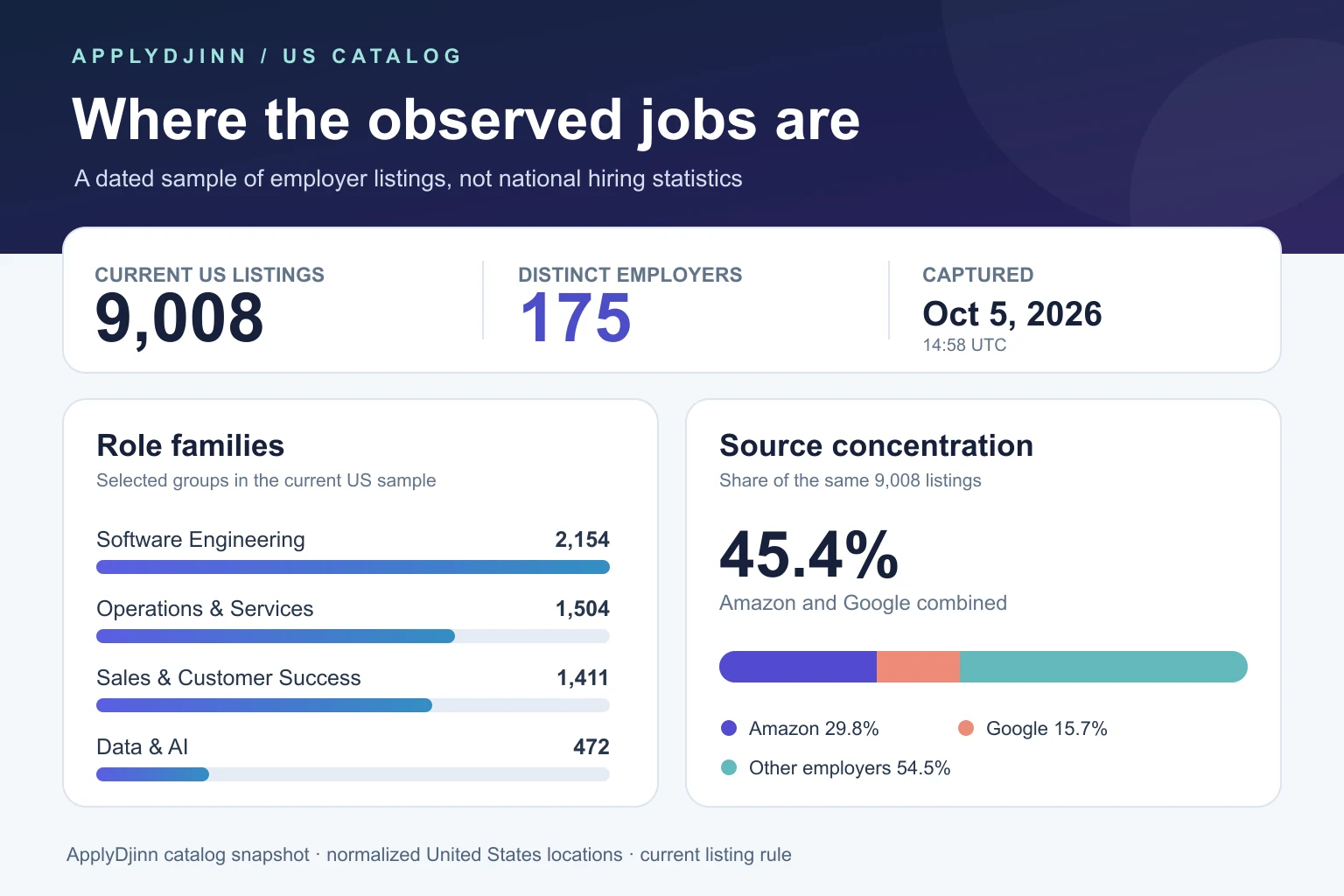
The snapshot was taken October 5, 2026 at 14:58 UTC. At that point, ApplyDjinn classified 9,008 US vacancies as current, across 175 employers. A US vacancy here is one with a normalized United States country facet, even if its source uses a city, state, or multi-location label. “Current” follows the site's active listing rule: a source publication date, or the first observation date when no source date exists, within the 30-day window; explicitly pinned active listings can also qualify. These are observed employer listings. They are neither all US openings nor a count of people hired.
Start with the right denominator
The US vacancy search is the live route to openings. It changes as employers post, update, archive and remove roles. The figures in this article are a frozen editorial snapshot so that each percentage refers to the same 9,008-listing denominator. A later click may show a different total. That is expected; the article should not be read as a real-time counter.
The site tracks several clocks for a listing. The source-published date is what the employer or its hiring system reports. The first-seen date is when ApplyDjinn first collected it. The current status is our display rule. They answer different questions. A listing can be new to us and old on the employer's site. A role can remain on the employer's site yet fall outside our current observation window. This matters especially when a new company feed is connected or an existing feed recovers after an interruption.
The US snapshot is broad enough to be useful for navigation, yet concentrated enough to demand caution. The largest employer in this sample, Amazon, accounts for 2,680 of 9,008 listings, about 29.8%. Google accounts for 1,413, about 15.7%. Together they make up 4,093 listings, about 45.4%. That is concentration in ApplyDjinn's observed catalog, not a claim about their share of all US hiring. If you are deciding which skills travel between companies, inspect employer counts alongside role counts and repeat a search without a dominant employer where the filter supports it.
Which work is visible in this snapshot?
Role families are mutually assigned for this breakdown. The largest observed groups are Software Engineering: 2,154 listings at 105 employers; Operations, Program & Services: 1,504 at 88; and Sales & Customer Success: 1,411 at 145. Finance, People & Legal contributes 803 at 92, while Data & AI contributes 472 at 55. These five groups are examples, not the whole catalog. Product, hardware, security, marketing and other families account for more listings.
The contrast between volume and breadth is more useful than a ranking alone. Software engineering has more listings than sales in this sample, but sales and customer success are visible at more employers. That may give a candidate more independent places to investigate even when the total count is smaller. The reverse can happen inside a specialty: one employer may publish hundreds of variations of a similar role, creating a strong count with a much narrower employer base.
Use role markets to compare a family before choosing a title. A “software engineer” search can span application development, infrastructure, data systems and developer tooling. A “sales” search can span account management, solutions engineering and customer operations. Open a few actual listings from separate employers, then write down the outcome each role owns. That exercise prevents a broad family label from becoming a misleading career target.
For a concrete search sequence, begin with current US vacancies, select a role family or specialty, and check the employer and location facets. Open the source listing before you invest time in an application. If a role is labelled remote, read its permitted countries or states in the employer's own text. “Remote” can still carry a location restriction.
A technology mention is not a hiring requirement
ApplyDjinn records both technology mentions and their apparent role in a vacancy. This lets a reader distinguish a term in the background description from a requirement for the applicant. In the US snapshot, AI appears in 4,644 listings at 143 employers, but 1,469 of those listings classify it as core or required. Python appears in 1,550 listings at 96 employers, with 647 core or required. Machine Learning appears in 1,560 at 85, with 608 core or required. AWS appears in 1,789 at 93, with 533 core or required.
Those numbers are not interchangeable. AI can describe a product category, team mission, customer use case or required implementation skill. Python is a named language. AWS is a provider platform. Machine Learning is a field of work. The labels have different breadth, and the classification is derived from job text; it should be checked against the source listing for an application decision. The technology overview shows the Core, Required, Context and Nice-to-have split. A large overall count should not be advertised as a large pool of mandatory skills.
The practical question is not “Which tag wins?” It is “Which requirement can I demonstrate for the role I want?” If a posting asks for Python to maintain production data pipelines, a project showing tests, monitoring and recovery is stronger than a course badge alone. If AI appears only in a company overview while the job focuses on enterprise sales, the AI tag should not be treated as a prerequisite. If a machine learning role asks for model evaluation, the portfolio evidence should cover data selection, baseline, metrics, error analysis and deployment constraints rather than merely naming a model.
Build a shortlist of three technologies or competencies, then compare their core-plus-required counts and distinct employer counts in your target geography. Open several examples from independent employers. When a term appears as context, do not add it to a learning plan until another employer also asks for it in the work you want. This is a way to spend learning time on repeatable demand rather than the vocabulary of one large source.
What changed between the two full weeks?
For a fair calendar comparison, use September 21–27 and September 28–October 4 rather than a partial October 5. In the observed US records, 2,641 listings carry a source publication date in the first week and 2,067 in the second. That sounds like a decline. It is not enough to conclude that US technology hiring fell. The set of monitored employers, update behavior and feed coverage can change, and a publication date may be revised or absent. Even a matched-employer comparison can be driven by a few large publishers. The trends dashboard is the right place to inspect the two windows with its coverage notes, not to turn one difference into a market headline.
The first-seen clock tells a different story: 2,113 US listings were first observed in September 21–27, and 4,271 in September 28–October 4. Of the 4,271 first observed in the second week, 2,180 had a source publication date more than seven days before ApplyDjinn first saw them. They are discoveries for our catalog, but not fresh employer postings. Calling all 4,271 “new jobs created last week” would be wrong. This is precisely why source coverage and labor demand need separate measures.
A useful comparison should hold the employer cohort stable where possible, report both the count and the share of a skill within that cohort, and show how much the biggest employer contributes. It should also distinguish source-published listings, newly discovered listings, updated listings and archived listings. We can observe each, but none is a direct measure of hires. If an employer briefly removes a feed or republishes many roles, a headline based on the raw net change can reverse without a meaningful change in its hiring intent.
How to read the BLS report beside this catalog
The US Bureau of Labor Statistics' September 2026 Employment Situation, released October 2, reported a 29,000 increase in nonfarm payroll employment and a 4.2% unemployment rate; both changed little over the month. Its household and establishment surveys measure national labor-market outcomes. ApplyDjinn counts observed listings from participating or discovered employer sources. These datasets have different populations, time frames and units. A catalog increase cannot confirm a BLS employment increase, and a flat national payroll month does not mean a particular engineering specialty has no open roles.
For a job seeker, the report gives broad context while the catalog provides places to act. Use BLS for national employment context and the employer's listing for the details of one opportunity. Do not blend the BLS unemployment rate with a vacancy count into an invented “chance of getting hired.” Neither source supports that individual probability.
Salaries: keep the sample narrow
The salary evidence section is useful when a listing discloses a pay range, but this review does not turn its subset into a US-wide average. Disclosed base pay is a selected sample. A range can be tied to a level, geography, hours or compensation component. Equity, bonus and benefits do not become base salary because they appear in the same employer description. A single posting can contain different ranges for different levels or locations.
To use salary evidence for a specific decision, filter to the role, level, country and currency that match your target. Check the source vacancy and the period attached to a quoted amount. Compare like with like, and record how many observations remain after filtering. If only a few comparable ranges exist, describe them as examples rather than a benchmark. In a negotiation, the employer's written offer terms and the actual location rule matter more than a mixed catalog median.
A ten-minute route from the review to a decision
- Open US vacancies and set your intended work location, role family and seniority. If you can work only in certain states, inspect the employer wording on remote jobs.
- Look at role markets to see whether the role appears across independent employers or clusters at one large source. A broader employer base can make a skill more transferable.
- Use technology evidence to distinguish core and required signals from context or preferences. Select an exact canonical technology when a text search returns similar names.
- Open three real listings from different employers. For each, list the outcome, non-negotiable constraints, two proof points you can defend and the source publication date if available.
- Run match analysis only after your profile contains real project evidence. Treat its score as a structured prompt for review, not an employer decision.
- If compensation is disclosed, check salary evidence within a comparable role and geography. If it is absent, prepare a clear question for the recruiter instead of guessing from unrelated ranges.
This route is deliberately small. Its output is a shortlist of actual roles and a few justified next actions, not a prediction of the economy. If you find that one company dominates your shortlist, repeat the search with that employer excluded or use the company filter to compare a second source. If every promising role requires a skill you have only used in tutorials, plan a demonstrable project before you claim production experience.
Method and limits
The snapshot uses ApplyDjinn's normalized country facet for United States, current active-vacancy rule, role-family classifier and versioned skill-evidence tiers as they stood on October 5, 2026, 14:58 UTC. Employer counts are distinct company identities, not brands or office locations. The skill figures count vacancy mentions; a vacancy may mention multiple skills, so skill totals should never be added together as if they were separate jobs. Core-plus-required counts use the classification attached to each mention. The employer concentration figures use the same 9,008 current-vacancy denominator.
The two weekly comparisons use full Monday-to-Sunday windows and distinguish source publication from first observation. Late discovery is identified when the source publication date precedes our first observation by more than seven days. Source dates are available for most, not all, current US listings. Our catalog's sources, freshness rules, classification and geography normalization can change after the snapshot. We do not infer all-market demand, layoffs, wages or hiring outcomes from these counts.
Sources and routes: ApplyDjinn current US vacancies, roles, technology evidence, trends, salary evidence, locations, and the BLS September 2026 Employment Situation. The ApplyDjinn figures above come from its own catalog snapshot, not from the Google Trends export or BLS estimates.