The AI Stack Employers Actually Pair Together: August 2026
A skill rarely appears alone. ApplyDjinn analyzed 5,836 current vacancies to find the cloud, language, agent and frontend combinations employers are asking teams to deliver.
A technology count can tell you that AI is common. It cannot tell you what employers expect a person to build around it.
Stack patterns answer a more practical question: which technologies repeatedly appear together in the same current vacancies?
In the ApplyDjinn August 2026 catalog snapshot, 5,836 vacancies contributed to 24 recurring stack patterns, including eight emerging combinations. The leading AI patterns connected models to cloud platforms, Python, agent tooling and production interfaces—not to isolated prompt use.
How to read this snapshot
These figures describe the current ApplyDjinn stack catalog, not the entire global labor market. They are affected by the employers, sources, locations and active-vacancy rules represented in the catalog. One vacancy can contribute to more than one pattern, and a pattern count is not a count of unique companies.
The seven-day movement shown on the stack page is a directional comparison with an earlier catalog snapshot. It can move because employers publish or close roles, sources refresh and the composition of the active market changes. Small bases can produce dramatic percentages.
Use the data to generate hypotheses. Verify those hypotheses against live vacancies, the technology market and individual company hiring footprints.
The five leading AI-centered combinations
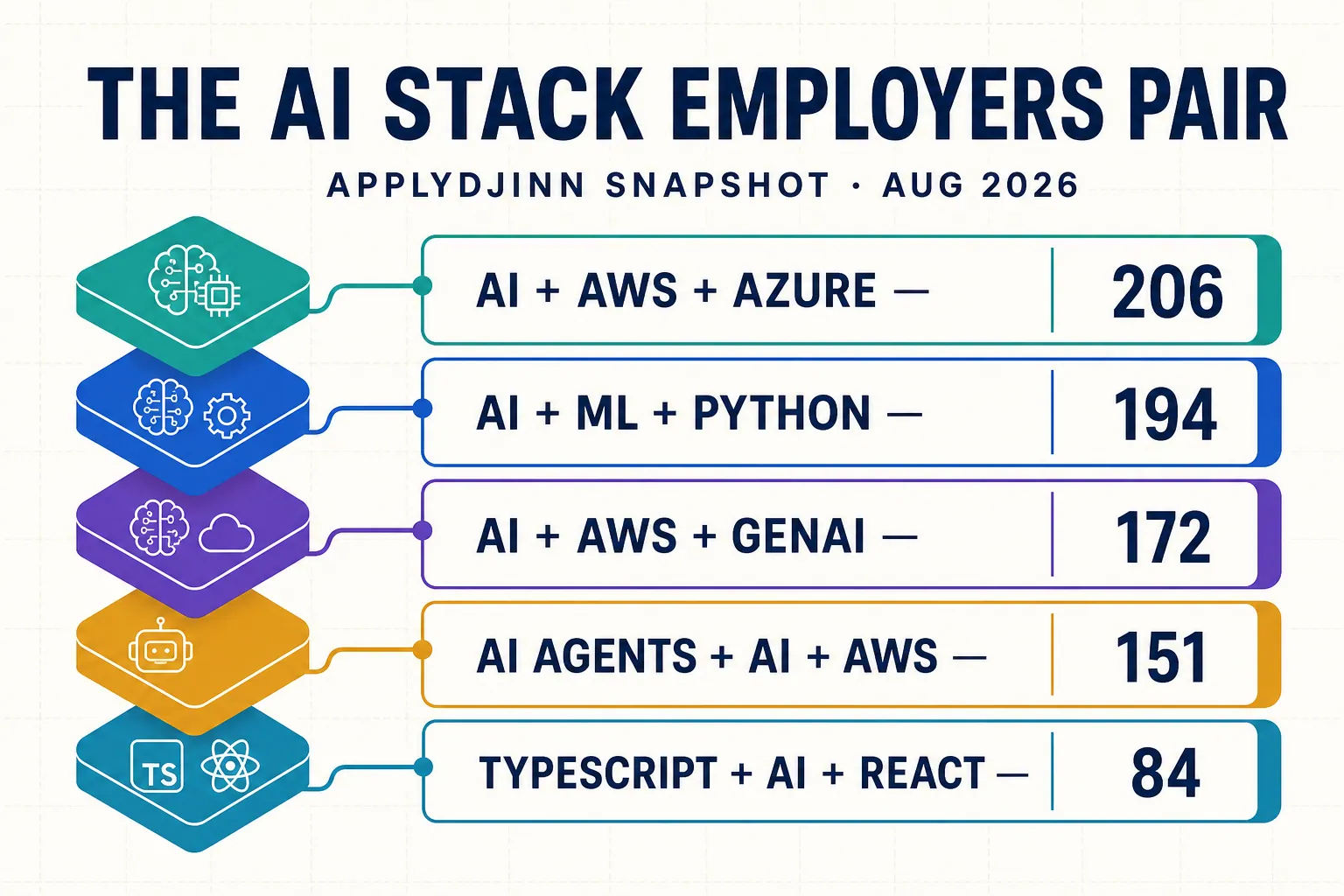
AI + AWS + Azure — 206 vacancies
The largest observed AI combination crossed two major clouds. This does not mean every individual engineer must administer both platforms. It often reflects enterprise environments where teams integrate AI capabilities into existing estates, support customers across clouds or migrate between platforms.
The career signal is broader than memorizing two consoles. Employers value the ability to discuss identity, data movement, observability, cost and deployment trade-offs across a real cloud boundary.
If you already know one cloud well, build a small comparison project on the second: the same service, equivalent security boundary, equivalent deployment and a written trade-off analysis. That is more credible than two beginner certificates with no delivered system.
AI + Machine Learning + Python — 194 vacancies
This is the clearest model-building and applied-ML foundation in the leading set. Python remains the connective language for data preparation, experimentation, evaluation and service integration.
The important word is not Python alone. It is the workflow around it:
- define the target and baseline;
- prepare representative data;
- train or configure a model;
- evaluate failure cases;
- expose the result safely;
- monitor quality after deployment.
A notebook proves exploration. An employer-ready project adds reproducibility, tests, an evaluation set and an interface another system can call.
AI + AWS + Generative AI — 172 vacancies
This pattern connects generative capability to cloud delivery. The work may include managed model access, retrieval, data permissions, inference services, monitoring and integration into an existing product.
Candidates should be ready to explain how they would prevent a prototype from becoming an uncontrolled production dependency. Useful evidence includes request tracing, cost limits, fallbacks, evaluation, caching and privacy-aware data handling.
The ApplyDjinn AI technology page shows the broader demand context; the stack view shows what tends to travel with it.
AI Agents + AI + AWS — 151 vacancies
Agent language has moved into a substantial set of current descriptions. The strongest interpretation is not “autonomous workers replace teams.” It is that employers are experimenting with multi-step systems that call tools, maintain context and complete bounded workflows.
That increases the value of engineering controls:
- explicit permissions;
- structured inputs and outputs;
- tool allowlists;
- idempotent actions;
- human approval for consequential changes;
- traces, evaluations and stop conditions.
Read the career guide on working with AI agents for a human-centered handoff model. In a technical portfolio, make the same boundaries executable.
TypeScript + AI + React — 84 vacancies
AI products still need usable interfaces. This combination is a reminder that the model is only one part of the experience. React and TypeScript connect AI output to real users, state, permissions, latency, feedback and error recovery.
Frontend evidence becomes especially valuable when it handles uncertainty honestly. Show sources, allow correction, preserve intermediate state and design for partial failure. A polished chat box that hides confidence and provenance is weaker than a modest interface with reliable interaction design.
What the movement signals add
Several leading patterns were growing in the seven-day comparison:
- AI + AWS + Azure: +34%;
- AI + Machine Learning + Python: +31%;
- AI + Python + C++: +29%;
- TypeScript + AI + React: +25%;
- AI + AWS + AI-Assisted Development: +33%.
Two visible patterns were declining in that comparison:
- AI + AWS + Generative AI: -16%;
- AI Agents + AI + LLM: -21%.
Do not convert one week of movement into a long-term forecast. A negative week does not make a skill obsolete, and a positive week does not guarantee a durable career. The useful signal is composition: cloud integration, strong languages, product delivery and reliability repeatedly sit next to AI.
Small-base signals need a separate lens
TypeScript + React + Next.js showed +900% at 39 vacancies, while Python + Kubernetes + Go showed +300% at 32. The growth rates are visually dramatic because the earlier base was small.
Treat these as emerging watchlists rather than market-wide mandates. Ask three questions:
- Is the absolute count large enough for your target geography and seniority?
- Does the combination appear across several companies or one hiring burst?
- Does it extend a foundation you already possess?
The third question prevents trend chasing. A TypeScript developer can plausibly add Next.js and an AI integration. Starting three new ecosystems at once is less likely to produce interview-ready depth.
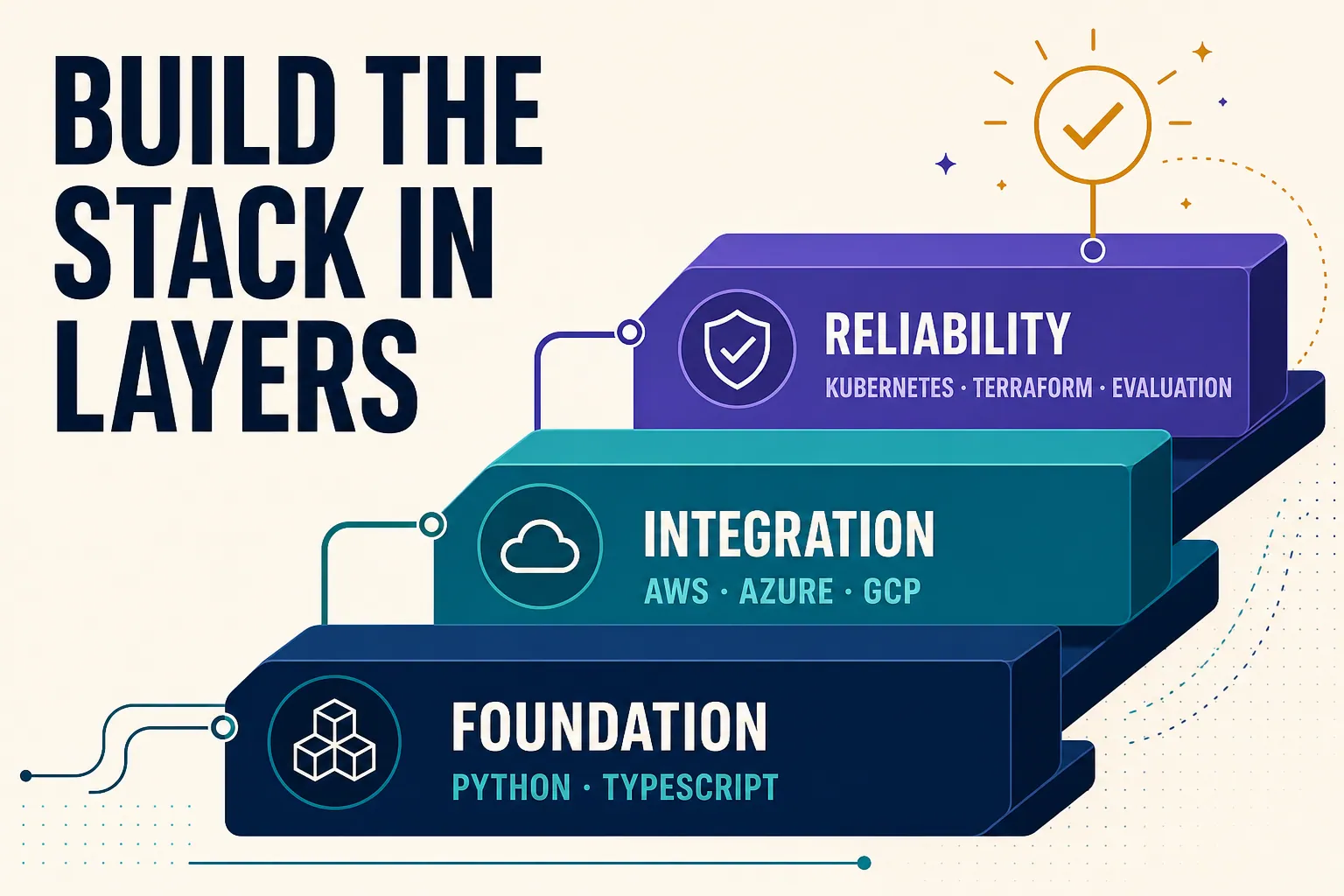
Build the stack in three layers
Foundation: one production language
Choose Python for data, ML and backend-heavy paths, or TypeScript for product, full-stack and interface-heavy paths. Some roles reward both, but one should be strong enough to debug without an assistant.
Foundation evidence includes testing, dependency management, error handling, data structures and readable code—not only framework setup.
Integration: one primary cloud plus comparison literacy
Learn identity, networking, storage, deployment, observability and cost on one cloud. Add enough comparison literacy to map the concepts to a second platform.
The multi-cloud count is a signal to understand boundaries, not a command to collect every service badge.
Reliability: evaluation and operations
Add the layer most portfolio demos omit:
- a repeatable evaluation set;
- latency and cost measurement;
- logs or traces;
- protected secrets;
- input and output validation;
- fallback behavior;
- a human escalation path.
This layer turns “I called a model API” into “I can help operate an AI feature.”
Four portfolio projects mapped to the data
Cloud-neutral document triage
Build a Python service that classifies a small public document set. Deploy it on one cloud, then document how the identity and storage design would translate to another. Include evaluation and cost per document.
Retrieval assistant with evidence
Create a bounded retrieval workflow using public sources. Show citations, abstain when evidence is missing and test ten adversarial or ambiguous questions. Link the result to RAG and evaluation rather than only to a framework name.
Agent with a safe write boundary
Build a TypeScript agent that can read task data and propose a change but requires approval before writing. Add an action log, idempotency key and failure recovery.
AI interface for correction
Use React and TypeScript to show sources, uncertainty and a correction flow. Measure whether a user can identify and fix a wrong result. This demonstrates product thinking alongside implementation.
How to tailor a résumé without keyword stuffing
Select the stack relevant to the vacancy, then connect each technology to an outcome.
Weak: “AI, AWS, Azure, Python, React, agents.”
Stronger: “Deployed a Python retrieval service on AWS, evaluated 120 question–answer pairs, added source citations and a no-answer threshold, then documented the equivalent Azure identity and storage design.”
The stronger version contains fewer claims and more evidence. Use the document studio to keep this connection visible, and use match analysis to identify whether a missing technology is core or supporting for the target role.
Questions to ask before choosing a course
- Does it end in a deployed artifact?
- Does it teach evaluation, not only prompting?
- Will you debug the language and cloud layer yourself?
- Does it include identity, privacy, cost and observability?
- Can you explain one failure and correction?
- Does the stack match current vacancies in your geography?
If the course cannot answer those questions, it may still be useful as orientation. It is not enough as career proof.
The practical takeaway
The strongest AI labor-market signal in this snapshot is connection. AI is paired with clouds, Python, machine learning, agents, React and TypeScript because employers need complete delivery systems.
Choose one language foundation. Learn one cloud deeply and another conceptually. Add evaluation and operational reliability. Build a project that exposes the boundaries, not only the happy path.
Then revisit the live stack patterns. Counts will change; a delivery method built on foundations, integration and reliability will travel much further.