Canada Tech Jobs: Compare the Work, the Location and the Level
What 343 technical listing records across 72 employers reveal about a Canadian search: software demand, remote and hybrid conditions, and why missing seniority labels matter.
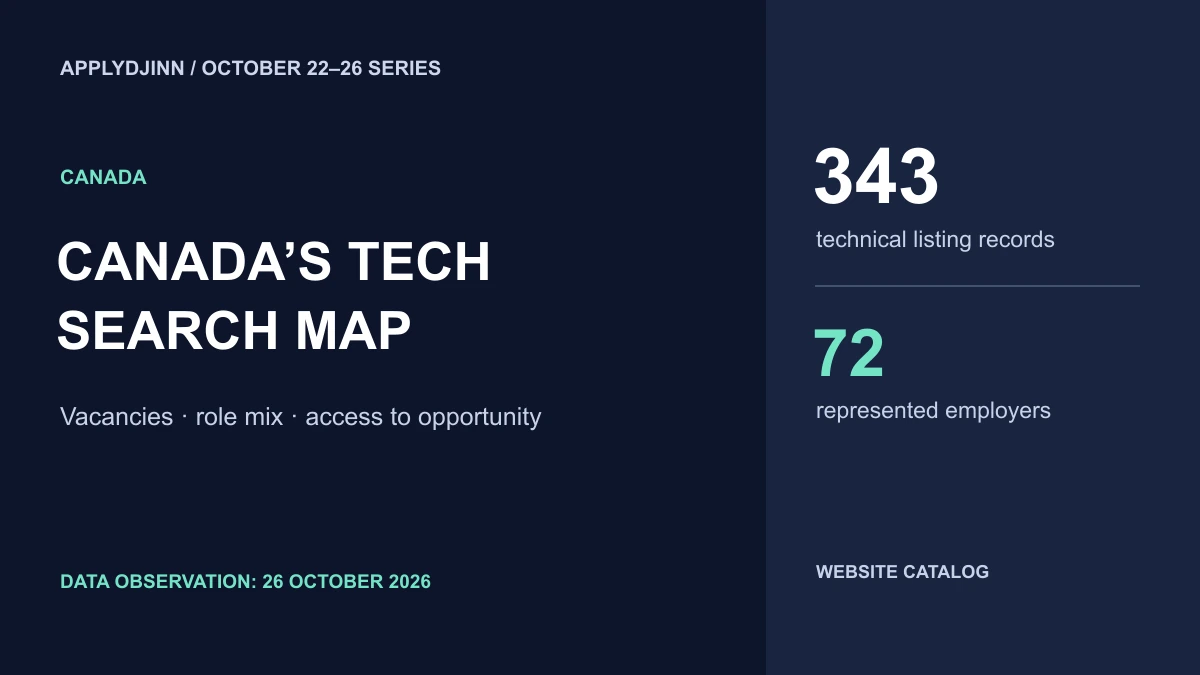
A Canadian technology job search often involves three separate questions. Is the work relevant to your experience? Can the employer hire you in the advertised location and arrangement? Does the expected level match the contribution you can demonstrate? Answering only the first question can produce a long shortlist with very few usable opportunities.
Our ApplyDjinn website observation contains 343 technical listing records associated with Canada, across 72 employers. Software engineering is the largest saved family. Remote, office and hybrid arrangements all appear, and a substantial group of records has no saved seniority label. Together, those features make a structured search more useful than a single ranking of popular titles.
Series date: October 25, 2026. Data updated October 26, 2026, at 19:08 UTC. The catalog figures are from that October 26 observation. They are not historical October 25 totals, a census of Canadian vacancies or a measure of completed hiring. Our source coverage is selective, so smaller counts should lead to closer inspection rather than a claim that a specialty has disappeared.
Read the national context at the right scale
Statistics Canada's October 9 Labour Force Survey release reported a September employment decline of 68,000 and an unemployment rate of 6.5%. Those measures concern the broader labor market and should not be treated as the unemployment rate of software engineers or as a count of technology openings. Statistics Canada September Labour Force Survey.
A vacancy catalog has a different purpose. It can show the descriptions currently represented in its sources and help an applicant find the next relevant role. It cannot establish how many people have already been hired, whether a team will expand next quarter or how many candidates are competing for one advertisement.
Keep the two views separate when planning. National statistics provide economic context. Source descriptions provide the immediate conditions of a possible application. Neither should be stretched into an unsupported prediction about your individual outcome.
The software share is substantial, but it is not the entire search
Within the 343 technical records, 205 are classified as software engineering, or 59.8%. Data and AI account for 46, product for 21, security for 20, design for 14 and cloud and infrastructure for 12. Other technical classifications make up the remainder, including technical customer work and IT and business systems.
These are saved primary-family classifications. A software role can contain extensive data work, and a product role can require analytical skills. The label is a discovery tool, rather than a complete description of the job. Read the responsibilities before deciding that an adjacent family is irrelevant.
For an engineer, the next useful split is often by the system you would work on. Compare customer product, internal tools, data infrastructure and platform responsibilities. For a product or design candidate, compare the user, business problem and technical environment. A familiar title can still describe a poor match, while an unfamiliar one can describe work you already know well.
The smaller families need particularly careful interpretation. Two quality-classified records in this observation do not establish that there are only two QA openings in Canada. Coverage, freshness and classification can all affect what is visible. A narrow sample supports a narrower conclusion: this catalog contains few records in that saved family at this time.
Work mode changes the usable shortlist
The saved work modes are 143 remote, 111 office, 64 hybrid and 25 unclassified. Remote therefore accounts for 41.7% of this technical sample. Office and hybrid together account for 175 records. All groups remain visible in the infographic, including the missing labels.
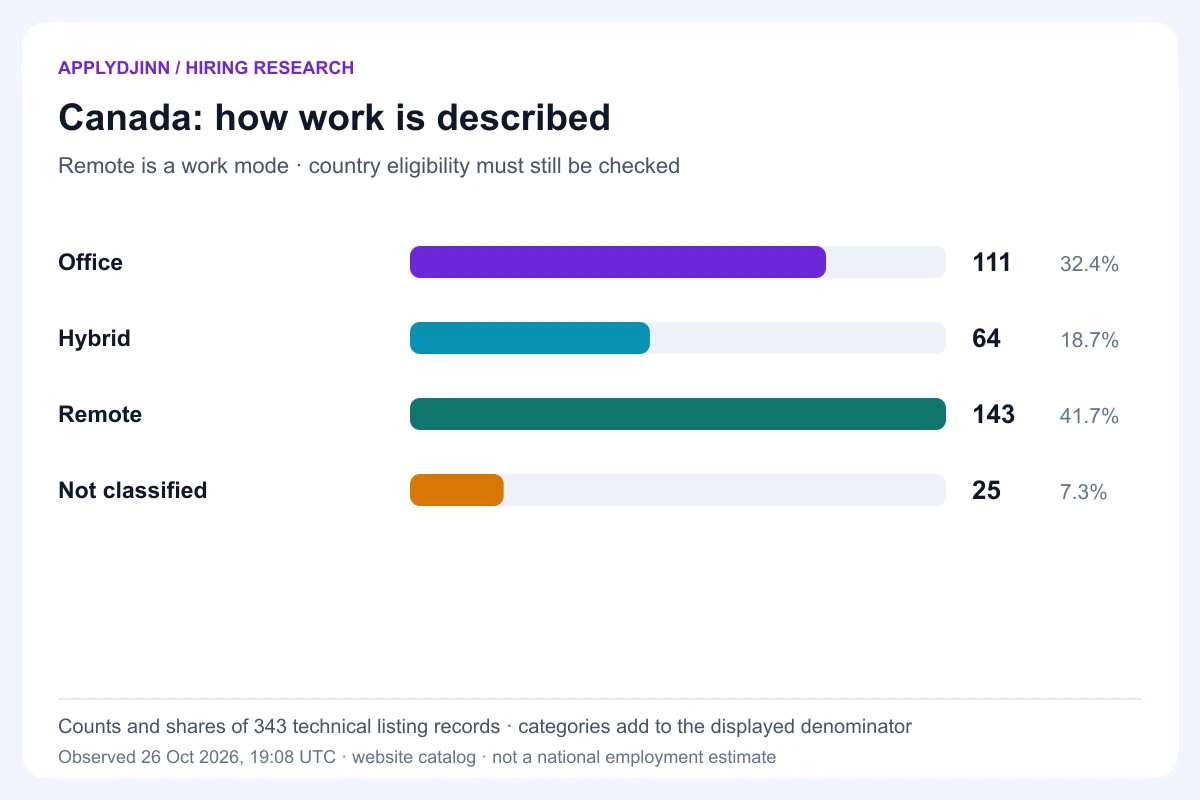
A Canada-associated remote advertisement does not automatically support working from every province or from another country. The country facet is a geographic association in the source data. It is not a legal determination of eligibility or a promise that every employment arrangement is available.
Confirm the practical conditions early. Which locations does the employer support? Are particular working hours expected? Does hybrid mean a regular office schedule, and at which site? Are occasional travel or onboarding attendance mentioned? If the source is unclear, keep the question visible rather than filling the gap with your preferred answer.
For someone who can relocate, an office role may be viable even when it falls outside the initial remote search. For someone who cannot, the same role can be a hard exclusion. A useful shortlist reflects those personal constraints before time is spent tailoring documents.
Missing level labels deserve their own column
The technical sample contains 136 senior labels and 98 unclassified levels. Staff, principal and architect together account for 59 records. Management and team-leadership labels account for 30. Intern and junior together account for 20, made up of 19 intern labels and one junior label. No record in this sample carries the saved middle label.
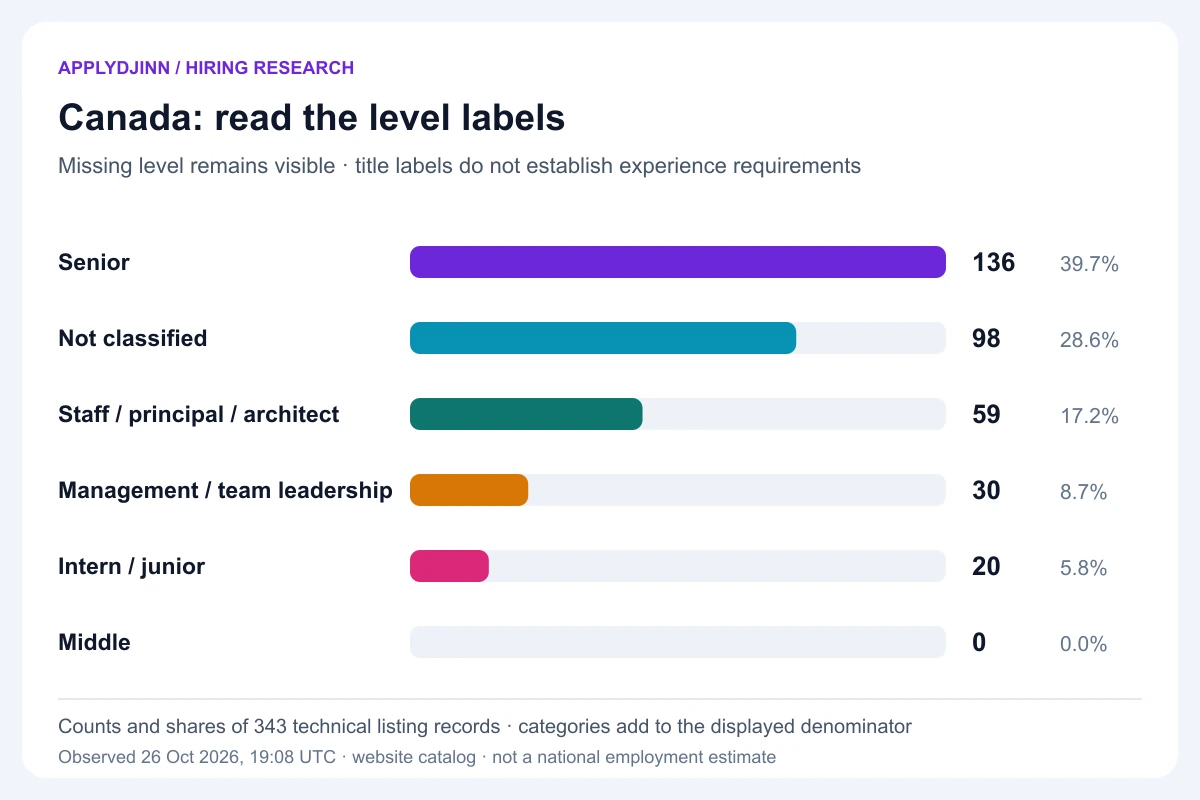
That last observation is about labeling, not the absence of intermediate work. Employers use titles differently, and an automated classification can miss a level that is described indirectly. The unclassified group is 28.6% of the sample, large enough that treating it as senior or junior would materially distort the picture.
Read the expected independence, required experience and ownership scope. A title can locate the advertisement, but those details establish whether you can make a credible application. For senior candidates, distinguish owning one service from setting direction across teams. For leadership roles, identify whether the vacancy expects people management, technical coordination or both.
Early-career applicants should inspect program conditions carefully. An internship may depend on enrollment, graduation timing, location or availability. Its presence in a catalog does not establish that every early-career candidate is eligible. Search explicitly advertised programs as one lane, while separately reading suitable responsibilities in records that lack a clear level.
A smaller employer set can still support a diverse search
There are 72 employers with technical records in the Canada observation. The largest represented technical counts include Affirm with 30, EPAM with 28, 1Password with 26, Autodesk with 23, Okta with 20 and Google with 16. These figures describe our coverage and should not be read as national employer rankings.
A company with many advertisements can offer several relevant teams, but its records can also include location variants or overlapping source representations. A company with one advertisement may offer a particularly strong match. Compare the team, responsibility and source identifier instead of assuming that every record is an independent hiring decision.
Use an employer-level view alongside the vacancy list. It can reveal when your shortlist is concentrated in one organization or one type of product. That matters because several applications at one employer can share the same recruiting process and business constraints.
A practical search can include a few employers with multiple relevant roles and a broader set with one specific match. The objective is a varied collection of credible applications, rather than a mechanically equal number of submissions to every organization.
Prepare different evidence for different contributions
For a software role, select an example that makes the system, your responsibility and the verification clear. Explain a decision and its constraints. If you improved performance or reliability, describe what was measured and under what conditions. When no reliable measurement exists, state the observable result without inventing a percentage.
For data roles, show the connection between a source, its limitations and a decision or output. For product roles, explain how you selected a problem and evaluated competing priorities. For security, describe the failure or threat and the boundary of your investigation. For design, show the user task and the evidence behind the interaction decisions.
These are suggested ways to present work, rather than requirements supposedly shared by every employer in the sample. The source description decides which example belongs in the application. A candidate should be able to explain why that example matters to the team, without reciting every technology they have encountered.
A tailored CV can preserve the same factual profile while changing emphasis. Move the relevant contribution higher, make the scope understandable and remove unrelated detail when it obscures the match. If a document is generated with AI, check each claim against your actual experience before sharing it.
Build a three-part verification note
For every serious shortlist entry, keep a compact note with three parts. The first identifies the work: what the team needs and why your example is relevant. The second records conditions: location, work mode, employment arrangement and explicit program requirements. The third lists open questions that need the source or recruiter to resolve.
This keeps a promising title from becoming an unexamined assumption. It also makes a first conversation more focused. You can ask about the uncertain condition while explaining the contribution you could make, rather than requesting a generic overview of the whole company.
Save the source link and date checked. Compare identifiers and destinations when several records look like the same underlying opportunity. Keep the source representations available for verification, but avoid counting them as several independent chances of an offer.
If the vacancy disappears or changes, update the shortlist. A catalog record is an observation at a point in time; the current source and recruiter process determine whether the opportunity remains actionable.
Use your first results to improve the next search
After a week or two, examine what happened to a small set of well-matched applications. Were the hard exclusions mostly geographic? Did the role level differ from the title? Did interview conversations reveal a gap in the evidence you presented? Separate those observations from applications that simply received no response.
Your personal results are too small and selective to estimate a national hiring rate. They can still identify a practical correction. You might need a broader employer set, a clearer description of one project or an earlier check of attendance conditions. That is a more useful next step than reacting to every broad market headline.
Keep one adjacent role lane if your experience supports it. A developer can compare platform or data responsibilities; a designer can compare product design and design systems; an analyst can inspect related product or analytics-engineering work. The adjacent lane should increase credible matches, not create a second generic application that fits nobody well.
Sources and scope
The figures use one read-only ApplyDjinn website observation from October 26 at 19:08 UTC. Records are active, catalog eligible, associated with an explicit Canada country facet and within a 30-day freshness window using the first available source-publication, first-seen or creation date. Pinned records would be exceptions, but none occurred. Restricted syndicated records also need a valid visibility lease.
Technical status, role family, seniority and work mode are saved automated classifications. Each catalog ID is counted once within Canada. Location variants and source representations can still correspond to one requisition. Counts do not establish funded seats, applicant volume or hires. Thirty technical records lacked a source publication date, so their observation-date fallback matters when reading freshness.
The linked Statistics Canada release supplies separate national context. Website coverage can exceed the mobile subset. Browse the vacancy catalog, review the original conditions and use the four-market comparison to separate a larger result count from a genuinely accessible alternative.