Four Tech Job Markets: Compare Opportunity, Employer Breadth and Access
Compare the US, Israel, Ukraine and Canada using one ApplyDjinn observation: technical role counts, represented employers, work modes and a practical way to choose your search lanes.
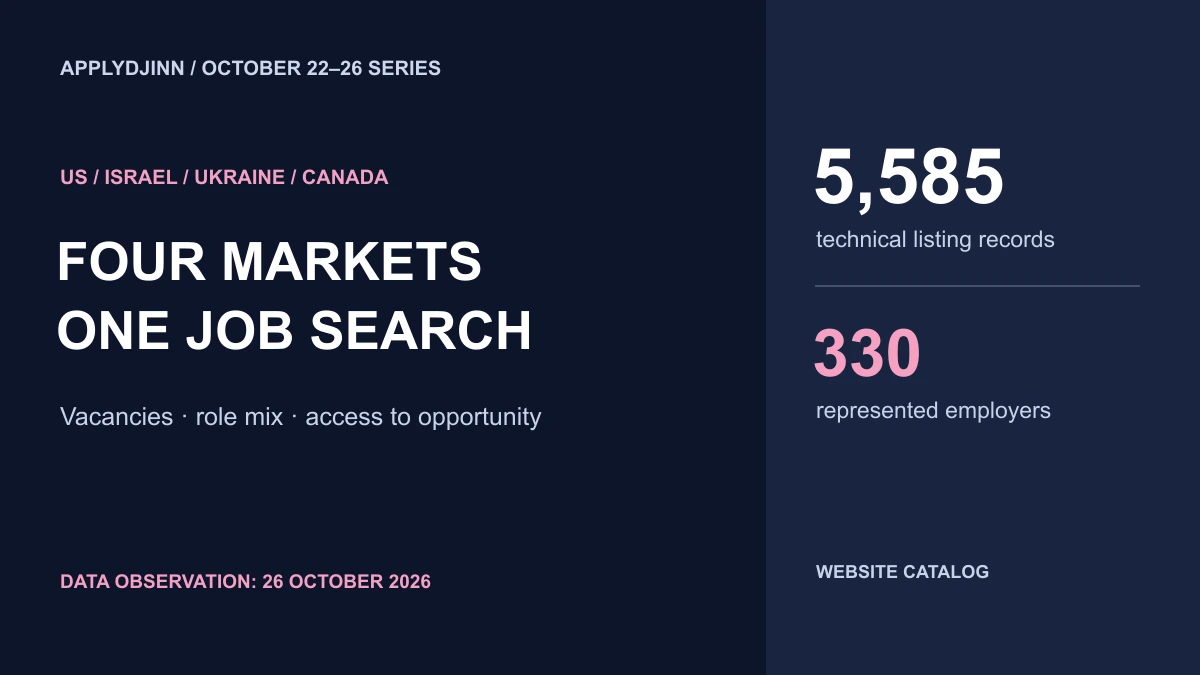
The country with the largest vacancy count is not automatically the best place for your next application. A role can look technically ideal while requiring an unsupported location, an impractical office schedule or a level of ownership you cannot yet demonstrate. A useful comparison should show the available search surface and the conditions that determine access to it.
This article compares the United States, Israel, Ukraine and Canada using one ApplyDjinn website observation. Across those four country panels, the union contains 5,585 distinct technical catalog records at 330 employers. The country panels differ in role mix, employer coverage and saved work modes. Those differences can help organize a search, provided we keep the units and limitations visible.
Series date and observation date: October 26, 2026. Snapshot time: 19:08 UTC. The four country articles in this October 22–26 series use this same observation, clearly marked as a later data update where necessary. We do not infer a five-day hiring trend from five editorial dates.
Start with the unit behind the number
A catalog record is a saved representation of an advertisement. It is not necessarily a unique requisition, and it is not a count of people an employer will hire. One underlying opportunity can have several locations or source representations. Conversely, one advertisement can sometimes describe more than one seat, which our record count cannot establish.
Official labor statistics also distinguish units carefully. For example, BLS JOLTS definitions separate openings at a reference point from additions to payroll during a month. Our catalog observation does not meet all the survey's conditions or reproduce its population, so it should not be substituted for those measures. BLS JOLTS definitions.
For a job seeker, the catalog remains useful as a discovery tool. It can show which employers and responsibilities to investigate. The next step is to verify the current source and the candidate-specific conditions. That is a practical use of the evidence without turning advertisements into a forecast of employment growth or personal offer probability.
Compare employer breadth alongside record volume
The United States panel contains 3,638 technical records across 204 employers. Israel has 770 across 127, Ukraine 923 across 81, and Canada 343 across 72. All four panels use the same active, eligible, 30-day selection and saved technical-role classification.
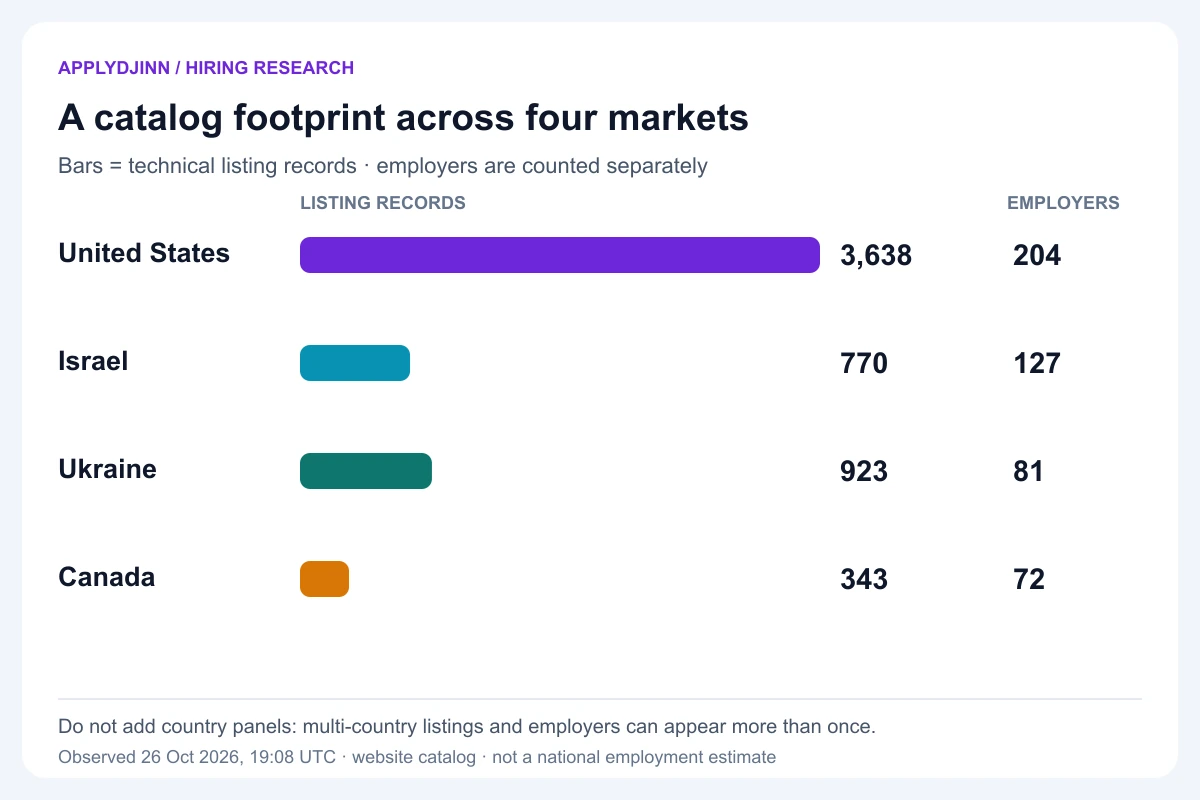
These are coverage measures, not national market sizes. The US panel's larger result count does not establish that it has proportionately more accessible opportunities for you. The source set, represented employers, freshness and classification affect each panel. Missing country associations can also leave some genuinely relevant advertisements outside this comparison.
Record volume and employer breadth answer different planning questions. Many records can offer several choices within a few organizations. More distinct employers can expose a candidate to different recruiting processes and business contexts. Neither is sufficient on its own: a broad employer set with no suitable responsibilities is no more useful than a large list of ineligible roles.
The country totals overlap. Their sum is 5,674 technical country-record memberships, while the union contains 5,585 distinct catalog IDs. A record associated with more than one selected country appears in several panels and once in the union. Employers can also appear in several countries, so summing the employer columns would not produce a distinct-employer total.
Work mode changes the comparison
Remote labeling varies considerably in this sample. It appears on 529 US technical records, 19 Israel records, 638 Ukraine records and 143 Canada records. Against each panel's own denominator, the shares are 14.5%, 2.5%, 69.1% and 41.7%, respectively. The second infographic retains office, hybrid and unclassified labels as well.
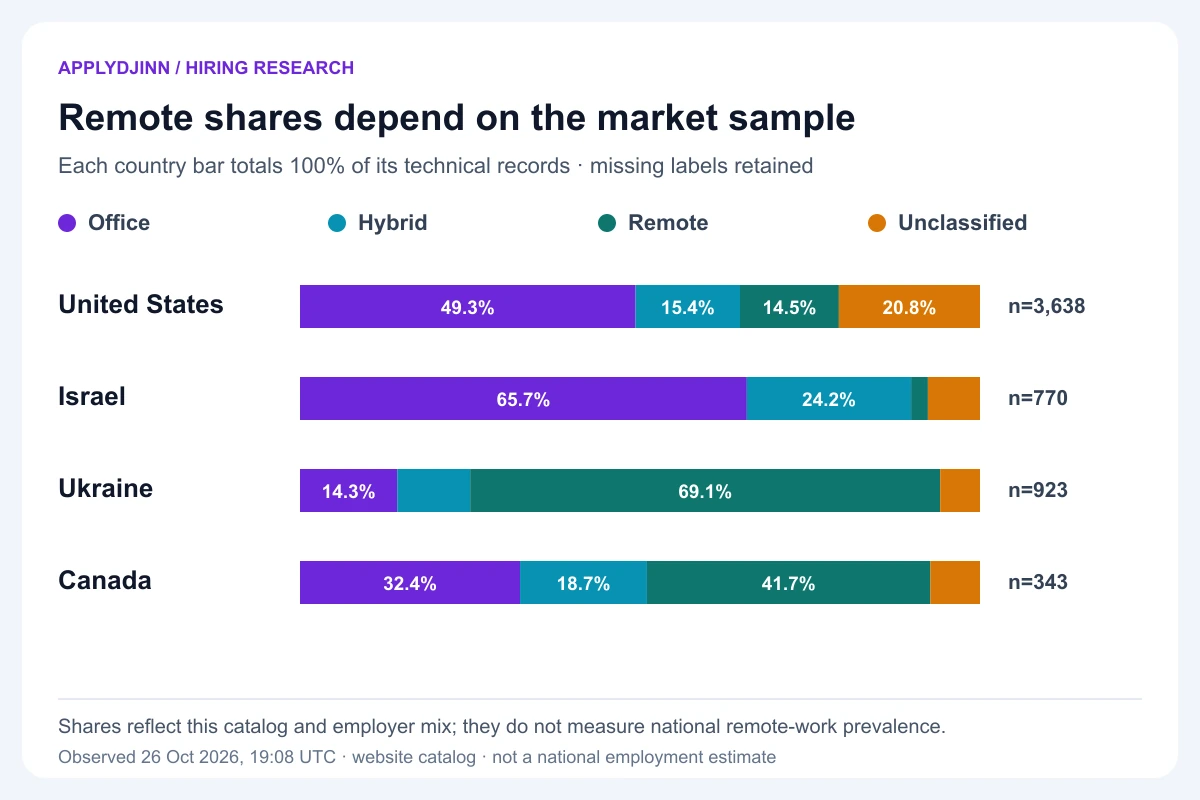
Those figures describe the employer and role mix represented here. They do not establish national remote-work prevalence or prove that one country's employers are more flexible in every occupation. Hardware-heavy coverage, a particular service provider or missing work-mode information can change the comparison.
The unclassified groups matter: 755 records in the United States, 59 in Israel, 54 in Ukraine and 25 in Canada. They remain part of the denominator. Removing them without explanation would increase the apparent shares of the known modes and hide the uncertainty a candidate actually encounters.
A remote label is also not permission to work from anywhere. Country support, hours, employment arrangement and occasional attendance still need source-level verification. The larger remote panel becomes relevant only after those conditions are compatible with your situation.
Geography should be a filter on access, not a company stereotype
An employer's nationality does not determine every location in which it recruits. A multinational can advertise in several countries, and a locally headquartered company can hire elsewhere. This comparison uses explicit normalized country associations in the vacancy data, rather than assigning all a company's jobs to its headquarters.
That distinction matters when you follow an employer across markets. A similar title in two countries can have different team responsibilities, compensation structures, scheduling and eligibility conditions. Compare the descriptions and application destinations. Do not assume that a recruiter can simply transfer an application between them.
Worldwide or remote-only text is not treated as an automatic match to all four countries in this analysis. That conservative choice prevents us from claiming country access that the geographic data does not establish. It also means the panels can omit remote opportunities that deserve manual investigation.
For your own search, maintain a clear list of locations and arrangements you can consider. Apply it before investing in a tailored document. If a condition is uncertain, mark it as a question rather than counting the role as either definitely accessible or definitely impossible.
Role mix gives the next layer of detail
Software engineering is the largest technical family in all four country panels, but its share differs. It accounts for 1,643 of 3,638 US records, 300 of 770 Israel records, 427 of 923 Ukraine records and 205 of 343 Canada records. That is a description of saved classifications within our sample, not a statement about each country's full occupational structure.
Other families can create more specific search lanes. Israel's panel contains 90 hardware and manufacturing records and 74 security records. Ukraine's includes 95 cloud and infrastructure and 86 quality records. The US panel includes 344 product and 213 design records. Canada's includes 46 data and AI records alongside its larger software group.
Those observations help decide where to read next. They do not justify declaring a specialty absent where our count is small. Classifications can be imperfect, and relevant responsibilities can sit inside another primary family. A quality engineer should still read appropriate software descriptions; a product analyst may find relevant work in both product and data families.
Choose an adjacent lane when your evidence supports it. Shared tools can help locate an advertisement, but the actual contribution and expected scope should determine the application.
Seniority is partly an information problem
A cross-country title comparison can create false precision. Our saved seniority labels include substantial unclassified groups: 1,242 technical records in the United States, 264 in Israel, 175 in Ukraine and 98 in Canada. Treating those records as junior, senior or unavailable would change the apparent market without adding evidence.
Read ownership and requirements at the source. An employer may describe an intermediate scope without using the word middle, or advertise a role with a title that means something different elsewhere. The number of years requested is another clue, but it should be read alongside the expected work and any explicitly required qualifications.
For early-career candidates, separate internships, graduate programs and ordinary vacancies. They can have different enrollment and timing conditions. For experienced candidates, distinguish individual technical ownership from coordination and people management. A more precise view of scope helps choose both the shortlist and the example you present in an interview.
The comparison should help you ask better questions. It should not assign you a universal level based on the title you currently hold.
Build two search lanes you can actually use
A practical starting point is one primary lane and one adjacent lane. The primary lane combines your strongest contribution with an accessible geography and arrangement. The adjacent lane changes one meaningful dimension, such as a related role family or another country where you already meet the stated conditions.
For each lane, collect several employers rather than many near-identical records from one organization. Write down the responsibility, relevant evidence and unresolved condition for each serious candidate. This turns a vacancy list into a set of decisions that can be checked.
For example, an experienced backend engineer might compare product backend work with platform responsibilities in locations they can use. A QA engineer might examine both quality and software-in-test descriptions. A designer might compare product design with design-system work. These are proposed search strategies, not claims that every represented employer offers those exact transitions.
Do not broaden all dimensions simultaneously. Changing country, specialty, seniority and employment arrangement at once makes it hard to understand why an application is or is not a fit. A controlled adjacent lane creates clearer feedback and more specific preparation.
Tailor the document after verifying the opportunity
Once the hard conditions are compatible, select the project or experience that best supports the work. Keep the factual profile stable while changing emphasis. Describe your contribution, the constraint and the result you can actually substantiate. Use the employer's terminology where it accurately describes that experience.
A vacancy-specific CV should make relevant evidence easier to find. It should not add a technology, responsibility or employment period that you cannot explain. If an AI tool helps organize the document, review every claim and verify that the final version still matches the source opportunity.
Keep the original link, the date checked and a note about the team. Where several records appear to describe the same requisition, compare employer identity, source identifiers, locations and application destinations. Retain useful corroborating links while avoiding the assumption that duplicate representations are independent opportunities.
This process is deliberately smaller than indiscriminate mass application. Its value is the quality of the next decision: whether to apply, ask a question, prepare an example or move on.
Measure your search separately from the market
Review the two lanes after a reasonable period of actual applications. Record which opportunities were excluded by conditions, which generated a conversation and which exposed a mismatch in evidence or level. Keep silence from an employer separate from a known reason for rejection.
A personal application log is too small and selective to estimate a country's hiring rate. It can still reveal a practical problem. You may need to check geography earlier, diversify the employer set, explain one project more clearly or close a recurring skills gap with a bounded exercise.
For future catalog comparisons, preserve the same definitions and record source coverage changes. Adding a feed, refreshing a large employer or merging duplicate records can change counts without a corresponding change in real hiring. A genuine trend analysis needs comparable observations over time, not a line drawn between editorial publication dates.
That distinction lets the catalog support both immediate job discovery and more careful market research. The current snapshot helps you choose where to look; a consistent series of observations can later help explain what changed.
Sources and scope
The original infographics use a single read-only ApplyDjinn website snapshot from October 26, 2026, at 19:08 UTC. Records must be active and catalog eligible, have an explicit US, Israel, Ukraine or Canada country facet, and meet a 30-day freshness window using the first non-null source-publication, first-seen or creation date. Pinned records would be exceptions, but none occurred. Restricted syndicated records need a valid visibility lease.
Technical status and the displayed categories are saved automated classifications. Country panels overlap; the union counts each catalog ID once. Location variants and multiple source representations can still refer to one underlying requisition. No applicant, private-profile or payment data is used. Website visibility can exceed the mobile subset.
For country detail, read the US role-mix analysis, Israel hiring analysis, Ukraine delivery-role analysis and Canada search analysis. Then open the vacancy catalog and verify the current source conditions before applying.