Ukraine Tech Jobs: Reading Demand for Software, QA, Cloud and Data
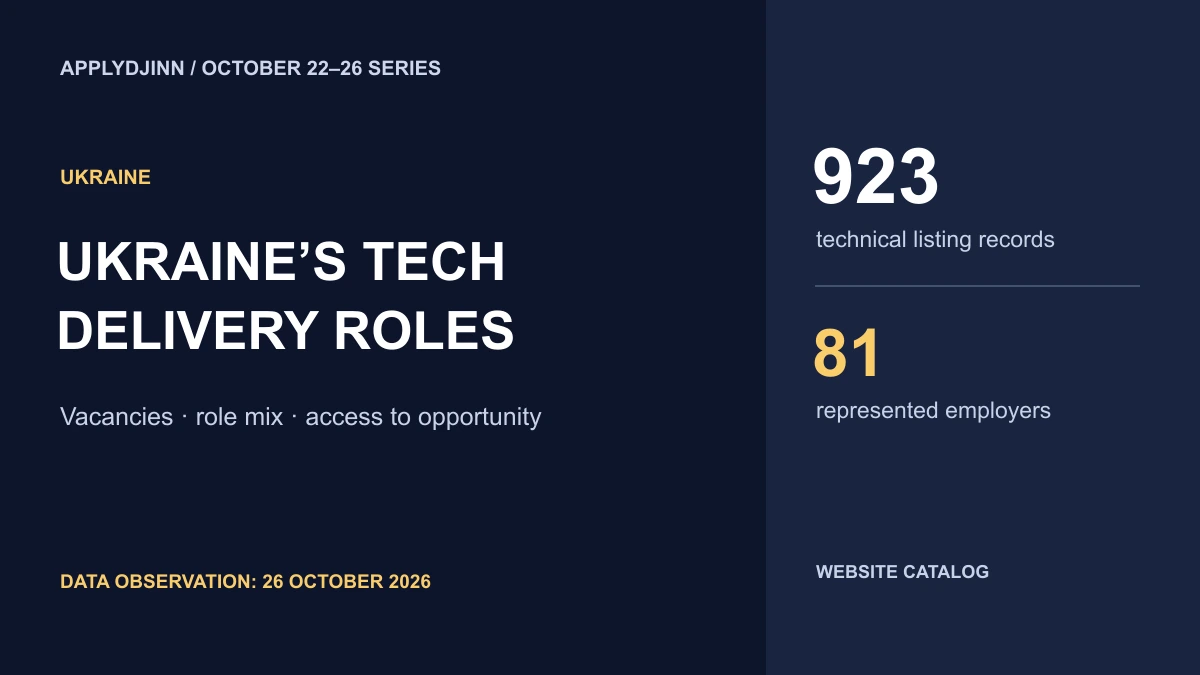
A snapshot of 923 technical listing records across 81 employers reveals a broad delivery mix, substantial remote labeling and important limits to what job counts can tell us.
A useful view of Ukraine's technology job market should make room for the whole delivery team. Programming is central, but a software product also needs data work, quality, infrastructure, design and coordination with the business. Candidates can miss appropriate vacancies when they search only for one language or one familiar job title.
ApplyDjinn's current website observation contains 923 technical listing records associated with Ukraine, across 81 employers. Software engineering is the largest family. Data and AI, cloud and infrastructure, quality and design form visible parts of the same sample. Remote labeling is common, but it still needs to be read alongside the actual hiring geography and source conditions.
Series date: October 24, 2026. Data updated October 26, 2026, at 19:08 UTC. All catalog figures below use that October 26 observation. They are not a reconstruction of October 24, a census of Ukrainian technology vacancies or a measure of completed hiring.
International demand provides context, not an application forecast
Ukraine's Entrepreneurship and Export Promotion Office reported computer-services exports of $3.34 billion in the first half of 2026, with the United States accounting for 36.9%. Its August 14 report identifies National Bank of Ukraine data as the source for services and marks April–June services data as preliminary. These are trade measures, rather than vacancy or employment counts. Official first-half export analysis.
That context helps explain why international clients belong in a discussion of the sector. It does not tell us which company has an approved position, how many applications it receives or whether a particular project is hiring. A rise in export revenue cannot be translated directly into a rise in job openings: revenue, pricing, staffing and delivery models are different variables.
For the job seeker, the actionable evidence remains the description of the work, the employing organization and the arrangement offered to the candidate. Read the vacancy as a set of conditions and responsibilities. Use broader economic information to frame questions, rather than treating it as a prediction that your next application will succeed.
The delivery mix extends beyond programming
The sample includes 427 software engineering records, 140 data and AI, 95 cloud and infrastructure, 86 quality, 51 design and 35 IT and business systems. The remaining 89 fall in other technical families. Software engineering represents 46.3% of the technical sample; cloud and quality together account for 181 records.
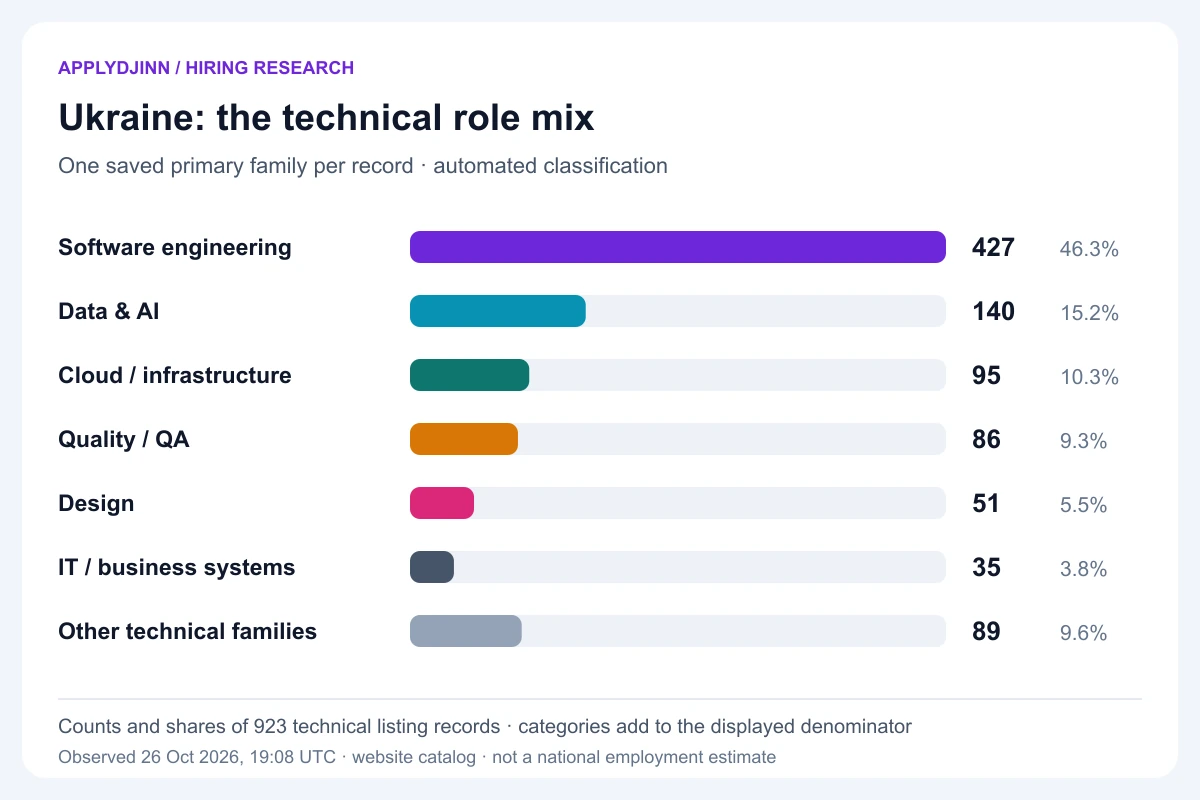
The chart uses one saved primary family per catalog record. It should not be read as a rigid boundary between skills. Quality engineering can involve substantial programming. Infrastructure work can require deep application knowledge. Design and product work can include analysis and experimentation. The family label organizes discovery; it does not describe every responsibility.
For an applicant, this is a reason to search for a contribution as well as a title. Someone who has automated release checks can examine relevant quality and infrastructure roles. A developer who has built reliable ingestion pipelines can inspect data-engineering responsibilities. A designer with experience simplifying complex internal tools may find a better match in an enterprise product than in an advertisement with a more familiar industry label.
The adjacent search should remain evidence based. Identify what transfers from your experience and what does not. Avoid treating the presence of a shared tool as proof that two roles require the same work.
QA is a distinct search lane
The 86 quality-family records are worth examining separately from a broad software query. The family can help a candidate discover advertisements where testing, validation or quality ownership is central. It cannot tell us, without reading the descriptions, which records emphasize manual exploration, automation, performance or another specialty.
Build an application around the most relevant quality problem you have handled. Explain what could fail, why it mattered and how your approach helped expose or prevent it. A useful example might describe an unreliable integration, a critical user journey or a release check that repeatedly missed an important case. Describe the actual evidence, rather than claiming that a larger test count automatically improved the product.
If you are moving from manual testing toward automation, separate existing experience from work you are learning. A small, reproducible project can show how you design checks and investigate failures. Label it as a personal exercise if that is what it is. The credibility comes from the reasoning and the artifact, not from presenting it as production employment.
For experienced quality engineers, show how you choose what to test and what uncertainty remains. That makes the conversation about risk and product behavior, rather than only a list of frameworks.
Cloud and data searches benefit from a concrete operating context
Cloud and infrastructure account for 95 records, and data and AI for 140. Those broad families contain different tasks, so they should lead to further reading rather than one generic cloud-and-AI CV. A role focused on operating a platform can demand different evidence from one focused on analyzing data or developing a model.
For infrastructure work, describe the service or environment you supported, the constraints and the verification behind a change. Explain how someone could detect a failed deployment or recover from it. For data work, make the source, transformation and validation understandable. If a project involved AI, distinguish using a model from building data pipelines, evaluating behavior or operating a production feature.
Choose the example after reading the advertisement. If the role emphasizes customer-facing analysis, a complex infrastructure demonstration may be less useful than a clear explanation of an analytical decision. If it emphasizes reliability, the ability to discuss failure and recovery can matter more than a long list of providers.
These are preparation suggestions based on the kinds of contribution those families describe. The aggregate counts do not prove that every represented employer asks for the same portfolio or interview format.
Remote work is common in this sample, with conditions attached
Of the 923 technical records, 638 are labeled remote, 132 office, 99 hybrid and 54 unclassified. Remote therefore accounts for 69.1% of this catalog sample. The chart preserves the unclassified group rather than assuming that every missing label means remote or office.
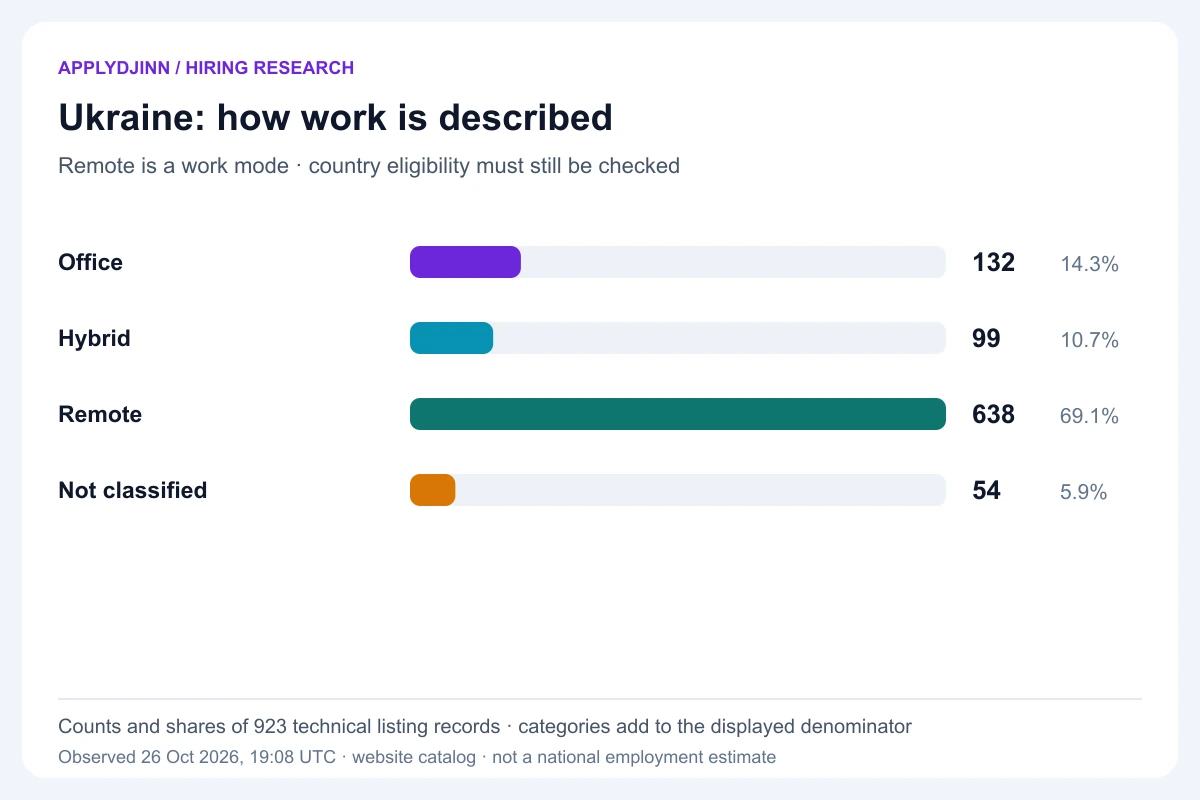
The geographic association is important. These records have an explicit normalized Ukraine country facet. A remote label does not establish that an applicant can work from any other country, use any employment arrangement or choose any time zone. Confirm the location and scheduling expectations from the source or recruiter.
For international delivery work, ask which hours need to overlap and which responsibilities require synchronous contact. If equipment, security requirements or occasional attendance are mentioned, clarify them early. A job that is technically remote can still be impractical for a particular candidate's location or availability.
Keep the distinction between a remote-work condition and a personal assumption. A missing detail belongs in a verification question. It should not silently become a promise that the employer can support your preferred arrangement.
Seniority labels show one obstacle, not the whole opportunity set
The technical sample contains 522 senior-labeled records, 84 middle, 29 junior and 13 intern. Another 175 have no saved level. Other records carry leadership, architect or principal labels. Senior-labeled work is prominent in this observation, but the counts do not establish an acceptance rate for candidates at any level.
A junior applicant should not treat every unclassified record as an entry-level opportunity. Read the actual required experience and expected independence. Equally, searching only for the word junior can hide advertisements that use another title while describing a suitable scope. Program conditions, language expectations and the nature of the work all need individual checks.
Experienced candidates can improve their shortlist by comparing ownership. Does the employer need someone to deliver within an established system, lead a team through a difficult integration or define an approach for a new product? Use an example that matches the scope instead of adding senior adjectives to every CV bullet.
A title can begin the search. The responsibilities and conditions should determine whether the application is worth preparing.
Employer concentration requires deliberate diversification
EPAM accounts for 401 technical records in the Ukraine sample, or 43.4%. Other represented employers include N-iX with 57, GlobalLogic with 38, Sigma Software and SoftServe with 26 each, and Ciklum with 25. Those counts reflect our observed coverage and can be affected by source availability and location variants.
Do not read them as national market shares or as a ranking of employers' quality. A company with fewer catalog records may have the most relevant opportunity for your specialty. A company with many records may advertise similar work across several locations or teams.
For application planning, maintain a list of distinct employers as well as individual advertisements. Compare source identifiers and destination links when two records look similar. Keep one coherent note per underlying opportunity where you can establish that relationship. Multiple views of the same requisition can help confirm details, but they do not create additional independent hiring decisions.
Diversification is also practical. Several suitable applications within one employer can make sense, but a search concentrated entirely there shares the same organizational risks. A broader employer set can expose you to different products, client arrangements and technical scopes.
Turn the snapshot into a manageable search routine
Choose one primary family and one genuinely adjacent family. Define the conditions that make an opportunity usable: country, attendance, hours, arrangement and any explicit eligibility requirement. Then read a small, diverse set of source descriptions before tailoring documents.
For each shortlist entry, write three sentences: the work the employer needs, the evidence you can offer and the uncertainty you need resolved. This is enough to distinguish a serious match from a role saved only because the title looked familiar. Use that note to select a relevant project and to prepare a concise introduction.
Review the search weekly. Track whether the obstacle was eligibility, a mismatch in responsibilities, a missing example or simply no reply. Avoid turning a small personal sample into a universal claim about the market. Its purpose is to improve your next decision: adjust the employer set, improve a demonstration or ask a clearer screening question.
Keep learning attached to real gaps. If several relevant descriptions expose the same missing capability, choose a bounded exercise that demonstrates it. A finished example with clear limits is easier to evaluate than a large, unfinished portfolio assembled from unrelated trends.
Sources and scope
The charts are original ApplyDjinn figures from a read-only website observation at October 26, 19:08 UTC. We include active, catalog-eligible records with an explicit Ukraine country facet and a first available source-publication, first-seen or creation date within the preceding 30 days. Pinned records would be exceptions; none occurred. Restricted syndicated records require a valid visibility lease.
Technical status, family, seniority and work mode are automated saved classifications. We count each catalog ID once within Ukraine. Different locations or source representations can still refer to one requisition, and the totals do not measure funded positions, applications or hires. In 305 technical records, a source publication date was unavailable, so the fallback observation date matters when reading freshness.
The official export report supplies separate economic context. It is not used to calculate vacancy counts. Website coverage can exceed mobile-app coverage. Explore the vacancy catalog and compare the four-market analysis while checking the source conditions for each shortlisted role.