Israel Tech Hiring: Security, Hardware and Product Alongside Software
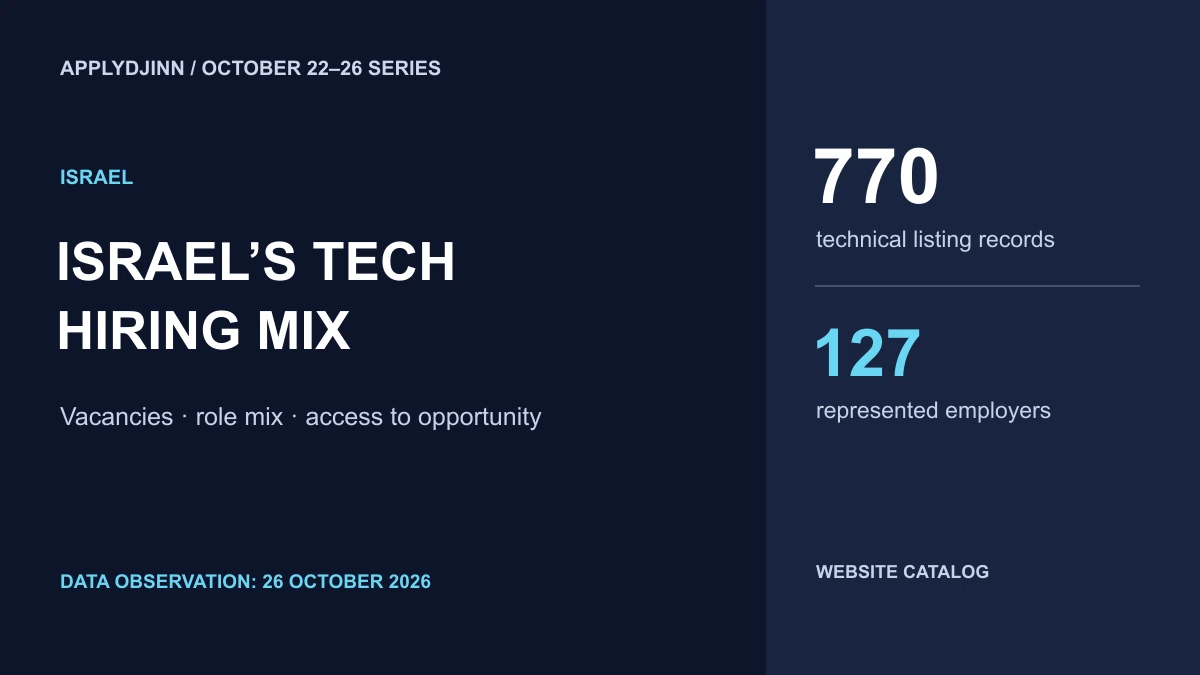
Across 770 technical listing records at 127 employers, Israel's ApplyDjinn sample shows several hiring paths and a strong need to verify role level and attendance.
Israel's technology job market is easier to navigate when it is divided into the work employers need done. Software, security, hardware, product and quality roles can appear in the same company directory, but they lead to different teams, different evidence requirements and different working arrangements. A single search for a fashionable technology can hide that structure.
Our current ApplyDjinn website observation contains 770 technical listing records associated with Israel, across 127 employers. Software engineering accounts for 300 records. Hardware and manufacturing, security, data and AI, product, infrastructure, design and quality supply additional search routes. This is a map of the opportunities represented in our catalog, rather than a complete measurement of Israel's labor market.
Series date: October 23, 2026. Data updated October 26, 2026, at 19:08 UTC. The charts use that October 26 observation throughout. They do not claim to reconstruct the catalog on October 23, and an advertisement is not proof of a funded seat or a completed hire.
A changing mix can coexist with an active hiring process
An Israel Innovation Authority and Zviran survey released August 11 covered 210 high-tech companies with more than 50 employees, employing approximately 130,000 people. It reported different first-half layoff rates for software and hardware companies, while recruitment continued. Its population and employer survey measures differ from our advertisement sample, and the authority explicitly notes that startup trends may differ. Innovation Authority employer survey.
For a job seeker, that context is a reason to inspect the composition of demand. A layoff announcement at one company and an opening at another can both be real. Neither tells you enough about the precise responsibilities, seniority or attendance conditions of the role you are considering.
Use employer news as a prompt for questions rather than an automatic ranking. Is the advertised team connected to an existing product? Is the position a replacement or part of an expansion? Which tasks would the new person own? Those questions can make a recruiter conversation more productive without pretending that the vacancy feed reveals confidential staffing plans.
Software is the largest family, with several meaningful alternatives
The 770-record technical sample includes 300 software engineering records, 90 hardware and manufacturing, 74 security, 71 data and AI, 69 product and 40 quality. Another 126 belong to other technical families, including infrastructure and design. Software represents 39.0% of this sample, leaving a substantial portion of the search surface outside that primary label.
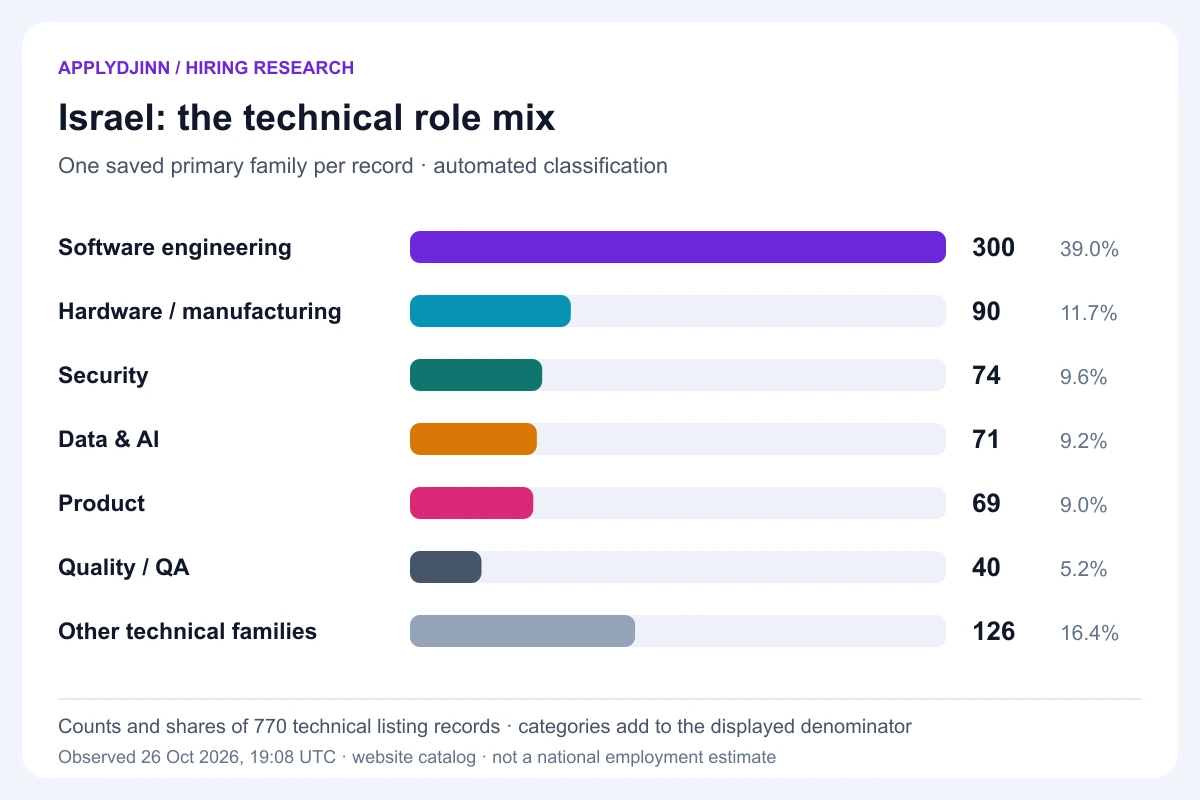
The chart assigns one primary family to each record. Responsibilities can span families: a security engineer may write production software, a hardware validation engineer may build automation, and a product manager may work closely with analysts. Saved classifications simplify discovery; they do not replace reading the original description.
This mix offers a useful way to broaden a search without abandoning a specialty. A developer with systems experience can examine infrastructure and security roles where that experience is relevant. A QA engineer with strong automation work can inspect validation and reliability responsibilities. A product designer can distinguish interaction design from research, design systems and work on technically complex enterprise products.
The key is to carry evidence across an adjacent boundary. A familiar tool name is a starting point, but the stronger match comes from the problem you have solved, the constraints you understand and the decisions you can explain.
Security opportunities ask for a problem, not just a product name
Security accounts for 74 records in the saved primary-family classification. That number does not tell us whether every role is detection engineering, application security, research or another specialty. It does tell us to open the family and separate those responsibilities before preparing the same application for all of them.
A candidate moving from software into application security might show a concrete investigation: a trust boundary, a reproducible failure, a remediation and a check that the relevant behavior changed. Someone interested in detection work might explain data quality, an investigation workflow and the trade-off between useful alerts and noise. These are examples of evidence to select where relevant, not claims extracted from all 74 advertisements.
Palo Alto Networks appears in the Israel sample with 50 technical records, alongside employers such as Check Point Software Technologies. Those counts are catalog observations and can include different locations or underlying requisition representations. They are not promises that each advertisement corresponds to an independent opening.
Within one employer, inspect the team and specialty. Several advertisements bearing a cybersecurity company's name can require very different work. The company category should help you find the page; the vacancy responsibilities should decide whether you apply.
Hardware expands the search beyond a software-only vocabulary
The 90 hardware and manufacturing records are another reason to search by function. They can be relevant to candidates whose experience includes systems, validation, low-level software or the relationship between a physical device and its supporting software. A broad family count cannot establish the exact qualifications required for any one of those roles.
NVIDIA has 118 technical records in the Israel observation, Mobileye 46 and Applied Materials 25. These are represented employers with varied technical work, not a complete ranking of Israel's hardware labor market. Our coverage, source freshness and classification influence the ordering.
For a hardware-adjacent application, describe the environment accurately. Separate simulation from physical testing, your own contribution from a team's result and a prototype from a production release. Explain what you measured, what failed and how you investigated it. If your work was academic or personal, state that clearly; its relevance comes from the reasoning and evidence, rather than an inflated employment claim.
Attendance can also become central. A role involving physical equipment may have different practical constraints from a distributed software role. Confirm the actual arrangement instead of assuming it from the company sector.
Read seniority as a set of clues
There are 285 senior-labeled records and 264 with no saved level in the technical sample. Staff, principal and architect labels together account for 60. Management and team-leadership labels account for 127; intern and junior together for 25; and middle for nine. The grouping in the infographic keeps all 770 records visible, including missing labels.
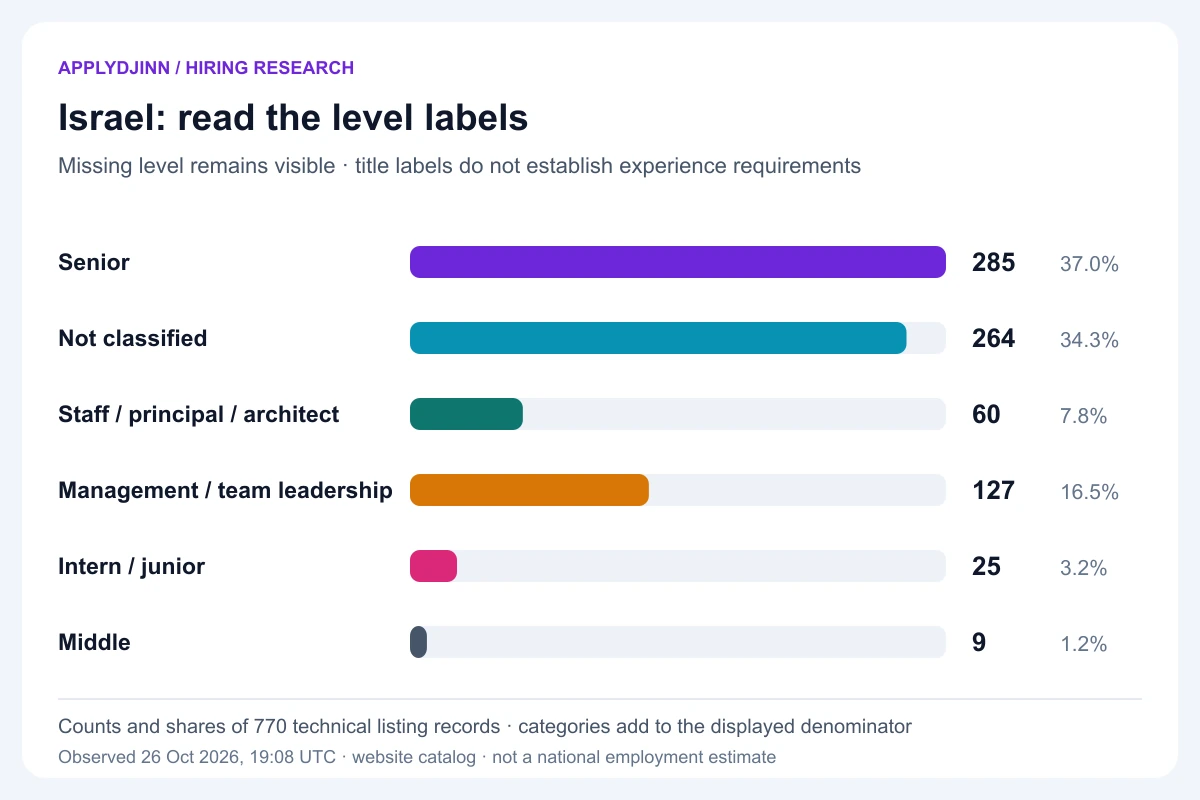
An unclassified level is an uncertainty, not an entry-level category. Conversely, an advertisement can contain responsibilities suitable for a less experienced candidate without carrying the word junior in the title. Read the required experience, the expected independence and the scope of ownership together.
For senior candidates, compare the decisions you would be expected to make. Owning delivery within one team differs from defining architecture across several teams. For leadership roles, distinguish people management from technical coordination. An applicant who understands that distinction can select better examples and avoid turning every interview answer into a generic story about leadership.
For internship searches, verify program conditions and dates. The catalog labels help locate candidates for further reading; they do not prove that an applicant meets enrollment, graduation or availability requirements.
The attendance question belongs near the beginning
The saved work modes are 506 office, 186 hybrid, 19 remote and 59 unclassified technical records. Office and hybrid together account for 692 records, or 89.9% of this sample. This is a feature of our observed employer and role mix, rather than a national estimate of attendance policies.
Make practical location questions part of the first screening step. Can you reach the advertised site on the expected days? Does the team support a different office? Is an apparently flexible arrangement available to new starters or only to established employees? The source may answer those questions; if it does not, ask before investing heavily in an application.
A remote role associated with Israel still requires an eligibility check. It does not automatically support employment from every country. Likewise, a missing work-mode label does not justify assuming that the employer requires full-time office attendance. Keep unknown conditions visible until they are resolved.
These questions are particularly useful when comparing several openings at one employer. Similar technical responsibilities can come with different team locations, equipment needs and hiring arrangements.
Build a shortlist around a technical contribution
Begin with the contribution you want to make: secure an application, improve a data product, validate a system, develop a customer-facing feature or guide a product decision. Then collect relevant descriptions from several employers, rather than building the whole search around one recognizable company.
For each vacancy, write a short match note. State the responsibility you can support with evidence, the strongest relevant example and the condition you still need to verify. If the match relies on an adjacent specialty, identify the actual overlap and the gap you would need to close.
Use that note to tailor a CV or introduction. A product candidate can foreground a decision and its supporting research. A quality candidate can show how a test strategy exposed a meaningful failure. A software candidate can explain ownership, validation and collaboration. Do not replace these examples with a long list of every technology mentioned in the advertisement.
Keep the original vacancy link and the date checked. When the same opportunity appears through multiple channels, compare the employer, source identifier, location and destination before treating it as another independent application. A duplicate view of a role is useful corroboration, but it does not create another hiring seat.
Review the search by employer and by role family
After a week of applications, examine the shortlists separately. Are you finding relevant work across several employers, or repeatedly applying within one organization? Are most rejections caused by a hard eligibility condition? Is one family producing more appropriate conversations than another?
Those observations help adjust your own search process. They do not establish a market-wide conversion rate, and a quiet week is too little evidence for a sweeping conclusion. Still, a clear record can show whether you need a broader employer set, a more precise specialty or a stronger example of the work you claim.
Consider maintaining two related lanes. One can focus on your strongest established contribution; the other can test an adjacent family supported by real experience. Keep the applications specific enough that a reader understands why you chose the role. Breadth is useful when it increases the number of credible matches, rather than simply increasing the number of submissions.
Sources and scope
These original infographics come from one read-only ApplyDjinn website observation on October 26 at 19:08 UTC. We select active, catalog-eligible records with an explicit normalized Israel country facet and a source-publication, first-seen or creation date within the preceding 30 days. The first available date is used. Pinned records would be exceptions, but none occurred in the sample. Restricted syndicated records need a valid visibility lease.
Technical status, family, seniority and work mode are saved automated classifications. A record is counted once within Israel; location variants and source representations can still refer to the same underlying requisition. These are not counts of applicants, funded headcount or hires. Country association describes advertised geography, not employer nationality.
The linked Innovation Authority survey supplies separate external context and predates the series date. Website coverage can exceed the mobile-app subset. Explore the vacancy catalog, compare the source requirements and use the four-market research before treating another country's larger result count as an accessible alternative.