US Tech Jobs: Where Software, Product, Data and Security Demand Meet
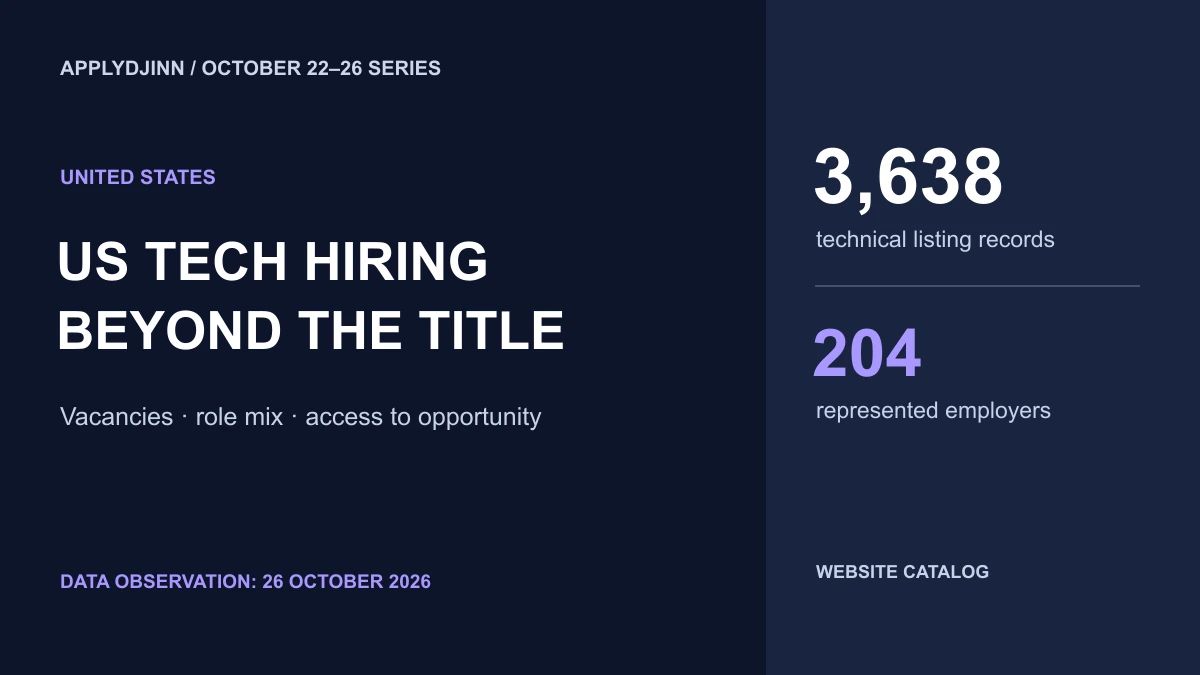
A fresh ApplyDjinn snapshot of 3,638 technical listing records across 204 employers shows how to build a more precise US job search beyond a single title.
A search for a technology job in the United States can produce plenty of results while still feeling narrow. One title returns hundreds of similar advertisements. Another returns almost nothing, even when the work described inside those advertisements looks familiar. The useful question is which kinds of work employers are advertising, and where a candidate's existing evidence fits those responsibilities.
This article maps that question using ApplyDjinn's website catalog. Our observation contains 3,638 technical listing records associated with the United States, across 204 employers. Software engineering is the largest saved role family, but product, data, security, design and infrastructure also create distinct routes into a technical organization. A search built around responsibilities can therefore reveal opportunities that a single preferred title misses.
Series date: October 22, 2026. Data updated October 26, 2026, at 19:08 UTC. All catalog figures below come from that later observation, rather than an October 22 historical reconstruction. They describe advertisements in our coverage, not national vacancies, funded headcount or completed hires.
The national headline and your search answer different questions
The US Bureau of Labor Statistics reported little change in September nonfarm payroll employment, with a gain of 29,000 and an unemployment rate of 4.2%. Its October 2 release also reported little monthly change in information and in professional and business services. Those are broad survey measures, with a different population and purpose from a vacancy search. They do not establish whether a particular employer needs your specialty. BLS September employment release.
Use that context to resist overreacting to either an optimistic headline or a discouraging one. Your immediate task is narrower: identify eligible openings that match a credible body of work. An employer can be filling a replacement, building one specialist team or recruiting for several locations while broad industry employment changes very little. An advertisement alone cannot tell us which explanation applies.
Our snapshot is useful for examining the available search surface. It is unsuitable for estimating a national unemployment rate, predicting an offer probability or declaring that the whole technology market has recovered. Those conclusions require different data.
Software leads, while several other families remain substantial
Of the 3,638 technical records, 1,643 are classified as software engineering, or 45.2%. Data and AI account for 502; product for 344; hardware and manufacturing for 264; security for 258; and design for 213. The remaining 414 sit in other technical families, including infrastructure, quality and technical customer work.
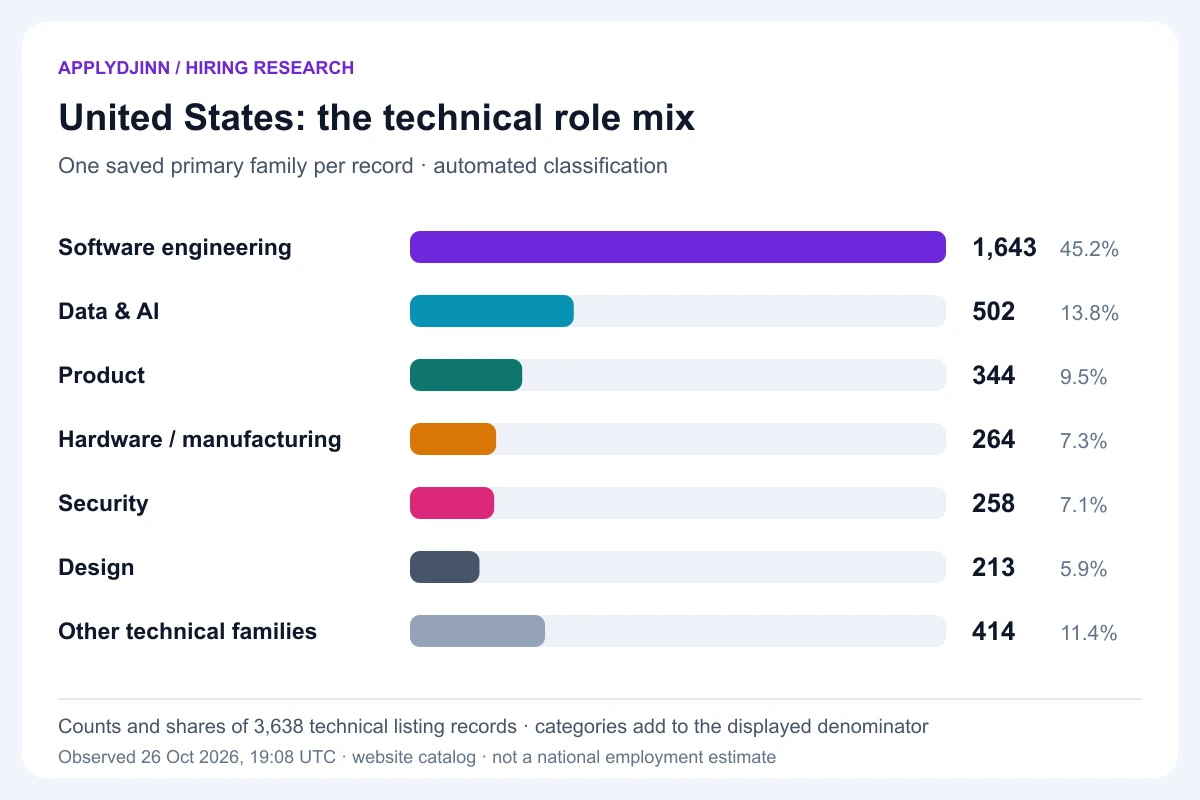
Each record receives one primary family in this chart. A product advertisement can also require analytics, and a security role can involve substantial programming. The family is a way to organize the search, rather than a claim that responsibilities never overlap. Classifications are automated and can be imperfect, so the source description remains the place to verify an individual match.
For a software engineer, the distribution suggests two useful reading habits. First, distinguish the kind of system you would own: customer product, internal platform, embedded software, data infrastructure or developer tooling. Second, inspect adjacent families when your experience supports them. Someone who has built authorization controls and investigated incidents may have relevant evidence for a security engineering role, even if their current title says backend engineer.
That is a suggestion about search breadth, not permission to relabel experience. A candidate should be able to explain the actual work behind every claimed skill. The adjacent title becomes useful only when its responsibilities connect to something demonstrable.
Employer breadth changes how you organize applications
The sample includes 204 employers with at least one technical record. Its largest represented employers by technical record count are Google with 626, NVIDIA with 455 and Amazon with 198. Together they account for 1,279 records, or 35.2% of this US technical sample. This concentration reflects our observed catalog and its sources; it does not measure those employers' share of all US technology hiring.
For an applicant, several advertisements from one organization are several possible conversations, but they are not fully independent opportunities. They may share a recruiting process, a hiring freeze decision, a location restriction or a common business unit. Treat the employer as a useful planning unit alongside the individual role.
A practical shortlist can contain both large employers with several relevant openings and smaller represented employers with one specific match. Within each company, compare the responsibilities before applying repeatedly. If two advertisements look like location variants of the same requisition, investigate the source identifier and application destination. Our counts are catalog records and can include location variants; they should never be read as an exact count of distinct recruiting decisions.
Record which team or product attracts you, rather than just the company name. That makes it easier to write a useful introduction and to explain why two applications to the same employer are meaningfully different.
Work mode removes a different set of opportunities
The work-mode distribution is a second view of the same 3,638 records: 1,795 office, 559 hybrid, 529 remote and 755 not classified. Remote therefore represents 14.5% of this particular sample. The unclassified group is large enough to matter and stays visible in the chart.
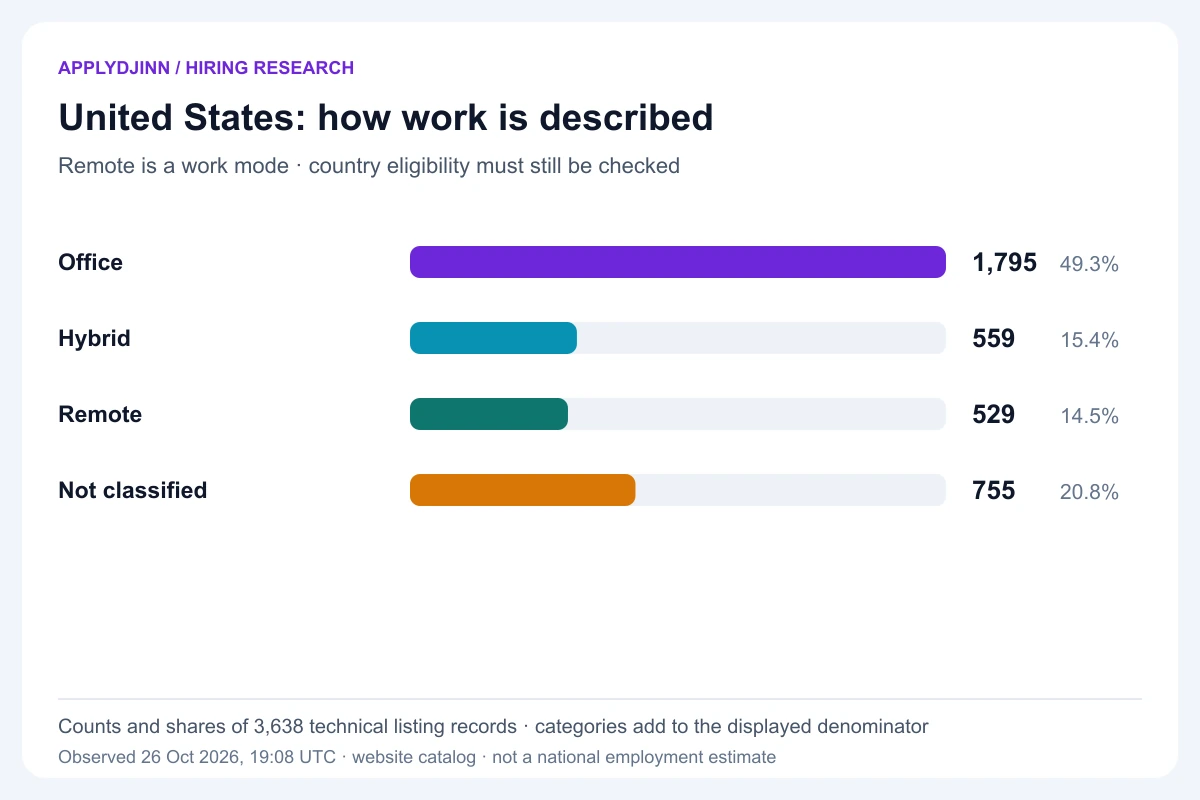
Do not interpret an absent work-mode label as office work. Equally, do not interpret a remote label as worldwide eligibility. A role associated with the United States may require residence in a supported state, particular working hours, authorization to work or attendance at occasional team meetings. The catalog's country association identifies the advertised geography; it cannot settle those conditions for you.
Apply hard constraints before spending time on a tailored application. If you cannot relocate, ask whether hybrid attendance is practical. If you need a particular hiring arrangement, confirm it from the source or recruiter. The objective is to avoid preparing a polished application for an opportunity whose employment conditions you cannot meet.
When the advertisement is ambiguous, keep it in a short verification queue. A missing label can justify a question. It does not justify inventing an answer or excluding every uncertain record from the market picture.
Senior titles are visible, but missing labels are also visible
The snapshot contains 1,217 senior-labeled technical records and 1,242 without a saved seniority label. It also contains 77 intern and 14 junior labels. These numbers show how the catalog is labeled; they are not a census of opportunities available to people at each experience level.
A role without the word junior may still have modest experience requirements. An internship may require current enrollment, a specific graduation date or a research specialty. A senior title can describe very different scopes at different employers. Read the required outcomes, years of experience where stated, ownership expectations and constraints together.
For early-career candidates, search for responsibilities and explicitly advertised programs as well as title labels. Verify the application window and enrollment conditions. For experienced candidates, look for the level of decision-making the employer expects: owning one component, setting a team's architecture or coordinating work across several organizations. These distinctions make interview preparation more specific than rehearsing a generic senior-engineer story.
A weak label should remain an uncertainty to resolve. It should not silently become evidence that every unclassified role is either entry level or senior.
Translate the role mix into evidence you can present
For software engineering, choose examples that connect implementation to an operating result. A concise account might cover the initial constraint, your design choice, how you tested it and what you observed after release. If the result was not measured, say what you verified instead of supplying an invented percentage improvement.
For product roles, show how you identified a problem, selected a useful outcome and handled competing priorities. For data roles, include the provenance of the data and the validation behind an analysis. For security, explain the threat or failure you investigated and the scope of your remediation. For design, show a user task, the interaction decisions and the evidence that informed them.
These are editorial suggestions, not a checklist supposedly demanded by every advertisement. Use the actual vacancy to select the relevant example. A portfolio filled with unrelated technologies creates more reading work for a recruiter and can obscure a strong match.
When adapting a CV, keep a stable factual base and change the emphasis. Put the most relevant project near the top, make the responsibility understandable and use the employer's terminology where it accurately describes your work. A vacancy-specific document should help a reader find evidence quickly; it should not add experience you do not have.
A two-week search experiment
Start by selecting two related role families and a manageable group of employers. Define the non-negotiable conditions first: geography, attendance, employment arrangement and any program eligibility. Save the source link and date checked for each shortlisted advertisement.
During the first week, read enough descriptions to recognize recurring responsibilities. Group the roles by the work you would actually perform. Choose a small number of high-fit applications and prepare a relevant example for each. Keep uncertain eligibility questions separate so that they do not disappear inside a long to-do list.
During the second week, examine your own process. Which employers replied? Which roles turned out to have an incompatible location or level? Which interviews exposed an evidence gap you can address? These are observations about your search, not statistically reliable estimates of the whole market. Still, they are more useful for the next round than the raw number of applications sent.
Keep one adjacent search lane open. A backend engineer might compare platform and security work; a designer might compare product design and design systems; a data analyst might compare analytics engineering and product analytics. Narrow or widen that lane according to the responsibilities you can credibly discuss.
Sources and scope
The original charts use one frozen ApplyDjinn website observation, taken October 26 at 19:08 UTC. Records must be active, catalog eligible and associated with an explicit US country facet. The freshness rule uses the first available source publication, first-seen or creation date within the preceding 30 days; pinned records would be exceptions, but none occurred in this sample. Restricted syndicated records also require a valid visibility lease.
The technical subset uses the saved technical-role classification. Product, design and quality can be included when classified as technical work. Records without that classification are outside these charts. A record is counted once within the country, but multiple locations and source representations can still correspond to one underlying requisition. Counts are therefore not headcount, offers or hires.
The external context comes from the linked BLS release, published before this series date. Catalog coverage is selective and website visibility can exceed mobile-app visibility. Start from the vacancy catalog, verify each source and use the four-market comparison to understand why geography changes the available search surface.