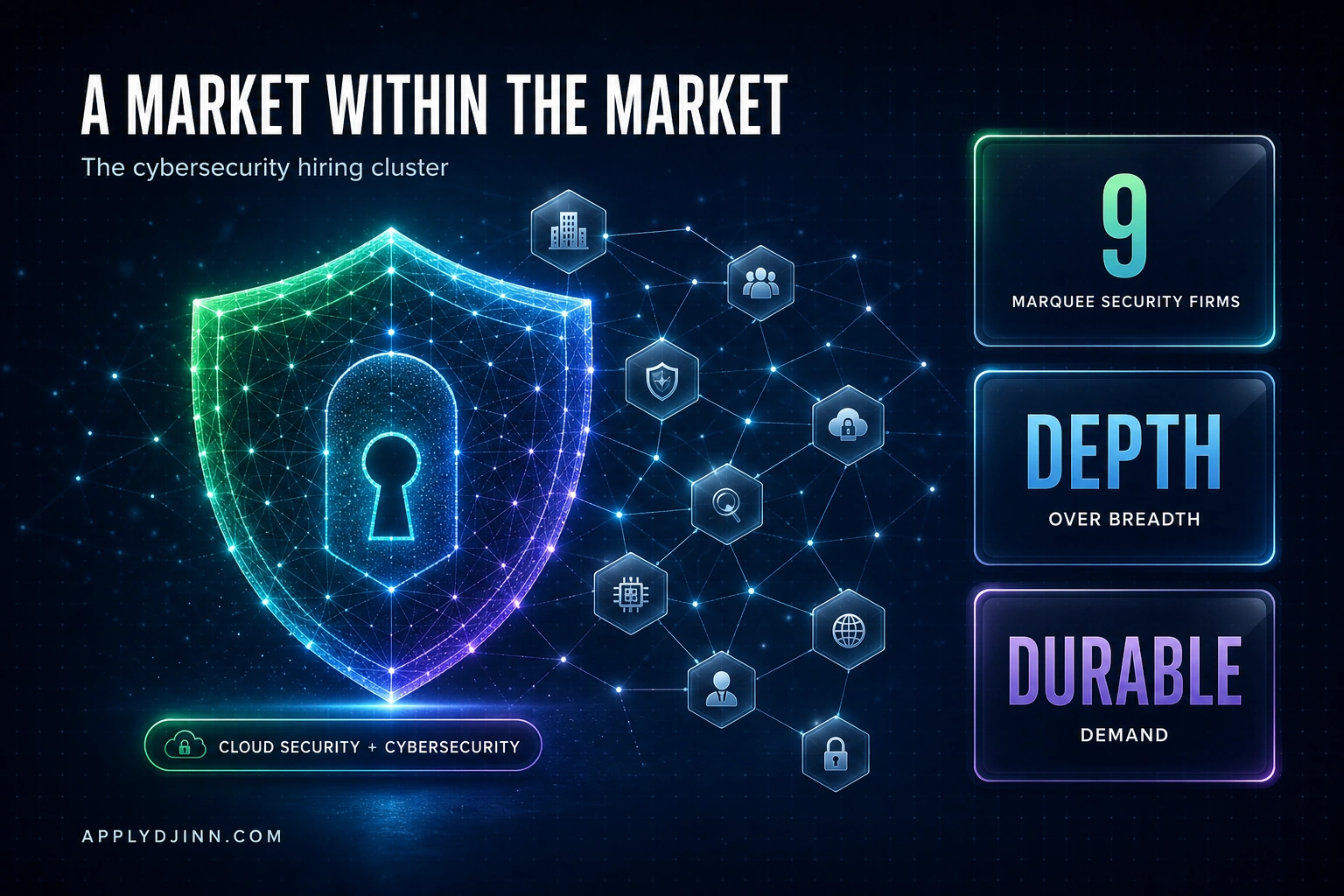
Cybersecurity Is a Market Within the Market
SentinelOne, Wiz, Cato, Armis, Pentera and more keep hundreds of security roles live. The security job market sits inside the broader one and plays by its own rules.
Every market snapshot we publish comes with an asterisk: the cybersecurity numbers behave differently from everything else. So this piece is about the cluster that refuses to average in — the security-company job market that sits inside the broader one and plays by its own rules.
The cluster
A single row of names carries a disproportionate share of security demand in our catalog: SentinelOne, Wiz, Cato Networks, Armis, Axonius, BigID, Silverfort, Pentera, and Checkmarx — and between them they keep hundreds of security-shaped postings live. Most are Israeli, and together they form the densest concentration of security hiring we track anywhere. When people say "Israel is a cyber nation", this is what it looks like from the demand side: not a slogan, a hiring pattern.
Depth over breadth
Here is the defining trait. A typical AI or full-stack posting lists many technologies at shallow depth — a wish-list. Security postings do the opposite: fewer technologies per role, but far deeper mastery demanded of each. "Cloud Security" and "Cybersecurity" form their own stable stack imprint in our mining, and around it cluster concrete, non-negotiable skills: threat detection, incident response, reverse engineering, cloud IAM internals, WAF/XDR/SASE architectures, and the ability to reason about an adversary rather than just a spec.
That depth is why the cluster resists commoditization. You cannot cram a security interview the way you can cram a framework. The bar is knowledge that compounds over years, and the market prices it accordingly.
What these postings actually ask for
Why it is a good market to be in
Three structural reasons the security cluster is worth targeting:
How to break in
The rest of the market is chasing AI. The security cluster is quietly hiring depth, paying for it, and competing for a much smaller pool than its size suggests. For the right engineer, that asymmetry is the whole opportunity.
Based on live postings from the security companies in the ApplyDjin catalog, July 2026. See our full State of Tech Hiring report for the market-wide picture.