Durable Core + AI-Native Edge: A Technology Portfolio for 2026
The ApplyDjinn catalog shows huge AI demand beside durable cloud, language, data and delivery skills. Build a two-layer portfolio that can survive the next tool cycle.
A career plan built only on durable technologies can miss a major platform shift. A plan built only on the newest AI tools can become obsolete before the portfolio is finished.
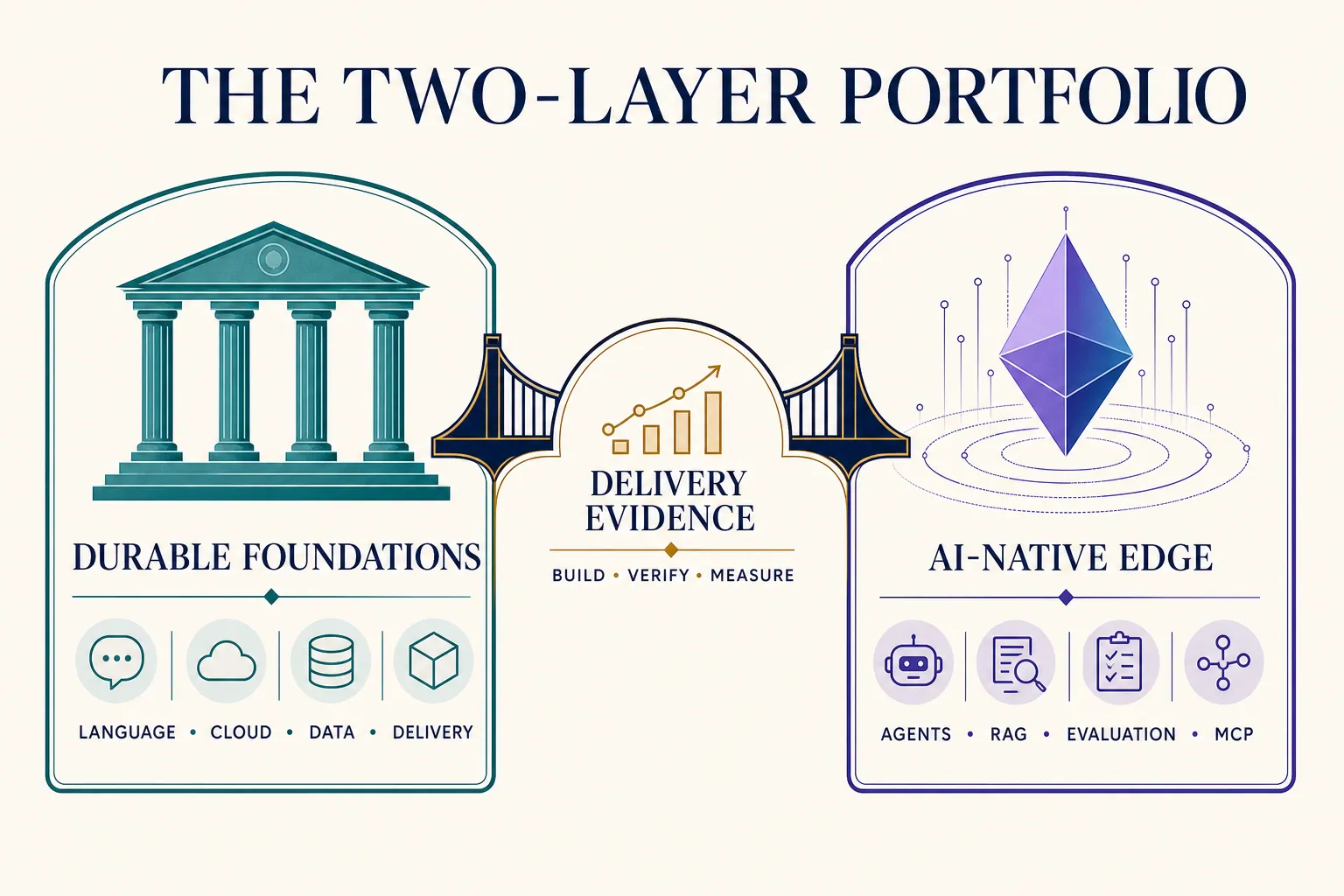
The better structure is a two-layer portfolio:
Durable foundations let you deliver reliable systems. An AI-native edge shows that you can apply those foundations to current work. Delivery evidence connects the two.
The August 2026 ApplyDjinn demand snapshot
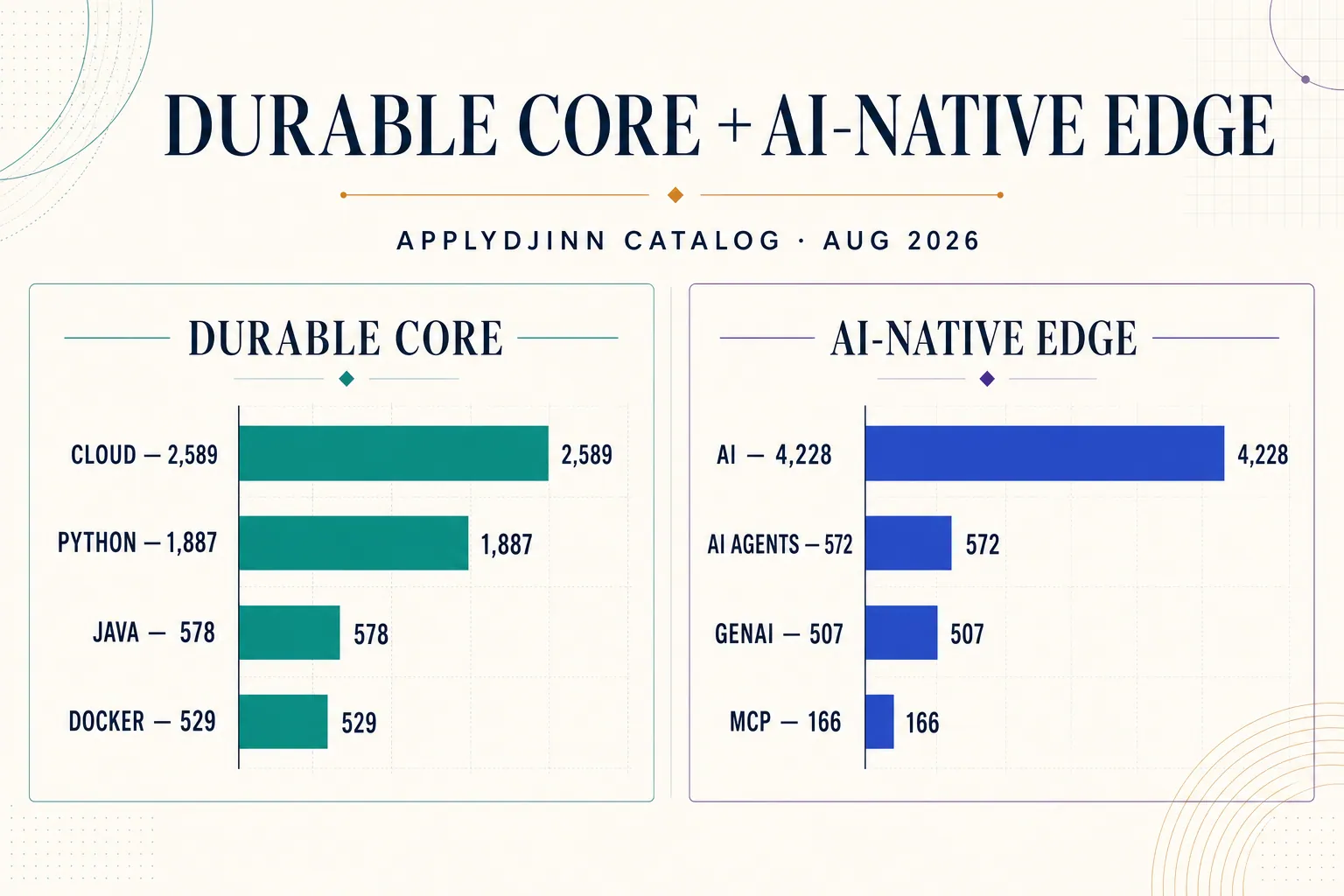
At the time of this analysis, the technology catalog represented 8,290 current vacancies, 933 normalized technology tags and 151 companies. The largest broad signals included:
- AI: 4,228 vacancies;
- Cloud: 2,589;
- Python: 1,887;
- AI Agents: 572;
- Java: 578;
- C++: 552;
- Docker: 529;
- Generative AI: 507;
- TypeScript: 391;
- Terraform: 360;
- Data Science: 386;
- Deep Learning: 272;
- Snowflake: 267;
- Kafka: 258;
- Retrieval-Augmented Generation: 255;
- PostgreSQL: 252;
- Databricks: 201;
- Spark: 192;
- PyTorch: 176;
- Model Context Protocol: 166.
These counts can overlap because one vacancy names several technologies. They describe the ApplyDjinn source mix and active-market rules, not a census of every employer. The public methodology explains how catalog evidence is normalized and how claims should be interpreted.
The signal is still useful: AI is enormous, but it appears inside a market that continues to value cloud platforms, general-purpose languages, containers, databases, data systems and delivery infrastructure.
Layer one: durable foundations
Durable does not mean unchanged. It means that the capability remains useful even when a vendor, framework or model changes.
Language depth
Choose a language aligned with the work you want.
- Python connects backend services, automation, data and machine learning.
- TypeScript connects web products, Node.js services and AI user experiences.
- Java remains important in enterprise services and high-scale platforms.
- C++ matters in performance, systems, robotics, hardware and model infrastructure.
Depth means you can test, debug, profile, manage dependencies and explain trade-offs. A generated implementation is not a substitute for owning those fundamentals.
Cloud and systems
Cloud demand is broad because software delivery includes identity, networking, compute, storage, observability and cost. Learn one platform through a real deployment. Add Docker because reproducible packaging is a transferable boundary. Add Terraform when infrastructure consistency and review matter.
Do not reduce cloud skill to product trivia. The durable knowledge is how components interact and fail.
Data and databases
AI systems depend on data systems. PostgreSQL, Kafka, Snowflake, Databricks and Spark serve different needs, but they share durable questions:
- What is the source of truth?
- How is schema change handled?
- Who can read or write?
- How is lineage preserved?
- What happens when data is late, duplicated or wrong?
- How are cost and performance measured?
This is why generic database capability deserves its own signal alongside specific products. A PostgreSQL logo proves a technology association; a portfolio should prove data modeling, query reasoning and operational awareness.
Delivery discipline
Testing, observability, security, review and rollback do not trend as dramatically as a new model launch. They are the difference between a demo and dependable work.
Make this layer visible. Include tests, deployment automation, logs, metrics, threat boundaries and a short runbook.
Layer two: the AI-native edge
The edge should extend the foundation, not replace it.
AI integration
Start with a bounded model-assisted feature connected to a real workflow. Define the input, output, user and success measure. Protect sensitive data and validate structured results.
Agents
Agent systems add multi-step behavior and tools. Demonstrate permissions, stop conditions, idempotent actions and human checkpoints. The AI agent career guide provides four modes for choosing how much autonomy is appropriate.
RAG and grounded output
Retrieval-augmented generation can connect a model to approved evidence. A credible project measures retrieval quality, shows sources and abstains when the evidence does not support an answer.
The presence of RAG in 255 current vacancies is a signal to learn the system boundary, not merely the acronym.
Evaluation
Evaluation is the bridge between model behavior and engineering ownership. Build a representative set, define what success means, include hard examples and track regressions.
Without evaluation, “the output looked good” is not a production claim.
MCP and tool interfaces
Model Context Protocol appeared in 166 vacancies in this snapshot. It is an emerging interface signal, so avoid making it your only differentiator. Learn why standardized tool and context boundaries matter, then connect that understanding to permissions, schemas and observability.
The delivery-evidence bridge
Two candidates can list the same technologies. The stronger portfolio makes the connection between them reviewable.
Use this bridge:
- Build: a usable feature with a defined user and outcome.
- Verify: tests, evaluation data, source checks and edge cases.
- Measure: latency, cost, quality, adoption or error reduction.
- Operate: logs, permissions, failure handling and rollback.
- Explain: one architecture decision, one trade-off and one limitation.
That sequence works for AI roles and for conventional engineering roles. It is deliberately tool-resistant.
Five coherent portfolio tracks
Product engineer: TypeScript + React + AI
Build an interface that helps a user complete a specific task, not a generic chat clone. Use structured outputs, show provenance, handle latency and let the user correct the result.
Foundation: TypeScript, React, API design, testing.
Edge: model integration, evaluation, feedback capture.
Applied AI engineer: Python + evaluation + cloud
Build a service around a public dataset. Compare a baseline with a model-assisted approach, deploy it and measure quality and cost.
Foundation: Python, data handling, APIs, cloud deployment.
Edge: model evaluation, RAG or agent behavior.
Data engineer: Python + PostgreSQL/Kafka + AI data quality
Create a small pipeline with schema validation, late-data handling and lineage. Add an AI-assisted classification step only where it creates measurable value, with a fallback for uncertainty.
Foundation: SQL, data modeling, orchestration, observability.
Edge: evaluated model-assisted transformation.
Platform engineer: Kubernetes/Terraform + AI workload operations
Deploy a bounded inference or retrieval service with autoscaling assumptions, secrets, logs, budgets and rollback. Explain which parts should be managed services and which should remain portable.
Foundation: containers, infrastructure as code, networking, SRE practice.
Edge: model latency, token cost, evaluation and safety controls.
Systems engineer: C++/Python + AI performance
Measure a real bottleneck: preprocessing, retrieval, memory, inference or hardware interaction. Use profiling evidence and explain the trade-off between speed, cost and quality.
Foundation: systems reasoning, performance, concurrency.
Edge: AI workload characteristics and evaluation.
How much breadth is enough?
Use a T-shaped rule with two connected tops.
- Go deep in one role-relevant foundation.
- Become operationally competent in adjacent delivery tools.
- Add one AI-native workflow that depends on that foundation.
- Learn the vocabulary of neighboring systems without claiming mastery.
For example, a frontend engineer does not need to become a distributed-training specialist to build a reliable AI interface. A data engineer does not need expert visual design to demonstrate evaluated classification. Relevance creates credibility.
A 12-week build plan
Weeks 1–2: choose the market and baseline
Read 25 current vacancies in one role family and geography. Record repeated outcomes and core technologies. Compare the result with stack patterns, then choose a project with one clear user.
Weeks 3–5: build the foundation without AI
Implement the data, service or interface boundary first. Add tests and deployment. This gives you a baseline and prevents the model from hiding weak architecture.
Weeks 6–8: add the AI-native edge
Integrate one model-assisted step. Keep inputs bounded, outputs structured and permissions narrow. Save representative examples.
Weeks 9–10: evaluate and break it
Create difficult cases. Measure quality, latency and cost. Document where the system should abstain or escalate.
Weeks 11–12: publish the evidence
Write the architecture, results, limitation and next step. Record a short demo. Tailor the résumé in the document studio and compare the finished evidence against target roles in match analysis.
Avoid three portfolio traps
The tool zoo
Do not add technologies solely to maximize logo count. Each dependency creates surface area you may need to explain in an interview.
The happy-path demo
If the project never shows a failure, reviewers cannot judge reliability. Include at least one incorrect output and the control that catches it.
The unmeasured AI claim
“Improved with AI” is not a result. Compare with a baseline. Even a small, honest evaluation is better than an unsupported adjective.
The practical takeaway
The catalog does not support a choice between fundamentals and AI. It shows demand for both.
Build durable depth in a language, cloud or data path. Add delivery discipline. Extend that base with one AI-native capability—agents, RAG, evaluation or a model-connected product experience. Then connect the layers with evidence that another person can inspect.
Tools will change. A portfolio that can build, verify, measure, operate and explain will remain legible through the next cycle.