Beyond Tel Aviv: How to Read Israel's Tech Job Geography
An ApplyDjinn snapshot of 1,174 current Israel-faceted roles at 144 employers, with a practical way to compare city labels, commute choices and source-level location rules.
“Most Israeli tech jobs are in Tel Aviv” is too broad to help someone decide where to apply. A candidate needs to know whether a role is available from their home, whether the office requirement fits their week, and whether the job shown in a city search is genuinely a different opportunity. ApplyDjinn's location index makes a first pass possible, but an employer's source posting remains the authority for its workplace rules. This article uses one dated catalog snapshot to show how to make a city comparison without treating facet counts as a census of Israel's labor market.
Define the denominator before the map
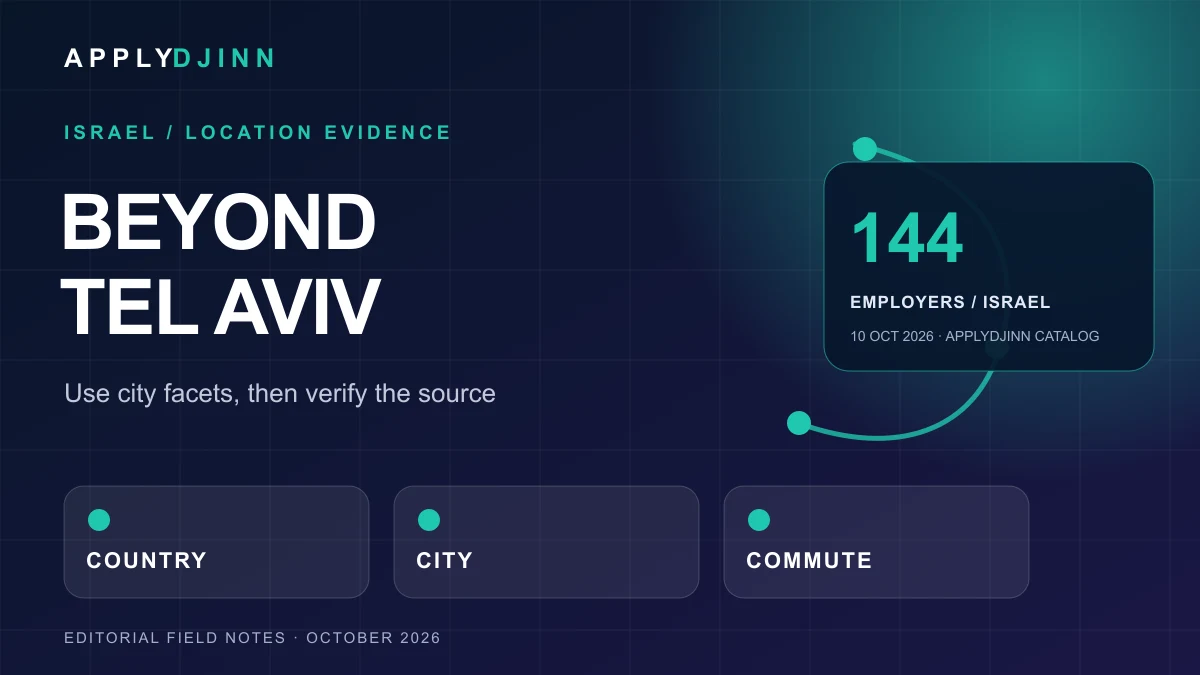
At October 10, 2026, 09:52 UTC, ApplyDjinn stored 1,174 active vacancies with an Israel country facet in its current 30-day window, across 144 employers. 845 of those were classified as technical roles. “Current” means an active catalog record with a source-published date, or first-seen/created date where needed, inside the 30-day window; an editorial pin can also include an older active record. This is a snapshot of monitored sources. It is not the number of all open tech jobs in Israel, people hired, or companies with offices there.
A vacancy can have several location facets because the source lists multiple cities or countries. The country and city counts are therefore views of records, not mutually exclusive categories. A company can also publish several listings for one broad recruiting pipeline. These limitations do not make the index useless; they tell you how to use it. The live vacancy search is a discovery tool, and the source requisition is where you confirm the decision-relevant details.
The 144-employer denominator is especially useful. A region with a large number of listings from one multinational may offer fewer independent pathways than a lower-volume region with varied employers. If your search is constrained by commute or work authorization, count relevant employers and role families, not only cards. A role outside your feasible geography is not made actionable by a high national total.
The country facet also needs a clear comparison boundary. At the same snapshot, 1,034 current records at 30 employers carried a Ukraine country facet and 8,787 at 181 employers carried a United States facet. Those totals cannot be added to Israel's to produce a global number: a multi-location requisition may occur in more than one country. Nor do the different employer counts measure national market size, because ApplyDjinn's source coverage is not identical in each country. Their proper use is to check the reach of a search inside this catalog, then investigate the source records that matter to you.
City names are labels, not neighborhoods
The snapshot's city facets included 439 listings labelled exactly “Tel Aviv, Israel,” 93 Yokneam, 85 Haifa, 66 Rehovot, 64 Petah Tikva and 44 Jerusalem. Another 71 used “Tel Aviv-Yafo, Tel Aviv District, Israel.” These two Tel Aviv forms may reflect source wording and normalization differences; adding them as if they were wholly separate labor markets would mislead. Other locations can also have alternate spellings or municipality names. The figures are recorded labels for source postings at a frozen time, not a ranking of where engineers actually work.
Some postings list “Israel” without a city. Some show a city because that is the office registered in the applicant-tracking system even though the team accepts hybrid work elsewhere. Others mention multiple sites but route every applicant through one requisition. The city facet points you toward a source page to inspect. It does not replace the source's statements about office attendance, relocation, commuting support or eligibility.
When comparing two cities, use a four-part note: exact source location phrase, office days or travel expectation, permitted home location, and whether the role ID is shared with another city. If any part is missing, ask the recruiter. A normalized location search may be generous or narrow depending on what the employer supplied; the candidate's real constraint is the agreement they can make with the team.
A candidate in Haifa needs a different map
Suppose you live in Haifa and are seeking infrastructure work. Starting only with the exact Haifa city label would show the 85 snapshot records in that facet, but it could miss compatible roles in Yokneam, remote arrangements within Israel, and multi-site requisitions with a different primary city. Starting with every Israel role creates the opposite problem: you may spend hours reading distant offices that require daily presence.
Build a practical ring around your location. Ring one is offices you can reach reliably for the stated schedule. Ring two is roles that are feasible only with a flexible hybrid pattern. Ring three is exploratory roles that would require relocation or a meaningful change in working life. Do not assume a “remote” chip removes country, time-zone or travel restrictions. Read the source text and put the answer into your shortlist before customizing a CV.
Now check the work itself. Filter the technology catalog and role pages to your target family, then open a few postings from separate employers. If a Haifa-faceted role is in a different specialty, it is not a good alternative merely because the commute works. If a Yokneam role closely matches your evidence and has a manageable office schedule, it may be a better target than a nominally remote posting whose employer requires work in another country.
This ring method is transferable to Jerusalem, Rehovot or any other starting point. It replaces an abstract “Tel Aviv versus the rest” argument with a decision you can make this week. The answer will differ for a hardware engineer who needs lab access, a developer working with a distributed team, and a security engineer on an incident rota.
Distinguish the workplace from the corporate address
A company profile may show headquarters or a general location. That is background about the employer, not necessarily the location of a particular vacancy. A global company may hire through a local entity in one city for a team operating elsewhere. A startup may list its registered office while the team works in a shared space or hybrid pattern. Do not infer the daily workplace from a company card, stock listing or news article.
On the source posting, look for the exact office, work model and team language. If the role says “hybrid” without a schedule, ask which days and whether they are fixed. If it lists multiple offices, ask whether candidates can choose one and whether the team meets in person at another. If it says “remote in Israel,” verify that your home location is accepted and that periodic travel is described. A clear answer early prevents an otherwise good interview process from failing on logistics at the offer stage.
The vacancy source can change after ApplyDjinn first observes it. An employer might add a city, change an office expectation or close one location variant. Record the date you checked the live requisition. If you return to the role weeks later, read the source again rather than relying on the first saved card. The freshness guide explains why first-seen and source-published dates can differ.
Compare quality inside each geography
Count unique employers and unique source requisitions where possible. Then compare relevant role families, seniority and technical requirements. A city with many sales and operations roles may have fewer suitable infrastructure roles than a smaller city with a specialized engineering cluster. Conversely, a candidate in customer success should not use a map built only from technical jobs. In the October snapshot, 845 of the 1,174 Israel-faceted current roles carried the technical-role classification; the remaining records matter to other candidates and should not disappear from a general market page.
Use a short evidence matrix for each shortlist: role ID, employer, source URL, location rule, essential skill, your proof and unresolved question. Ask whether the source mentions language, security clearance, travel or employment entity constraints. A keyword tag might describe the employer's product rather than a skill you will use. The requisition text is more important than the tag when deciding whether to apply.
If you want to compare demand between cities over time, hold the source set stable. A new parser or a repaired feed can produce a sudden rise in one city without a sudden rise in employer hiring. Multiple city labels for the same role can produce parallel movements. A responsible chart should disclose the distinct employer count and first-observed versus source-published dates. Without those, the shape of the line is too easy to overinterpret.
For a shared shortlist, keep a separate column for the employer's own wording and for the catalog's normalized location. If they disagree, preserve both and ask for clarification before applying. This is especially useful for distributed teams: one card might say “Tel Aviv” because it is the recruiting office, while the source describes work from several Israeli sites. If the source is silent, leave the workplace rule unresolved. An honest unknown is more helpful than converting a city facet into an employment promise.
A seven-day location experiment
Day one: define the commute and work-model conditions you can actually accept. Make them concrete enough to answer yes or no. Days two and three: inspect roughly twenty current source postings across the location rings, capturing the exact workplace phrase and role ID. Day four: remove duplicates and roles that fail a hard eligibility or commute condition. Day five: rank the remainder by work fit and evidence, not by city prestige. Day six: tailor the first applications. Day seven: review which locations yielded real, suitable roles and which filters were too narrow.
Do not turn this into an application quota. Ten roles that meet your location and experience constraints are more valuable than fifty that do not. Keep uncertain jobs in a separate question list; an email to a recruiter may resolve whether the office schedule is flexible. If no suitable roles appear in a ring, decide whether to widen geography, change work-model expectations or pursue a neighboring role family. Change one variable at a time so you can learn from the result.
The published snapshot will age; that is why the date and denominator matter. The durable method is to move from country facet to city label, then to actual source requisition, then to your personal feasibility test. ApplyDjinn can show where to look. The employer can confirm where the job can be done. Only you can decide whether that arrangement works with your life.