IT Hiring on October 28: The Skills Behind the AI Headlines
Fresh enterprise AI news meets a frozen ApplyDjinn analysis of 5,279 technical vacancy records across the United States, Israel, Ukraine and Canada: role families, work modes, seniority and the evidence behind AI labels.

Enterprise AI announcements are moving closer to everyday business systems. On October 27, Oracle announced a collaboration with OpenAI spanning enterprise applications, data, cloud services and software development. For someone planning an IT career, that raises a practical question: which capabilities help a team turn these ambitions into dependable work?
ApplyDjinn’s October 28 snapshot offers a useful starting point. Across four country panels, we identified 5,279 current catalog records classified as technical, associated with 331 identified employers. Software engineering remains the largest family. AI-related labels appear widely, although their meaning changes substantially when we examine the saved evidence behind them.
This brief combines those observations with five primary sources. The aim is to help developers, analysts, testers, designers and product professionals build a more useful shortlist: a role they can explain, a location they can actually work in, and evidence that supports their next application.
The news: enterprise AI expands while hiring stays selective
Oracle’s announcement describes connecting OpenAI capabilities with its applications, enterprise data and cloud infrastructure, including workflows for application development and security. These are announced products and plans; the release does not establish how many additional people will be hired. Our interpretation is that implementing such systems draws attention to integration, data quality, permissions and evaluation alongside model capability. Oracle’s October 27 announcement.
The employment backdrop remains cautious. The latest available U.S. Employment Situation release, published October 2, reported September payroll growth of 29,000 and unemployment of 4.2%, both described as little changed. Those figures describe the wider economy. U.S. Bureau of Labor Statistics.
For a closer sector view, TechServe Alliance’s October 14 report estimated that IT employment fell 4,196 jobs, or 0.08%, in September, while year-over-year growth was 0.12%. Its commentary described selective demand for data, AI and cybersecurity skills and longer hiring processes. This supports a careful search strategy: an advertised opening and a completed hire are separate events. TechServe Alliance’s employment report.
Canada’s September Labour Force Survey, released October 9, reported an employment decline of 68,000 and unemployment of 6.5%. That national context helps explain caution, but it cannot establish the prospects of an individual Canadian software applicant. Our vacancy sample supplies a narrower view of currently represented advertisements. Statistics Canada.

What our October 28 snapshot actually measures
We froze the catalog observation at 10:22 UTC on October 28, 2026. It contains 8,229 eligible current website records associated with at least one of the United States, Israel, Ukraine or Canada. Of those, 5,279 carry the saved technical-role classification used for this analysis.
Each observation is a catalog record. An employer can advertise the same underlying requisition in several locations, and one advertisement can cover several hires. We count each catalog ID once in the combined sample and once within each relevant country panel. The panels therefore overlap. Employer counts use identified catalog employers and also overlap across countries.
Coverage is concentrated. Google, NVIDIA and EPAM together account for 1,708 records, or 32.4%, of the technical sample. Their prominence affects the mix we observe. These figures describe ApplyDjinn’s covered sources at this moment; they do not rank the complete national job markets or measure the probability of receiving an offer.
Four markets, four different search constraints
| Country association | Technical records | Identified employers | Remote-labelled records | Remote share |
|---|---|---|---|---|
| United States | 3,359 | 201 | 518 | 15.4% |
| Israel | 765 | 136 | 26 | 3.4% |
| Ukraine | 928 | 87 | 636 | 68.5% |
| Canada | 334 | 75 | 151 | 45.2% |
The remote share uses each country’s technical records as its denominator. A remote label still needs checking against the employer’s location, working-hours and employment conditions. An advertisement associated with a country does not automatically authorize working there or working from another country.
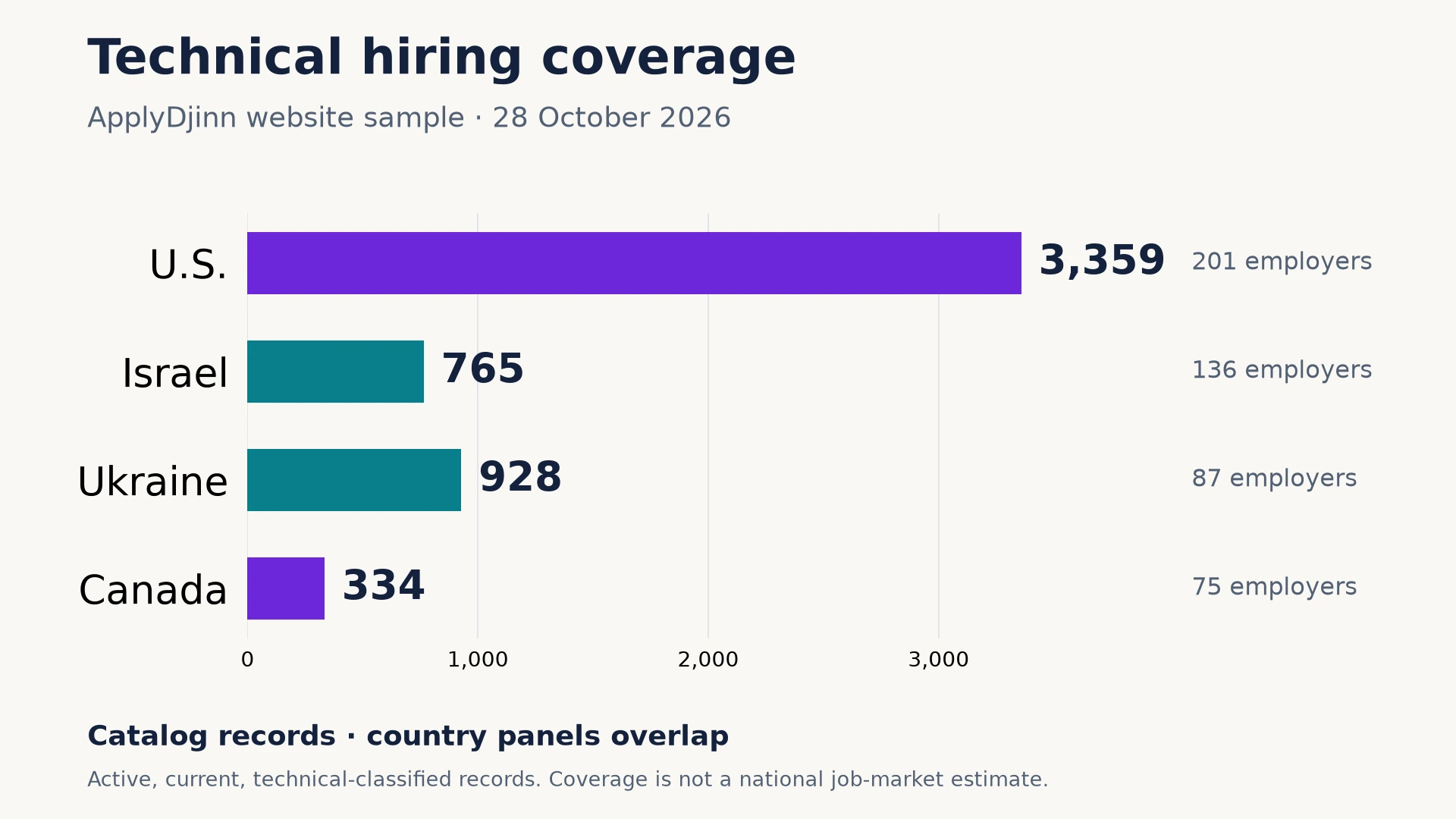
In the U.S. panel, 1,738 records are office-labelled and 541 hybrid. Another 562 have no saved work-mode classification. Searching only for remote work substantially changes the usable shortlist within this sample. A candidate who can attend an office should compare that constraint with the actual responsibilities before excluding a role by title alone.
Israel’s panel contains 486 office and 188 hybrid records, alongside 26 remote and 65 unclassified. Its 136 identified employers also show why a shortlist should look beyond one large company. Start with location and work mode, then compare the systems, customer problems and level of ownership described in each role.
Ukraine’s 636 remote-labelled records make remote work prominent in this covered sample. Canada’s panel is more mixed: 151 remote, 103 office, 64 hybrid and 16 unclassified. These differences can guide filtering. Source coverage, employer concentration and classification practices limit comparisons between the panels.
Software remains the largest family; delivery needs a broader team
| Saved primary role family | Technical records |
|---|---|
| Software engineering | 2,375 |
| Data and AI | 711 |
| Product | 425 |
| Hardware and manufacturing engineering | 360 |
| Security | 329 |
| Design | 303 |
| Cloud and infrastructure | 276 |
| Quality engineering | 183 |
Software engineering represents 45.0% of the sample; data and AI represent 13.5%. The remaining records include technical customer work, IT and business systems, and smaller adjacent classifications. These are automated primary-family labels. A backend role can contain substantial data work, while a product role can require technical analysis.
For applicants, the useful connection to enterprise AI is responsibility. A product still needs software that handles transactions, data that remains trustworthy, interfaces people can understand, tests that reveal failures and infrastructure someone can operate. That is our reading of the work involved, rather than a forecast that every announcement creates vacancies in every family.
Common saved skill labels include Python in 2,134 records, AWS in 1,113, SQL in 847 and Kubernetes in 816. The counts overlap and include different evidence tiers. Use them to investigate combinations in real descriptions: a familiar programming language paired with data ownership, platform work or operational responsibility can reveal a credible adjacent direction.
Read the evidence behind the AI label
We tracked five exact saved labels: AI, Machine Learning, LLM, AI Agents and Generative AI. At least one appears in 3,435 technical records, or 65.1% of the sample. That broad presence covers several kinds of evidence, including background context and optional capabilities.
Within those AI-labelled records, 1,479 have at least one tracked label classified as core or required. The remaining 1,956 have tracked AI labels only in supporting or optional tiers. That second group represents 56.9% of AI-labelled records. All 5,279 technical records had parsable saved evidence arrays for this calculation; the labels remain automated interpretations of source material.
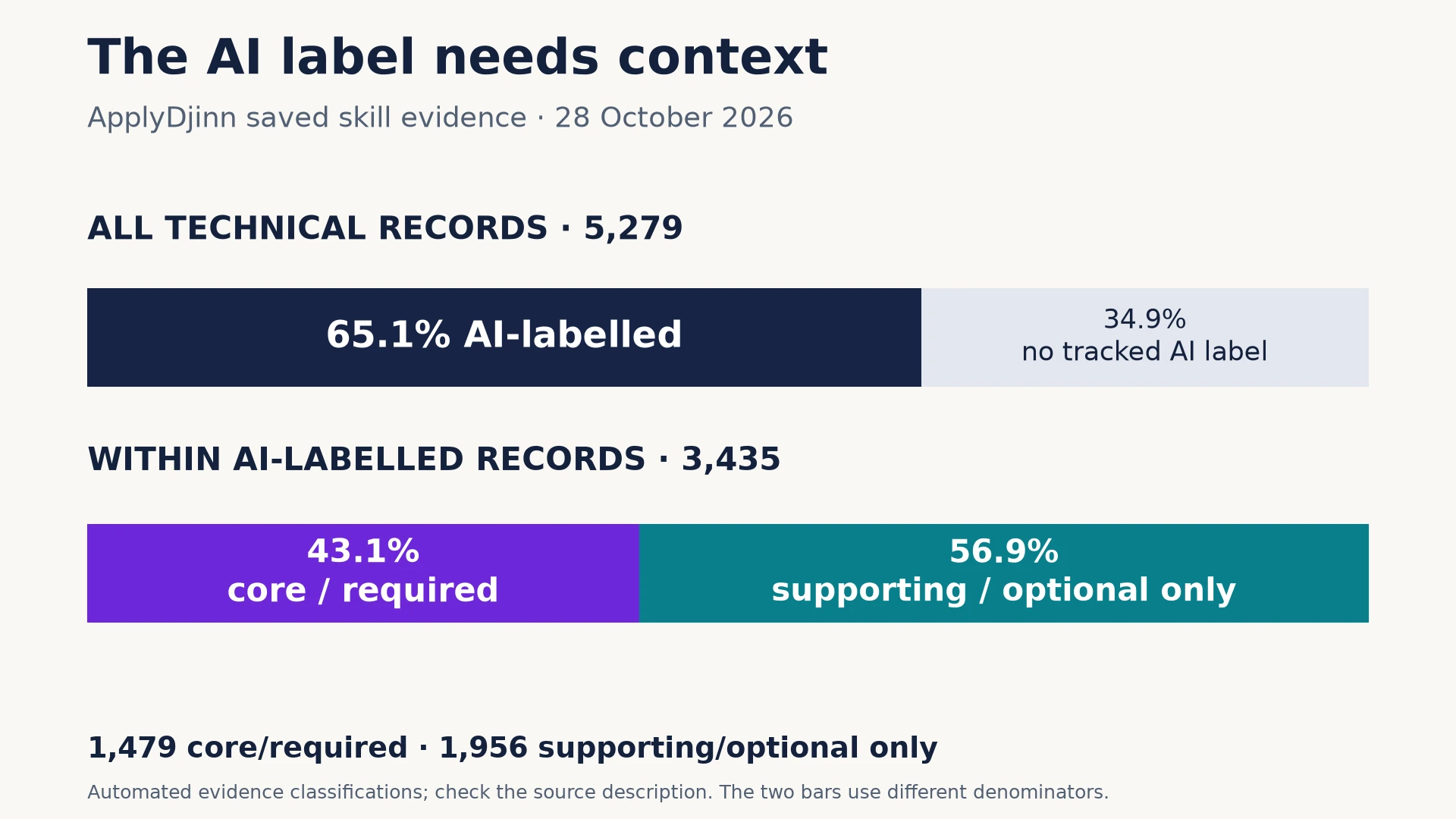
This distinction changes how a candidate reads an advertisement. Someone with strong backend experience might find a suitable application-engineering role that mentions AI in its environment. A research role with model-development responsibilities presents a different preparation problem. Read the tasks, expected experience and supporting evidence before treating a shared label as the same qualification threshold.
A useful application explains the relevant contribution. That might be building a service, maintaining a pipeline, testing an uncertain output or managing access to sensitive information. A general claim of being “AI-ready” gives a reviewer less to evaluate than a concrete account of what you built and how you checked it.
Seniority labels leave a substantial blind spot
The sample includes 2,051 senior-labelled records and 1,658 with no saved seniority label. Unknown levels therefore account for 31.4%. Staff, principal, architect and leadership titles add further distinctions that a single senior-versus-junior filter would miss.
Only 148 records carry junior or intern labels, comprising 51 junior and 97 intern records. That measures explicit saved labeling within our coverage. Applicants should also read unclassified descriptions for expected independence, mentoring, experience and project scope. A small labelled group cannot establish that other entry routes are absent.
For a career changer, prior experience still needs translating. Leading a project in one field can demonstrate communication or delivery skills, while a new technical role may require supervised practice in unfamiliar systems. Separate the experience you can already substantiate from the responsibilities you are preparing to assume.
Career transitions: start with a nearby responsibility
Pew Research Center’s October 22 analysis found that the employment-growth gap between men and women widened as occupational AI exposure increased. It compared 2017–2019 with January 2023–June 2026 using government employment data and task-based exposure measures. The relationship is observational and does not establish individual replacement risk. It makes access to useful training and career mobility a substantive part of this discussion. Pew Research Center’s analysis and methods.
Our editorial recommendation is to choose a transition that preserves a useful foundation. The following examples are preparation ideas, rather than measured transfer outcomes or promises of quick employment.
Backend development toward AI application engineering
Keep the software foundation visible: interfaces, authentication, testing and failure handling. Add a small model-backed capability with an evaluation set, a spending limit and a documented fallback. Explain what happens when the model is wrong or unavailable. The project should make your engineering judgment inspectable.
Analytics toward data engineering
Build on knowledge of metrics and business questions. Practice an incremental pipeline with validation, duplicate handling and recovery after a failed load. Show how a changing input schema is detected. A reproducible pipeline and a clear data contract make the transition easier to discuss than a dashboard alone.
QA, product or design toward AI-enabled delivery
QA candidates can demonstrate scenario coverage, reproducible failures and evaluation of uncertain outputs. Product and design candidates can show how approval steps, user feedback and clear interaction states shape a feature. Keep the target role specific: these responsibilities require different technical depth and should lead to different shortlists.

Turn today’s brief into a practical search
- Set real constraints. Choose countries, work modes, working hours and the arrangements you can support. Use the country panels as starting points, then confirm each employer’s conditions. Preserve unknown information as a question to resolve.
- Choose a role family and inspect a manageable shortlist. Compare ownership, responsibilities and evidence tiers across several advertisements. Record which capabilities recur and which belong to one employer’s particular environment.
- Close one meaningful gap with visible work. Use Typorithm’s lessons and practice and our practical guides to support a project. Keep a short record of decisions, tests, failures and improvements that you can explain in an interview.
- Connect your profile to the next application. The Career Switch planner helps explore directions from existing experience. Return to current vacancies to check whether the proposed route matches actual descriptions. Update your evidence as you learn, and tailor the application to the responsibilities of the specific team.
What to watch after today’s headlines
Follow the transition from announcement to delivered capability. Useful evidence includes employer descriptions explaining production responsibilities, published availability updates, and roles that specify how systems will be evaluated and operated. A new partnership alone cannot reveal whether a team will add staff or reorganize existing work.
For subsequent catalog comparisons, keep the country filters, freshness window and classification rules consistent. Check whether an apparent increase came from newly covered sources or from changes in already observed advertisements. That makes a later market brief more useful than a larger headline number assembled from a different sample.
For your own weekly review, keep a small comparison sheet with the employer, role, location constraint, essential capability and evidence you could present. Revisit the original advertisements before investing substantial preparation time. If several plausible roles ask for the same capability, build one project that demonstrates it clearly, then adapt the explanation to each team. If the common barrier is geography or expected seniority, another course may not resolve it. Change the shortlist instead. This turns the catalog into a way to test a career direction and spend learning time deliberately, while keeping applications connected to roles that remain available.
Methodology and reading notes
The frozen observation includes active website records meeting our current-market rules: a source publication date, or an available observation date when that is missing, within the preceding 30 days. Country association requires an explicit normalized country match. Role family, seniority, work mode and skill evidence are saved automated classifications; missing labels remain visible.
617 technical records lack a source publication date, so their observation-based freshness needs additional care. Reposts, incomplete descriptions and multiple location records can affect interpretation. This single snapshot supports a description of covered advertisements; changes in our coverage would require a comparable historical series before making a hiring-growth claim.
The two numerical graphics are rendered directly from the frozen data. The three editorial illustrations were generated with ImageGen and carry no measured values. Live vacancy pages will continue changing after this publication. Use the article to improve the questions you ask, then check the original advertisement before applying.