
ApplyDjinn field guides
Choose your next tech direction, then build a stronger search and learning plan.
Compare career directions, choose a market you can actually enter and prepare for the work your target role requires. These guides connect learning plans, current vacancies, worked examples and original practice tasks.
A repeatable process
The five-step application loop
This is a decision flow, not an application quota. If eligibility fails, skip the role early. If good applications repeatedly fail at one stage, improve that stage rather than changing everything at once.
 01
Choose a role
Name the role family, level, acceptable locations and work model. A clear target makes every later choice easier.
 02
Find proof
List projects that demonstrate the required skills. Record your contribution, the constraint and the outcome.
 03
Qualify the role
Check the employer's live vacancy, work-rights question, language, pay basis and permitted hiring location.
 04
Tailor the signal
Put the two most relevant projects near the top of your CV and write a short, specific introduction.
 05
Learn from the loop
Track responses, stages and feedback. Improve the stage that fails rather than repeating the same application.
Career decisions and adjacent moves
Choose a direction, then build the evidence
Three in-depth guides connect career decisions with a practical learning route, our lessons and current vacancy searches. Compare cloud infrastructure, software development in the AI era and application security.

Career transition / infrastructure
From Systems Administrator to Cloud Engineer: A Practical Career Transition
Keep your operations experience and build the missing engineering evidence: cloud identity, networking, infrastructure as code, safe delivery and recovery. A practical route with lessons, portfolio milestones and current vacancy searches.
Read the full guide · 13 min →

Career decision / software engineering
Is It Still Worth Becoming a Programmer in 2026? A Practical Guide to the Future of IT
What current labour data, AI productivity research and real vacancies can tell a beginner—and what they cannot. Compare plausible futures, test your fit and build a learning plan around software you can understand and maintain.
Read the full guide · 13 min →

Career transition / application security
From Software Developer to Application Security Engineer: Skills, Projects and a Credible Transition
Use your development experience to move toward application security. Learn threat modeling, authorization, secure delivery and risk communication through one bounded portfolio project, with lessons and current role searches.
Read the full guide · 13 min →
Three regional playbooks
Choose your market
Each regional guide now includes two illustrations, a visual decision route, concrete application examples, interview practice and links to primary authorities where rules can change.

Finding a tech job in the United States
A focused approach to the high-volume US market, from ATS-ready materials to compensation and work authorization.
- Resume
- 1 page is common
- Screening
- Keywords + evidence
- Pay
- Compare total comp

Finding a tech job in Europe
A country-aware search strategy for a region with shared patterns but no single hiring market.
- Scope
- Choose 2–3 countries
- CV
- Localize by market
- Mobility
- Verify per country

Finding a tech job in Israel
A practical route through Israel's relationship-driven, direct, and fast-moving hiring market.
- CV
- 1–2 pages, English first
- Network
- Referrals matter
- Work status
- State it early
9 technical guides
Practice the next round, not a rumor
Choose company-specific preparation or build evidence in coding, system design, AI implementation, security, backend APIs and data engineering. Each guide separates published sources from ApplyDjinn's original practice exercises.

NVIDIA engineering interviews: stages, technical preparation and practice
A role-specific preparation plan for NVIDIA engineering interviews, grounded in the company's published hiring process and original GPU, systems and coding exercises.
Open the guide
Microsoft technical interviews: how to prepare for the next round
A concrete guide to coding, testing, design and behavioral evidence for a Microsoft technical round, with original practice tasks and a realistic second-stage plan.
Open the guide
Amazon SDE II interviews: assessment, design, coding and the loop
A preparation route for Amazon's published SDE II assessment and interview loop, with original exercises for code, system design and evidence-based behavioral answers.
Open the guide
Coding interview practice: patterns, tests and original worked problems
A disciplined way to prepare for coding interviews without memorizing answer keys: choose a pattern, state an invariant, write runnable code and test the boundary cases.
Open the guide
System design interviews: requirements, trade-offs and a worked service
A practical system design playbook with a worked notification-service example, capacity reasoning, failure testing and a repeatable answer structure.
Open the guide
AI implementation interviews: evaluation, safety and production handoff
A role-led interview guide for turning an AI use case into a measured, reviewable service. Practice scoping, evaluation, safety boundaries and incident response with original exercises.
Open the guide
Security engineering interviews: threat models, incident triage and verified fixes
Prepare for security engineering conversations with a threat-modeling workflow, secure-development evidence and original practice tasks for abuse, incident response and rollout verification.
Open the guide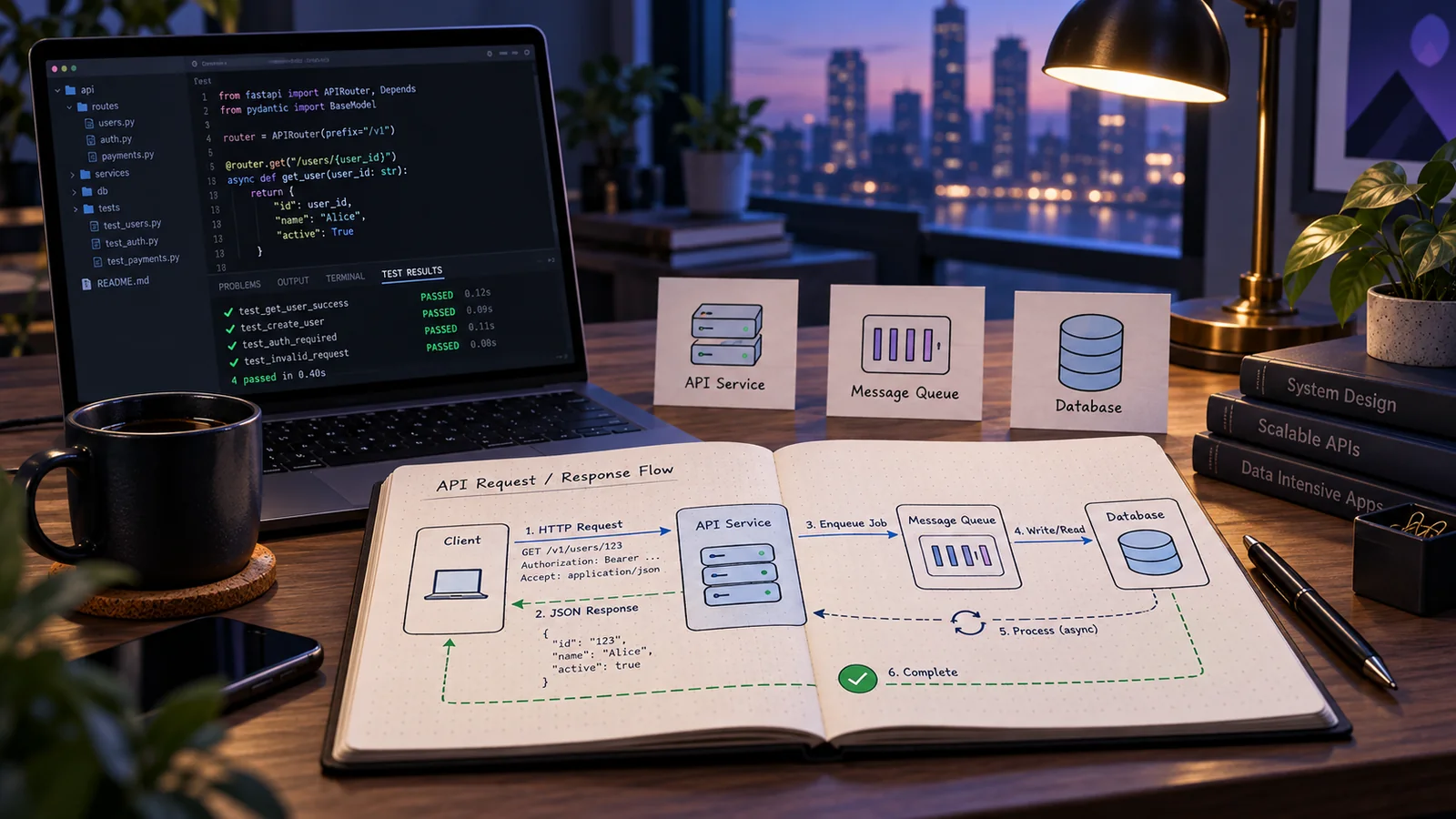
Backend and API engineering interviews: contracts, concurrency and reliable delivery
Build an interview answer from the request contract to a verified release. Work through a retry-safe inventory reservation, database races, asynchronous delivery and operational evidence, with original exercises and SQL.
Open the guide
Data engineering interviews: SQL, event pipelines and trustworthy metrics
Practice the path from raw events to a metric someone can trust. Work through duplicate deliveries, late payments, daily revenue, safe backfills and data-quality checks with an original fixture, SQL and failure scenarios.
Open the guideVisual comparison
Same role, three different checks
Use these prompts to identify what to investigate first. They are not universal legal rules or compensation estimates.
| Market | Verify location | Lead with | Compare offer |
|---|---|---|---|
| United States | State and employer hiring rules | Achievement-led resume | Base, bonus, equity and healthcare |
| Europe | Country, entity and mobility route | Country- and language-aware CV | Gross pay, contract and local costs |
| Israel | Office pattern and work status | Direct CV with owned outcomes | Monthly base and full package |
Interview practice
Questions that test reasoning
A junior answer can show disciplined investigation; a senior answer should also cover trade-offs, rollout and other teams. These sample prompts lead to full answer guidance in the regional playbooks.
United States
A product card looks right on desktop but overflows a phone viewport. How would you investigate?
A popular endpoint doubles in latency after a release. Walk through your response.
Your team must migrate a critical service without downtime. How do you stage the change?
Europe
A checkout bug appears only with one locale. How would you isolate it?
A reporting pipeline combines events from several countries. Where can the totals drift?
How would you plan a region expansion when latency and reliability targets differ?
Israel