Regional field guide / United States
Finding a tech job in the United States
Start with a specific role and a realistic hiring location. A US-wide search can mix jobs that differ on state eligibility, work authorization, pay bands, and interview expectations. The strongest applications make those constraints explicit, then show the relevant work in the first few resume lines.
- Resume
- 1 page is common
- Screening
- Keywords + evidence
- Pay
- Compare total comp

Visual search map
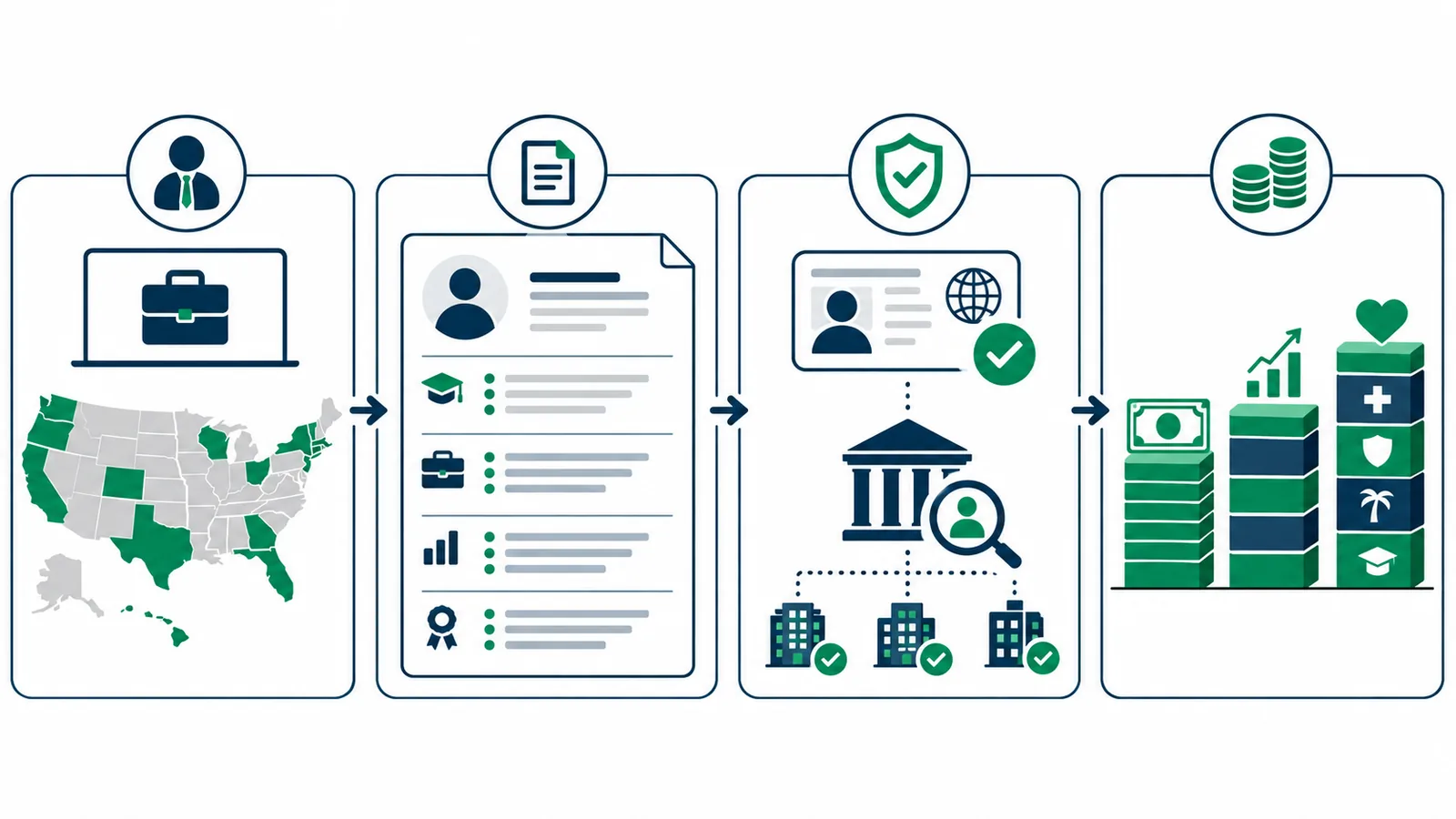
From role target to a credible application
Follow this sequence for each role. An unverified location or work-status assumption can invalidate an otherwise strong application.
- 1
Target
Pick one role family and approved locations; separate remote jobs by permitted states.
- 2
Prove
Put role-matching work, measurable outcomes, and your own contribution near the top.
- 3
Verify
Check the employer's live posting, authorization question, pay basis, and application link.
- 4
Practice
Prepare a project walkthrough and technical or functional examples at the advertised level.
01 / FIELD NOTES
Make the resume easy to screen
US recruiting funnels can be large. Your first page must make role fit visible in seconds.
- Use a resume rather than a full academic CV for most industry roles. One page is common early in a career; two pages are reasonable when the relevant experience earns the space.
- Do not include a photo, date of birth, marital status, nationality, or unrelated personal details.
- Mirror the role's real terminology without keyword stuffing, and back important skills with outcomes, scale, or shipped work.
- Use a simple layout that remains readable after ATS parsing. Keep the master profile complete, then tailor the top summary and strongest bullets.
03 / FIELD NOTES
Run a targeted, referral-aware search
- Prioritize roles posted recently and apply through the employer's official page after checking that the listing is still active.
- Build a target-company list by sector, stage, location, and work model. High application volume is useful only when the roles are genuinely close to your profile.
- Ask contacts for information and a credible introduction. Give them the exact role link and two sentences explaining the fit.
- Track every version of your resume and every recruiter conversation; large employers may consider you for several requisitions at once.
04 / FIELD NOTES
Prepare for structured evaluation
- Expect recruiter and hiring-manager screens followed by technical or functional rounds and behavioral interviews; some loops are compressed into a virtual onsite.
- Use concise situation–action–result stories and be explicit about your own contribution.
- For technical roles, practice coding or system design at the level implied by the role—not every company uses the same interview style.
- Compare base salary, target bonus, equity vesting, healthcare cost, retirement match, paid time off, location adjustments, and sign-on terms.
05 / FIELD NOTES
Work through one US application before scaling the search
A repeatable quality check is more useful than rewriting every resume from scratch.
- Start with the employer's current requisition. Highlight three required capabilities, the expected seniority, approved location and any explicit authorization question before editing your resume.
- For each capability, select one honest proof point: the system you changed, the constraint you faced, your own action and the outcome. If you lack evidence, note the gap instead of adding a keyword alone.
- Move the two closest proof points into the first half of the resume. Keep dates, titles and technologies accurate across the resume, application form and professional profile.
- After submitting, record the role ID, version of the resume, referral contact and next follow-up date. This lets you diagnose whether weak response rates come from targeting or presentation.
06 / FIELD NOTES
Diagnose the stage where your search stalls
- No screens after well-matched applications: revisit location and eligibility, role level, first-page evidence and whether the listings were still open. Do not immediately assume an ATS rejection.
- Screens but no technical round: practice a concise project walkthrough and ask what capability the team most needs. Save factual recruiter feedback without overgeneralizing from one company.
- Technical rounds but no offer: reconstruct the tasks and your decisions while fresh. Separate missed fundamentals from communication, testing and role-specific domain gaps.
- Offers with unclear value: request written compensation components and deadlines; compare guaranteed cash, contingent bonus, equity terms and personal costs on one timeline.
Decision board
Three decisions to get right
Choose fit before application volume
A title match is not enough. Compare the role's required skills with evidence you can actually discuss, then check location, level, and eligibility. A senior platform job asking for distributed systems ownership is a poor target if your experience is limited to consuming an API, even when the stack names match. A smaller list of well-qualified roles is easier to tailor and follow up.
Do this: For each vacancy, write three proof points and one gap. If you cannot find the proof points, change the target or build a relevant project first.
Answer sponsorship questions consistently
Work authorization and future sponsorship are separate questions. A role advertised as remote does not itself grant permission to work in the United States, and an employer may restrict hiring to particular states. Do not infer a company's policy from another vacancy or from an old recruiter message. For an immigration decision, use the current employer process and USCIS guidance.
Do this: Record your present authorization, any future sponsorship need, and the states where you can work before submitting applications.
Normalize the offer before comparing it
A large equity figure is not interchangeable with base pay. Ask about vesting, liquidity, target bonus conditions, healthcare premiums, retirement matching, and any sign-on repayment clause. Compare the same time horizon and location for two offers. A written offer should resolve ambiguities that a recruiter summary leaves open.
Do this: Make one row for guaranteed cash, one for conditional cash, one for equity, and one for recurring personal costs.
Worked example
Turn a generic resume bullet into evidence
“Worked on backend APIs and improved performance.”
“Led a checkout API redesign, reduced p95 latency from 620 ms to 310 ms under the same load test, and added rollback alerts for the release.”
The second version names the system, your ownership, a comparable result, and the operational safeguard. Use your real measurements only; never invent a metric to fill this pattern.
Practice bank · six scenarios
Interview questions by level and specialty
Practice aloud, using a project you really worked on. These prompts are examples, not a prediction of any employer's interview. A good answer makes assumptions, trade-offs, and verification visible.
A product card looks right on desktop but overflows a phone viewport. How would you investigate?
What a strong answer covers: Start with the smallest reproducible viewport. Inspect the overflowing element, fixed widths, long text, and image sizing. Explain a responsive fix and how you would check keyboard access and visual regressions.
Follow-up: What would you automate so the same layout break is caught earlier?
Two sources report different counts for the same daily metric. What do you check first?
What a strong answer covers: Clarify the metric definition, time zone, late-arriving records, duplicate keys, and filters. Reconcile a small sample before changing a dashboard. State what remains unknown rather than forcing a number to match.
Follow-up: How would you tell stakeholders which count is provisional?
A popular endpoint doubles in latency after a release. Walk through your response.
What a strong answer covers: Check impact and rollback criteria, compare traces before and after, inspect database plans and downstream calls, then isolate the change. Explain what you would measure during mitigation and how you would prevent recurrence.
Follow-up: When would you roll back instead of hot-fixing?
A public service exposes a new file-upload endpoint. What risks do you assess?
What a strong answer covers: Discuss authentication, type and size limits, malware scanning, storage isolation, authorization on retrieval, rate limits, and audit trails. Rank risks by exploitability and impact rather than listing controls without a threat model.
Follow-up: What would you test before launch and monitor after launch?
Your team must migrate a critical service without downtime. How do you stage the change?
What a strong answer covers: Define invariants and success measures, introduce compatibility, migrate a small cohort, compare outputs, and keep a tested rollback. Show how you communicate ownership across teams and decide when to stop the rollout.
Follow-up: What if the old and new systems disagree only for 0.1% of traffic?
A launch improves sign-ups but worsens retained usage. What do you do?
What a strong answer covers: Segment the funnel and cohorts, check instrumentation, quantify the trade-off, then propose an experiment or rollback threshold. Show how you balance a short-term acquisition gain against long-term user value.
Follow-up: Which evidence would change your decision?
Verify before acting
Official resources
Work rights and employment terms can change. Use these authorities to verify your particular case; this guide does not determine eligibility.
- Working in the United States ↗USCIS
- Resume formatting guide ↗CareerOneStop · U.S. Department of Labor
Put the guide into practice
Use the role, location, and eligibility checks above while reviewing current vacancies. Save the roles that meet your criteria and tailor your strongest evidence for each application.
Explore current vacancies →