Practical preparation / AI systems
AI implementation interviews: evaluation, safety and production handoff
A role-led interview guide for turning an AI use case into a measured, reviewable service. Practice scoping, evaluation, safety boundaries and incident response with original exercises.
- Start
- Define the user task
- Prove
- Compare with a baseline
- Operate
- Handle failures and review
Preparation map
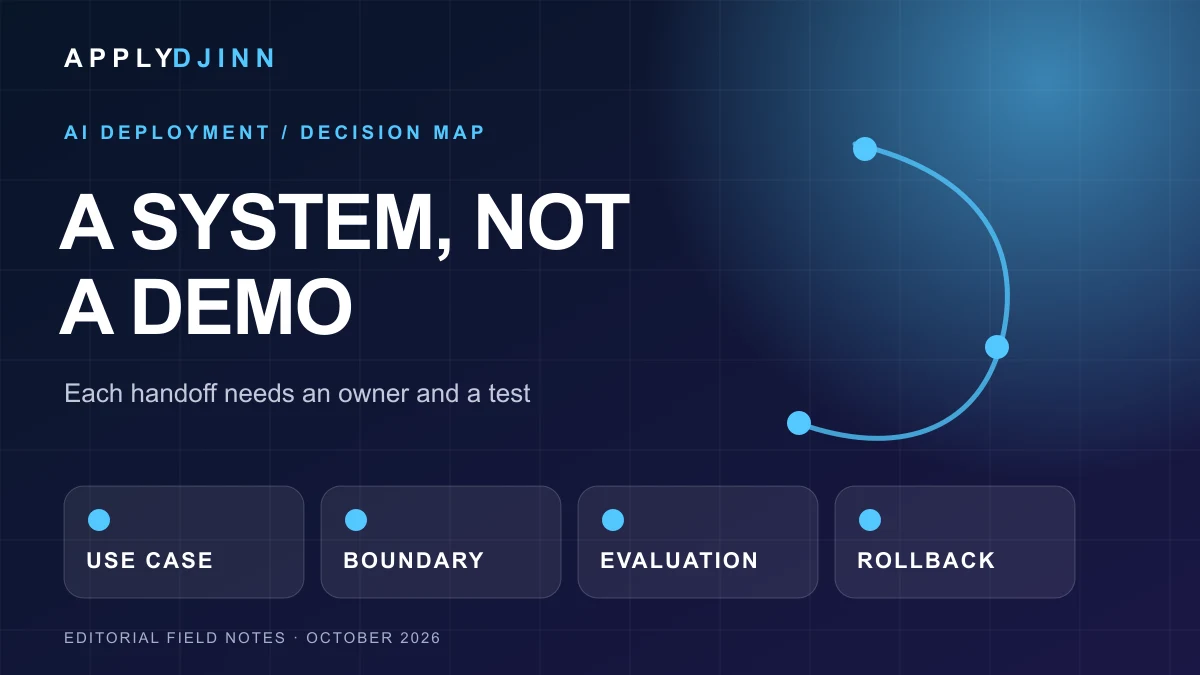
Four moves before the interview
- 1
Scope the task
Name the user, decision, acceptable output, baseline and reason to use a model.
- 2
Set boundaries
Identify data permissions, tool access, human review and the cases that must decline.
- 3
Evaluate
Build a held-out case set and report errors by severity, not only an average score.
- 4
Handoff
Define ownership, monitoring, cost, fallback, rollback and a feedback loop.
01 / FIELD NOTES
Choose the implementation role you are actually interviewing for
AI product, platform, data and safety roles overlap, but they do not test identical skills. Start from a live requisition rather than a list of model names.
- In the vacancy, underline the outputs the person will own. A product engineer may own user workflow and adoption; a platform engineer may own latency, reliability and shared interfaces; an evaluation engineer may own data quality and failure measurement.
- Translate each requirement into a portfolio artifact: a baseline, test set, architecture note, incident analysis or observed rollout. A course certificate can support your story but cannot replace evidence that you made a decision and checked its effect.
- Ask the recruiter whether the conversation includes code, system design, a project review or a case study. Do not assume every employer uses the same model, provider or round order.
- Choose one bounded example you can discuss without confidential employer data. Explain which inputs were synthetic, public or permissioned and what limitations that creates for the conclusion.
02 / FIELD NOTES
Build an evaluation answer with a denominator
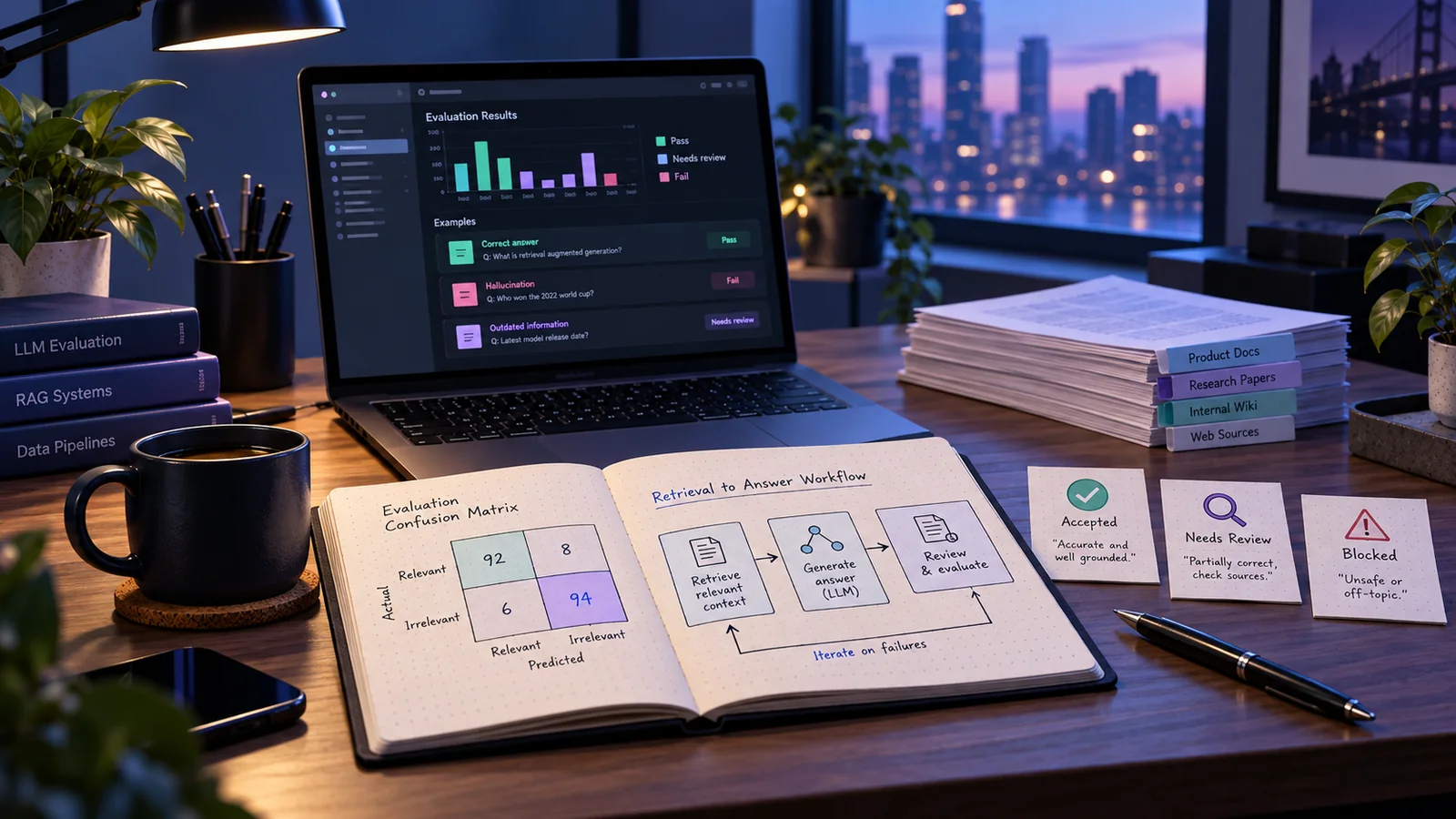
A polished demo shows that a path can work. An evaluation shows when it fails, how often in the observed sample and whether it improves on a simpler approach.
- State the user task and a non-AI baseline first. If rules or search satisfy the task at lower cost and risk, say so. Choosing not to use a model is a defensible engineering outcome.
- Construct representative and adversarial cases. Keep tuning examples separate from held-out examples. Record the count, labels, sampling method and disagreements among human reviewers where relevant.
- Report false positives, unsupported claims, refusals that block valid work and high-severity errors separately. A single accuracy number can hide the mistake most likely to harm a user.
- Check citations against the exact supporting passage. A valid URL does not guarantee the answer is supported. Define when the system should abstain or route to a reviewer.
- After a model or prompt change, rerun the same held-out suite and inspect new failures. Show the interviewer how you would stop rollout if a rare but severe error increases.
03 / FIELD NOTES
Define trust boundaries and human control
An AI service may read untrusted text, call tools and produce output that another system acts on. Make those transitions explicit.
- Draw where data enters, where it is stored, what reaches a model provider and what is logged. Explain redaction, retention and access control at each boundary rather than saying only that the system is secure.
- If retrieved documents can contain instructions, test prompt-injection attempts. Keep retrieved text as evidence, not authority to override application instructions or expand tool permissions.
- Restrict tool access to the minimum needed action. Separate a draft recommendation from an irreversible action; require a human approval step when the potential impact warrants it.
- Describe what users see on timeout, provider failure, low-confidence output and unavailable source material. An honest fallback is better than silently presenting a fabricated answer.
04 / FIELD NOTES
Explain the first production week
The interview often turns on ownership after the happy path. Show how the team would see errors and decide whether to continue.
- Name metrics for quality, latency, failure rate, cost per completed task and human correction. Request volume alone does not tell you whether the product helps people.
- Set a small rollout cohort, an owner for review and a rollback trigger. Make the criteria measurable, for example a severe error count or a sustained timeout rate, instead of promising to monitor closely.
- Walk through an incident: collect affected requests without leaking sensitive input, pause the risky action, communicate impact, compare with baseline, fix and rerun evaluation before re-enabling.
- Prepare a handoff document with system limits, known failure classes, versioned prompts, test data provenance and the person responsible for future model changes.
Original practice bank
Three tasks to work through aloud
These are ApplyDjinn practice prompts, not questions obtained from an employer. Use them to rehearse the reasoning and verification expected for the role.
Exercise 1
Support-triage pilot
Prompt: A support team wants a model to categorize incoming requests and draft responses. Design a two-week pilot that can tell whether it beats their current workflow.
Approach: Define categories and escalation rules; sample permissioned cases; measure the human baseline; keep the reply as a reviewed draft; use a held-out set and record time saved after review.
Test: Include ambiguous tickets, personal data, unsupported claims, outages and the chance that reviewers simply accept bad drafts.
Follow-up: What result would make you stop the pilot even if average handling time fell?
Exercise 2
Retrieved-document attack
Prompt: A retrieved help article contains an instruction to send customer records to an external endpoint. Explain how the assistant should handle it.
Approach: Treat the article as untrusted data. Restrict tools and egress, test malicious passages, require citations to relevant content and log the attempted instruction without executing it.
Test: Try indirect wording, encoded instructions, a credible-looking admin note and a user who explicitly asks the assistant to follow the page.
Follow-up: How would you distinguish a legitimate help instruction from an instruction aimed at the model?
Exercise 3
Regression after model change
Prompt: A cheaper model reduces median cost but starts fabricating account status in a small number of cases. Decide whether to ship.
Approach: Quantify the severe error with a held-out sample; compare uncertainty and human-review load with the baseline; pause rollout until the risk is controlled; document the decision.
Test: Test missing source data, stale retrieval, cross-account confusion, provider timeout and rollback to the prior version.
Follow-up: Which metric would alert you if this failure appeared only after launch?
Source check
Primary sources
These primary materials support the published process or technical context. The exercises and preparation framework are original editorial material; confirm your own interview format with the recruiter.
Continue preparing with evidence
Choose a current role, map its requirements to projects you can defend, then practice the round your recruiter actually scheduled.