Company process / technical round
Microsoft technical interviews: how to prepare for the next round
A concrete guide to coding, testing, design and behavioral evidence for a Microsoft technical round, with original practice tasks and a realistic second-stage plan.
- Round format
- Varies by role
- Technical focus
- Code, tests and design
- Interview answer
- Explain your reasoning

Preparation map
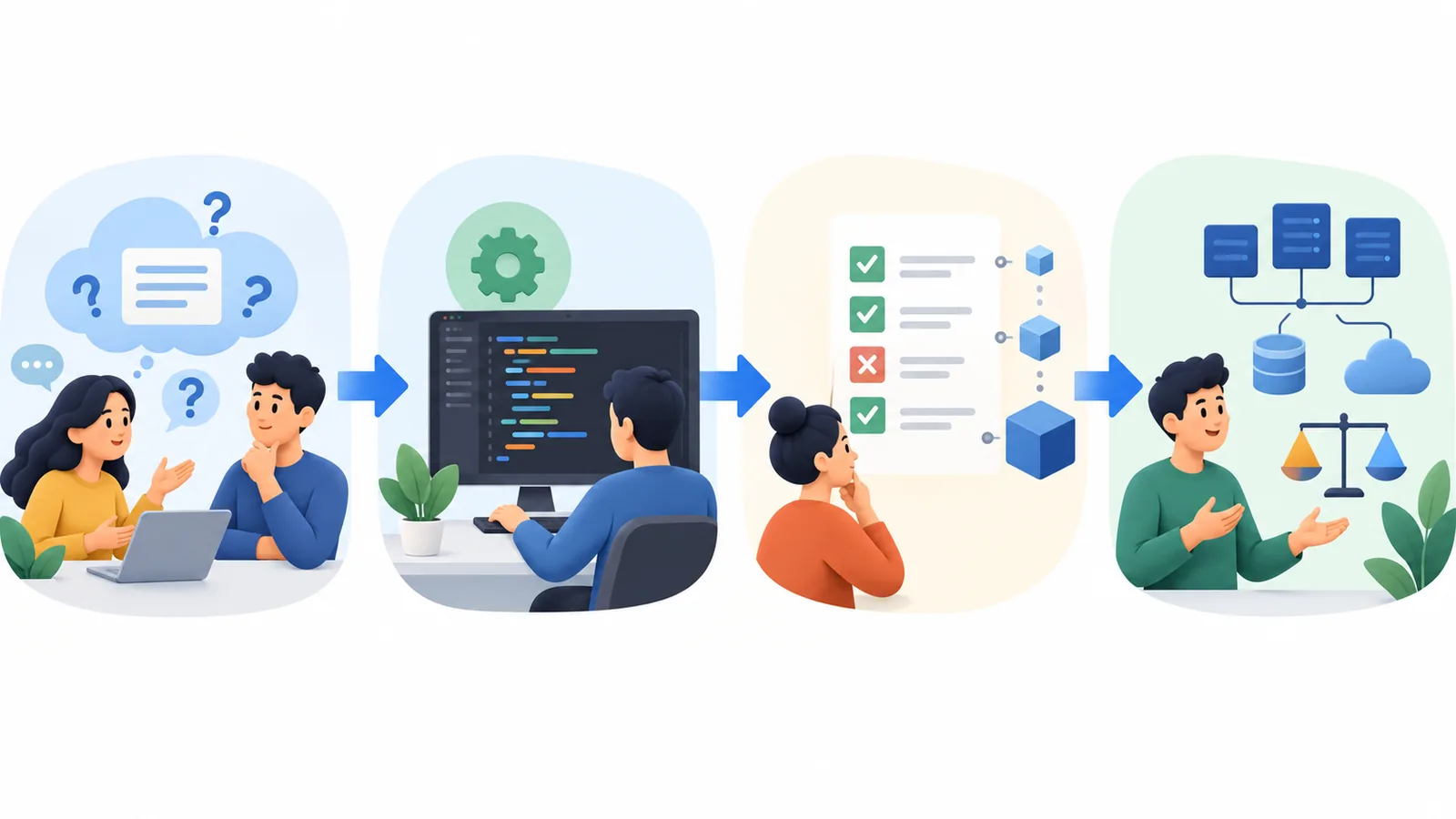
Four moves before the interview
- 1
Confirm your round
Ask the recruiter whether the next meeting is coding, system design, project review or a mix.
- 2
Rehearse live coding
Clarify assumptions, write runnable code, then test edge cases aloud.
- 3
Prepare one design
Show requirements, data flow, failure behavior and a credible rollout.
- 4
Prepare evidence
Use specific work stories with action, outcome and reflection.
01 / FIELD NOTES
What 'second round' can mean
Microsoft does not publish a universal stage-two question bank. It says interviews vary by role; most interview processes include several conversations with potential teammates or partner teams.
- After an initial screen, your next conversation might focus on coding, systems design, a role scenario, past project work or collaboration. Ask for the interviewer's role, time and assessment format rather than guessing from forum reports.
- Microsoft's technical interview guidance highlights problem solving, design, coding and testing. It recommends clarifying ambiguity, making a plan, coding in a language you know well and checking your own solution.
- For software roles, prepare data structures such as arrays, hash maps, trees and graphs, along with complexity analysis. For senior roles, add distributed-system concepts such as resilience, replication and partitioning.
- A student process can differ from an experienced-hire process. Microsoft separately describes an initial and final interview for some early-career hiring; do not project that pattern onto every requisition.
02 / FIELD NOTES
A 45-minute coding rehearsal
- Minutes 0–5: repeat the problem in your own words, ask about input constraints, duplicates, empty input and expected output. Give one normal example and one edge case.
- Minutes 5–10: outline a straightforward correct approach and its time and space costs. Explain what would make you choose a different data structure.
- Minutes 10–30: write complete, readable code in your strongest language. Name invariants when a loop or recursion is subtle; avoid pseudocode if the round expects executable code.
- Minutes 30–40: run normal, boundary and adversarial cases. If the tool permits execution, inspect failures and repair the actual cause rather than merely describing a fix.
- Final minutes: summarize complexity, trade-offs and what you would change if input size or API constraints changed. You may not finish every optimization; clear reasoning still matters.
03 / FIELD NOTES
System design without a memorized diagram
- Start with users, operations, service-level goals and an explicit out-of-scope list. Clarify whether the interviewer wants a high-level architecture or a deep component discussion.
- Draw the request path and core data model before naming queues or caches. Explain the source of truth, consistency requirements, failure boundaries and observability.
- Choose one bottleneck to reason through quantitatively. State assumptions rather than fabricating Microsoft-scale traffic numbers.
- Show how the design evolves: simple first version, load or failure trigger, mitigation, rollout and rollback. Include security and customer impact where relevant.
04 / FIELD NOTES
Experience and collaboration still count
- Prepare two project stories with a clear problem, your own action, a measurable or observable result and what you would improve. Microsoft's interview tips recommend STAR(R), including reflection.
- Have a story where feedback changed your design, one where you handled ambiguity and one where you put customer impact ahead of a technically elegant shortcut.
- When you are stuck, state what you know, ask a targeted question and propose a method to verify the unknown. Microsoft's published guidance values curiosity, learning and honest reasoning.
Original practice bank
Three tasks to work through aloud
These are ApplyDjinn practice prompts, not questions obtained from an employer. Use them to rehearse the reasoning and verification expected for the role.
Exercise 1
Stage-two coding practice: event windows
Prompt: Given events with user IDs and timestamps, return users with at least three events inside any rolling ten-minute window.
Approach: Sort per user if ordering is not guaranteed, then use a sliding window with two indices. State how you handle inclusive endpoints and duplicated timestamps. Explain O(n log n) sorting plus O(n) scanning.
Test: Try empty input, exactly ten minutes apart, unsorted events and many events for one user.
Follow-up: How would you update the result continuously as events stream in?
Exercise 2
Stage-two design practice: notifications
Prompt: Design a service that sends account notifications and lets a user see delivery state.
Approach: Clarify delivery channels and reliability targets, then model requests, queueing, idempotency keys, workers, provider callbacks and status storage. Discuss retries with a dead-letter path.
Test: Reason through duplicate requests, provider timeouts, out-of-order callbacks and opt-out rules.
Follow-up: What changes if a notification must arrive within one minute?
Exercise 3
Experience practice: changed your mind
Prompt: Describe a technical decision you reversed after teammate or customer feedback.
Approach: Use situation, task, your action, result and reflection. Identify the evidence that changed your view rather than claiming you were right all along.
Test: Make your contribution and the customer's outcome clear; do not confuse activity with impact.
Follow-up: What would you do earlier next time?
Source check
Primary sources
Company process details come from these official pages. The exercises and preparation framework are original editorial material; confirm your own interview format with the recruiter.
- Technical interviewing ↗Microsoft Careers
- Interview tips for all roles ↗Microsoft Careers
- How we hire ↗Microsoft Careers
Continue preparing with evidence
Choose a current role, map its requirements to projects you can defend, then practice the round your recruiter actually scheduled.