"DevOps engineer" is quietly being replaced by a bigger, better-paid title: platform engineer. The live data shows the shift, and the good news is that the skills that get you there are concrete and learnable.
The signal
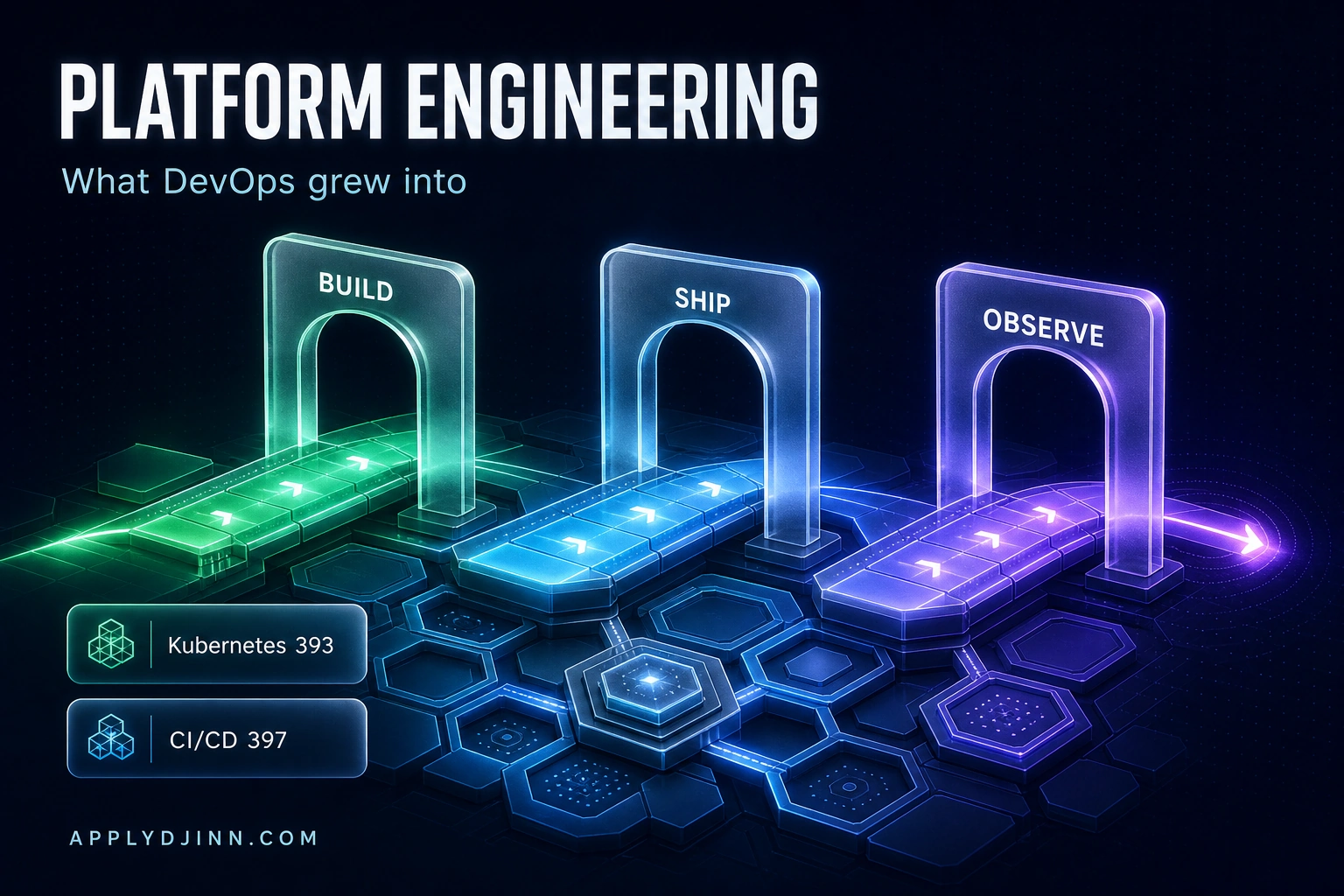
Kubernetes — 393 live roles. The substrate of the whole discipline.
CI/CD — 397. The delivery backbone.
Around them cluster Terraform, observability tooling, and explicit "platform" language, forming a stable imprint.
The role is less "keep the servers up" and more "build the internal platform every other engineer builds on."
What platform engineering actually is
DevOps was a culture; platform engineering is a product. The platform team''s customers are other engineers, and the product is the golden path: a paved road from code to production that hides the sharp edges.
The substrate: Kubernetes, run well — not just deployed to.
The contract: Infrastructure as code — Terraform — so the platform is reproducible, not clicked together by hand.
The pipeline: CI/CD treated as a product, not a one-off script.
The feedback loop: Observability — metrics, logs, traces — so the platform is debuggable.
The mindset: Developer experience. Success is measured by how fast every other team can ship.
Why it is a strong career bet
It sits above the clouds. The skills are portable across providers (the layer we described in our multicloud piece) and the demand is durable.
It is hard to fake. Real production Kubernetes and IaC experience cannot be crammed, so the qualified pool stays small and the leverage stays high.
It compounds. Every year of running real systems makes you more valuable, not less — the opposite of chasing framework churn.
How to move in, from DevOps or backend
Go deep on Kubernetes until you can debug it under pressure — not just apply a manifest.
Make Terraform reflexive. If you are still clicking around a cloud console, that is the exact gap to close.
Build one golden path: a template that takes a service from empty repo to running in production with tests, deploy, and monitoring already wired in. That artifact is your portfolio.
The distinction that matters
This is not the multicloud story of running on three providers at once. It is the platform story: owning the developer experience on whatever substrate you run. The two skills stack neatly — but platform engineering is the one that turns you from "the person who operates the infrastructure" into "the person who builds the thing every team depends on."
Based on 3,383 live postings across 102 companies tracked by ApplyDjin, July 2026.