Quantum's October Breakthroughs: The Engineering Work Behind the Headlines
Google's October 15 hardware result and Anthropic's October 16 circuit research point to different parts of the quantum stack. We connect the claims to 24 source-requisition groups in ApplyDjinn and explain realistic preparation paths.
Quantum computing had two notably different kinds of news on October 15 and 16. One concerned making a scarce resource work better on real hardware. The other concerned redesigning circuits with AI assistance. Reading them together is useful because a practical computing system depends on both the device and the program, with measurement and validation connecting the two. The employment question is similarly layered: research, software, electronics, fabrication, product work and customer implementation can sit around the same technology without being interchangeable careers.
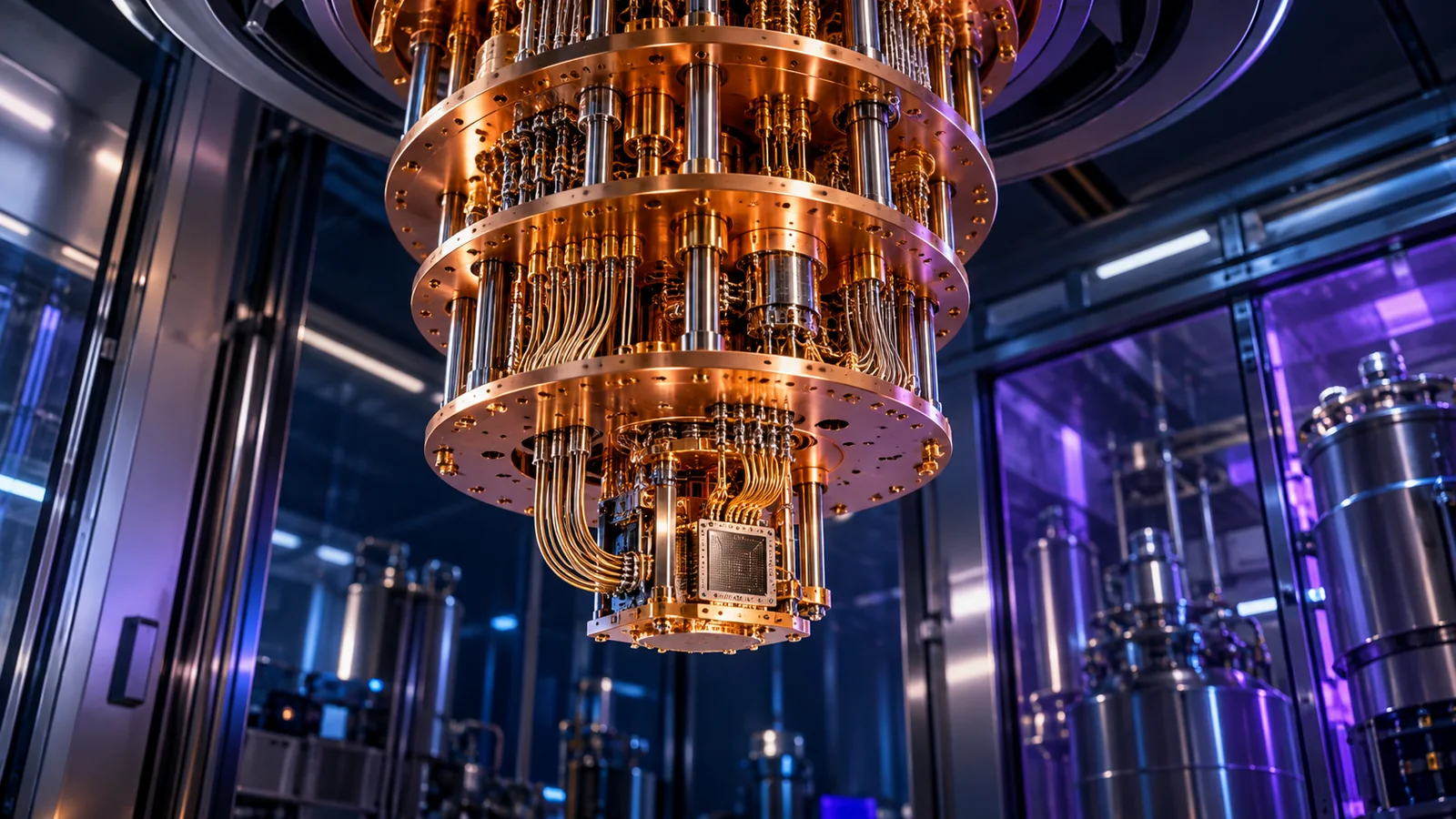
Both photographic-style illustrations in this article were generated with AI. They are conceptual scenes, not photographs of Google, Anthropic or another employer's laboratory.
Two results, with two different denominators
On October 15, Google Quantum AI reported an experimental magic-state cultivation result on Willow. It described about a 40-fold reduction in errors relative to uncultivated states and a logical T-state fidelity of 99.99%. Those measures concern a particular resource and protocol. They are not a claim that every quantum operation became 40 times faster, that a general-purpose fault-tolerant machine is complete, or that a commercial application has been demonstrated. Google's account also says that larger-scale work remains.
On October 16, Anthropic described AI-assisted designs for eight quantum-circuit tasks. An automated evaluator checked and scored proposals. In one reported elliptic-curve design comparison, a circuit used 12% more qubits and 17 times fewer gates than the smallest earlier design. That is a resource trade-off in a circuit design, not a measurement of an end-to-end application running 17 times faster on today's hardware. The research account includes validation steps; its broader implications still depend on assumptions, implementation and subsequent scrutiny.
Putting the two headline numbers on one performance chart would be a mistake. They measure different objects against different baselines. A better comparison asks what resource each result improves, how correctness was checked and what remains outside the experiment. Those questions are also useful interview questions for people moving into an unfamiliar technical field.
Why this is an engineering story as well as a science story
A proposed algorithm needs an implementation that obeys the target machine's constraints. A device needs control electronics, calibration, packaging, repeatable measurements and software that explains what happened. A result needs a baseline that survives a careful comparison. A team needs a way to reproduce it when a parameter or component changes.
These layers create different responsibilities. A scientist may define a mathematical construction. A software engineer may build a compiler or simulator around it. A control engineer may work on the interfaces between a program and an experiment. A validation engineer may investigate why repeated runs disagree. Some people cross several layers, but a candidate should understand which layer an actual role owns.
The practical lesson from this week's news is to investigate the interface between a claim and its measurement. A strong project makes its assumptions inspectable. A strong applicant can explain which component they worked on, what they tested and which conclusions would be unjustified. Knowing the right model or hardware name is a starting point for that conversation, rather than evidence of having done the work.
What our current catalog actually contains
At October 18, 2026, 06:19 UTC, ApplyDjinn's current 30-day selection contained 22,119 active listing records across 335 employers. A literal whole-word check found 29 records with quantum in the title, spread across six employers. A wider title-or-description text search returned 88 candidate records. The wider number includes contextual mentions and should not be presented as 88 quantum-specialist jobs.
Some title records were location variants of the same source position. Grouping by employer and official source identity, with Comeet location suffixes mapped to their parent position identifier, produced 24 source-requisition groups. This grouping describes source identities. It does not claim that a requisition represents one hire, that several locations are interchangeable, or that its conditions are identical everywhere.
| Employer represented in the sample | Source-requisition groups with quantum in the title |
|---|---|
| 8 | |
| Amazon | 6 |
| Quantum Machines | 4 |
| NVIDIA | 3 |
| Classiq | 2 |
| Palo Alto Networks | 1 |
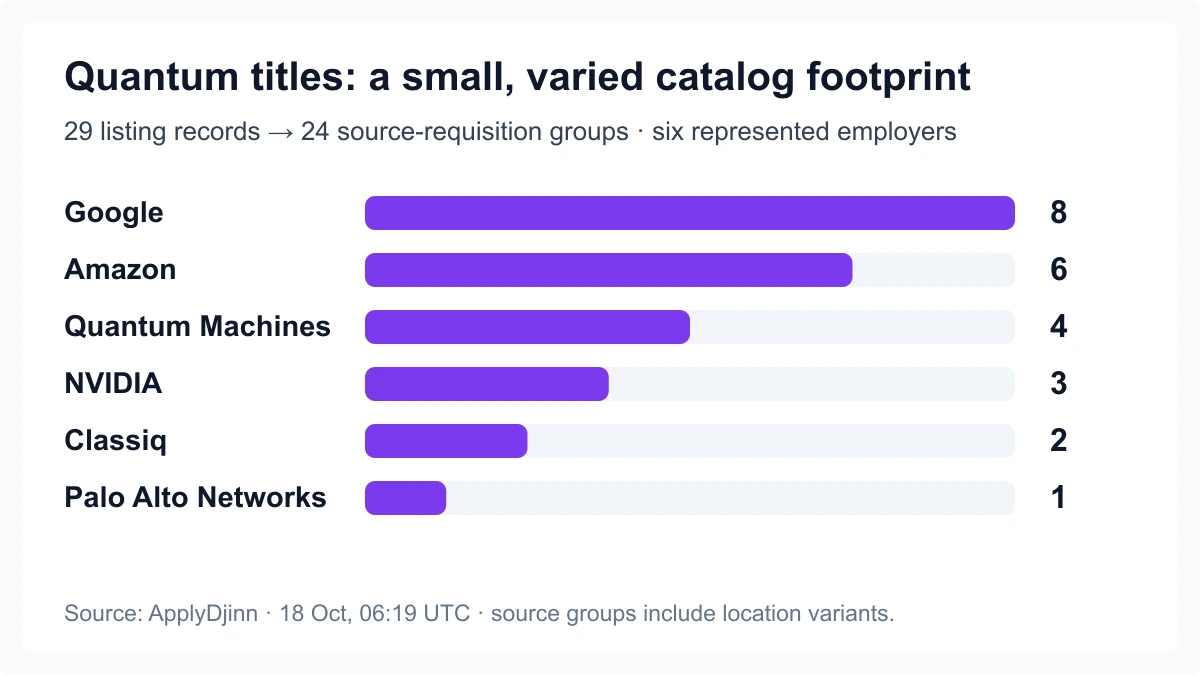
This is a narrow catalog footprint, not a ranking of quantum employers. Universities, laboratories and companies outside our connected sources are missing. A company with no represented role may still recruit through another channel. The Palo Alto Networks example concerns quantum-security go-to-market work, which also shows why a title keyword cannot define a single occupation.
Read the roles before choosing a learning path
The sample contains substantially different work. Google's titles include research in error correction, systems yield, circuit design, interconnects, fabrication and advanced packaging. Amazon's include device science, software development and hardware integration. NVIDIA has research internships and product work. Quantum Machines and Classiq add control, validation, application and solutions roles. These are examples from saved listings, not a promise that every source remains open when you read this.
A software engineer can begin by examining compiler, simulation, infrastructure and developer-tool responsibilities. An electronics or manufacturing engineer should investigate the measurement, fabrication, packaging and control requirements. A researcher should inspect the field, publications and degree expectations in the particular requisition. An application engineer needs to understand the problem a customer is trying to solve and the limitations of the available implementation.
It is reasonable to start from a skill you already have. It is less useful to infer that one introductory quantum course qualifies someone for all these tracks. Use a current vacancy search to read the task and required background, then check the employer's original listing. Compare several roles in the same track before deciding which gap is worth addressing.
Three concrete examples from the snapshot
The saved Google error-correction research role is an example of a research-centered path. The Amazon software-development listing points to software around a quantum-computing organization. The Quantum Machines validation role illustrates a control-systems and testing path. Their titles alone do not establish identical qualifications or locations; the full descriptions and employer sources are the evidence to inspect.
Read each with a simple template: what is being built, what must be measured, which prior knowledge is required, and who consumes the result? Then identify which of your existing projects is relevant. A distributed-systems project might support a software discussion without demonstrating quantum physics. A measurement project might show disciplined experimentation without proving expertise in a particular processor architecture.
When a listing has multiple location variants, keep the applicant conditions attached to the variant you intend to use. Grouping source identities for research should never erase a meaningful distinction in where the role can be performed. That is one reason we show the raw-record and grouped counts separately.

A small project for a software-oriented candidate
One reasonable portfolio exercise is to compare alternative implementations of a small, well-defined circuit in a simulator. This is a proposed learning exercise, not a reproduction of this week's research. Write down the mathematical target, supported input size and assumptions. Choose a simple reference implementation so that an improvement has something explicit to improve upon.
Check correctness before comparing resources. Use cases that exercise edge conditions as well as a typical input. State whether the check is exhaustive for a small domain, a sample of larger cases, a formal argument, or a combination. Each supports a different strength of conclusion. A few successful examples cannot establish that an implementation is correct for every input size.
Record the resource measures that your tools actually expose, such as circuit size or depth, with the tool version and transformation settings. Do not relabel simulated counts as measured hardware runtime. If an optimization reduces one measure while increasing another, retain both in the report. The trade-off is often the most interesting part of the work.
Finally, explain what the exercise omits. A simulator result can omit calibration, device connectivity, noise behavior, data movement or compilation costs. A short limitations section makes the project easier for a knowledgeable reviewer to trust. It can also generate a useful conversation about the team's real constraints.
A different project for a measurement-oriented candidate
For a candidate with a background in test systems, the useful artifact may be a reproducible measurement pipeline rather than a new algorithm. Use public or synthetic data whose origin is clearly stated. Define a baseline, track configuration changes and show how you distinguish an observed shift from a change in the measurement process.
Include a deliberately introduced failure, such as a configuration mismatch or drift in a synthetic signal. Explain how it was detected and which conclusions should be withheld until it is resolved. That demonstrates the habit of questioning an instrument before turning every anomaly into a discovery. It is valuable even when the example is much simpler than a quantum laboratory.
The report should be small enough to audit: an environment description, a repeatable command, a few labeled figures and a discussion of uncertainty. If you use AI to write analysis code, verify the transformations yourself. The value of the project lies in the measurement argument and reproducibility, rather than the amount of generated code.
Research announcements are a watchlist trigger
A new result can suggest teams to follow and questions to ask. It cannot establish a new opening in your city. Google or Anthropic may conduct work with existing staff, collaborators or teams outside your target country. The appropriate next step is to inspect the current requisitions and their requirements, not to assume that an announcement created a hiring wave.
The same distinction applies to search interest and prediction markets. A burst of interest in a company or a quantum claim can reflect media attention. A market contract can price an event with a particular resolution rule. Neither is a count of engineering positions. Our October radar analysis examines these signals separately so that a dramatic headline does not become a synthetic hiring score.
You can maintain a useful watchlist with a few fields: the source claim, the relevant team, the current role, a requirement you meet, and the next review date. Keep closed roles in a history section rather than presenting them as active targets. A watchlist should make your research easier to revisit, especially when announcements travel much faster than recruitment changes.
Questions that distinguish technical depth
Ask what the team's baseline is and which resource currently limits progress. Ask how correctness is checked, what is reproduced automatically and which part still depends on expert interpretation. Ask where the software meets the device, or where a theoretical resource estimate meets an operational cost. These questions let people from adjacent disciplines understand the job without pretending to share every specialist skill.
For a research role, discuss how a result would be challenged and what an unsuccessful experiment teaches the team. For an engineering role, discuss the interface the team owns and how it knows that a change is safe. For application or product work, ask which user problem is currently feasible and which claims the team deliberately declines to make.
A useful answer names a constraint and a method for investigating it. The same standard applies to an applicant. Be precise about what you have tested and which parts you are still learning. This week's results are a reason to take the field seriously and read carefully, with room for several engineering paths around the headline science.
Sources and reproducibility
- Google Quantum AI, magic-state cultivation on Willow, October 15, 2026. Hardware-specific claims and stated scaling limitations.
- Anthropic, Designing more efficient quantum circuits with Claude, October 16, 2026. Circuit-design results, validation and resource trade-offs; the page links the research paper.
- ApplyDjinn read-only catalog snapshot, October 18, 2026, 06:19 UTC. Saved source identities and grouping rules accompany this article in the repository. The 24 groups are derived from 29 title-matching catalog records; the wider text search is exploratory.
- Vacancies, technology research, methodology and research authorship. Live openings and source coverage can change after the snapshot.