Israeli Tech Companies Hiring: A Global Job Search Guide
Find live jobs at Israeli tech companies without hiding overseas openings. Five complete first-party feeds show how to search by employer, skill and canonical vacancy—not by headquarters alone.
If you search only for “tech jobs in Israel,” you will miss most jobs at Israeli technology companies.
That is the short answer.
An employer can be Israeli-founded, keep its product or R&D center in Tel Aviv, and still hire sales engineers in Texas, customer teams in London, security specialists in Belfast or field roles across Asia. Company origin and vacancy location are different fields. A useful search keeps them separate.
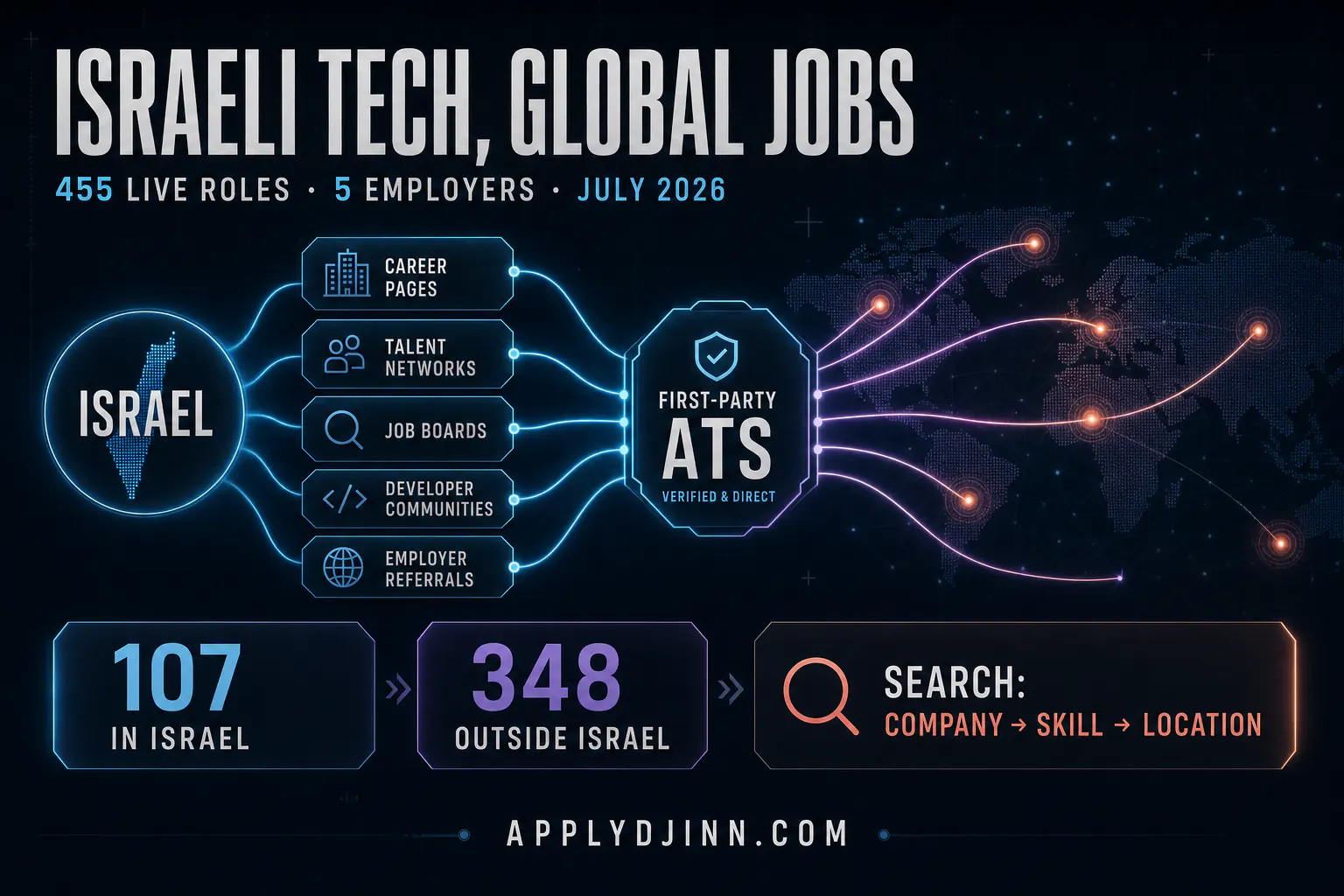
ApplyDjin checked the complete first-party career feeds for five major Israeli technology employers on July 17, 2026: VAST Data, Connecteam, Upwind, Buildots and BioCatch. Together they published 455 live openings worldwide. Only 107 were labeled in Israel; 348, or 76.5%, were elsewhere.
This is not another ranking of five logos. It is a practical guide to finding current jobs at Israeli companies without losing global roles to a country filter, a stale aggregator page or a duplicated listing.
Search the company before the country
The phrase “Israeli tech jobs” hides at least three different searches:
Those searches overlap, but they are not interchangeable.
If location is your hard constraint, start with the Israel vacancy search. If the employer ecosystem is your constraint, start with the company directory, open a company profile, and inspect its entire feed before narrowing by location. If your constraint is a skill or problem domain, start with all live vacancies and search the work itself.
This order matters. Filtering by Israel first would have hidden 348 of the 455 openings in this five-company snapshot.
Five complete career feeds, one live search
The point of this cohort is not that every candidate should apply to all five. It is that one employer-origin filter exposes several distinct job markets.
The totals are a dated snapshot; the links are live. The scrapers refresh from the employers’ own applicant-tracking systems, so a search can change as a company publishes or closes a role.
Why jobs disappear between an ATS and an aggregator
A company careers page is usually a view over an applicant-tracking system, or ATS. Comeet and Greenhouse are two common examples in this cohort. Third-party job sites copy those records, but the copy is not always complete or current.
Four failure modes matter to candidates:
For these five employers, ApplyDjin uses complete worldwide first-party feeds with no location filter and no maxJobs cap. Every upstream identifier becomes a company-specific source ID, and every result preserves its canonical application URL. In the captured 455-record cohort, all 455 source IDs and all 455 application URLs were unique.
That does not make every title unique. It makes every application record traceable.
How to search Israeli tech companies worldwide
Use this five-step sequence.
1. Choose the employer set
Start from the company directory, not a country keyword. Pick employers whose product, customer or technical problem gives your experience a plausible home.
2. Open the full company feed
Use the company-specific vacancy link before adding filters. Scan departments and locations once. You are building a map of the employer, not applying yet.
3. Search for the work
Use a skill, system or customer problem instead of relying on a perfect title. Examples from this cohort include distributed systems, cloud security, mobile infrastructure, computer vision, fraud analytics, solutions architecture and customer success.
Portable skills matter more than raw mention counts. The employer-breadth guide shows how to distinguish a skill used across many companies from one concentrated in a single hiring program.
4. Add location and work format last
Now apply the constraint that is actually non-negotiable: country, city, relocation, hybrid or remote. Do not treat “remote” as permission to work from anywhere. A remote role may still be restricted to the United States, EMEA or a specific payroll region. Our remote-work map explains why the location label still matters.
5. Verify the canonical application
Before tailoring a CV, open the source vacancy. Confirm that the role is active, the location matches, and the requirements have not changed. Apply through that canonical record rather than an old copied page.
How to recognize duplicates and stale jobs
Two vacancies with the same title are not automatically duplicates. “Account Executive” can represent separate territories, teams or requisitions. Conversely, one requisition can be shown in multiple locations.
Use this order of evidence:
If the source URL is gone, treat an aggregator copy as stale until the employer proves otherwise. If two records share a title but have different source IDs and locations, read both before discarding one.
Build a shortlist in 20 minutes
Do not begin by rewriting your CV for the first attractive title. Begin with a small evidence audit.
This method turns browsing into a market sample. Even if none of the first ten roles fits, you learn which evidence the company repeatedly rewards.
Are Israeli companies hiring outside Israel?
Yes. In this snapshot, the five complete feeds contained:
The five companies are not statistically representative of every Israeli employer, and VAST Data accounts for about half of the cohort. The result should not be read as “76.5% of all Israeli tech jobs are abroad.” It demonstrates something narrower and operationally important: a company-origin search must not silently become an Israel-only vacancy filter.
Frequently asked questions
Do I need to live in Israel to work for an Israeli tech company?
No. Many Israeli-founded companies hire in the United States, Europe, Asia-Pacific and other regions. Eligibility still depends on the location and employment terms of the specific vacancy.
Are all jobs at Israeli companies technical?
No. Global product companies also hire solutions, sales, support, customer-success, operations, finance and people teams. Search the full employer feed before assuming that an engineering center describes the whole company.
Is a remote listing global?
Usually not. “Remote” describes work format; the location field often describes where the employer can legally hire. Check both.
How often do these numbers change?
Continuously. The numeric snapshot was captured on July 17, 2026. The profile and vacancy links point to the live catalog, which is refreshed from first-party ATS sources.
Method and limits
The reproducible script is `scripts/report-israeli-tech-global-search-2026.mjs`. It reads every published record from the official VAST Data, Connecteam, Upwind, Buildots and BioCatch ATS feeds; normalizes company-specific source IDs, canonical URLs and location labels; and reports duplicate collisions.
“Israel” means the source explicitly labels the country, state, office or location as Israel. Everything else is reported as outside Israel; it is not automatically remote or open to international applicants. No generic talent-pool records were detected in the captured feeds.
The useful habit is simple: search the company, inspect the complete feed, search the work, then constrain the location. That sequence preserves the global job market the employer actually published.