Microsoft’s 60,000-Person Exit Offer: A Practical Tech Career Guide
About 60,000 Microsoft employees are eligible for a voluntary exit offer; confirmed departures remain unknown. What the announcement means, which training programs exist, and seven practical routes for technical career development.
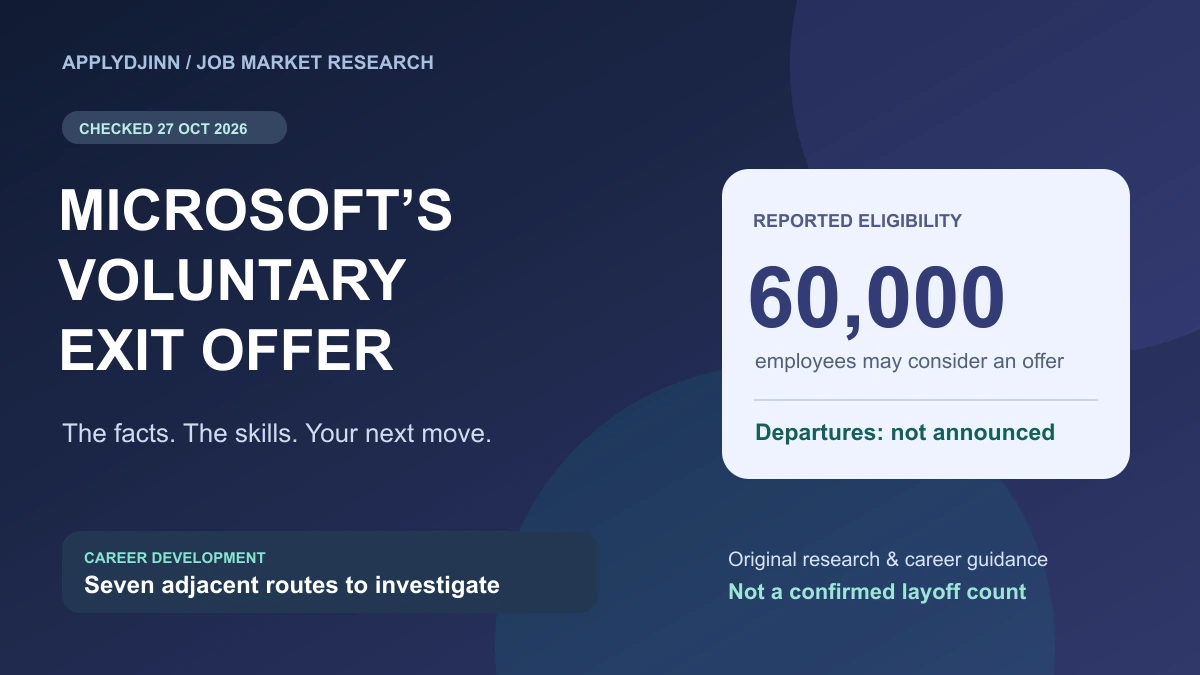
The claim that Microsoft is about to dismiss 60,000 employees needs a correction. Approximately 60,000 people are eligible for a voluntary exit offer. That is not a confirmed count of layoffs or accepted departures. Microsoft confirmed the eligibility figure to GeekWire and separately to CRN. Neither report establishes that everyone receiving an offer will leave. GeekWire reporting, CRN confirmation.
For technical professionals, the useful questions are more specific than the headline. Which parts of a career remain transferable when an employer reorganizes? What does retraining actually involve? Can a developer, analyst, tester, designer or product manager prepare for adjacent work without pretending to have become a different specialist overnight?
This guide separates the announcement, the financial context and our own career recommendations. Research checked: October 27, 2026. The suggested transitions below are ApplyDjinn editorial analysis, not a Microsoft placement scheme or a prediction of which jobs will disappear.
What Microsoft actually announced
On October 26, Chief People Officer Amy Coleman introduced the Voluntary Exit Offer. It covers eligible employees at level 70 and below in participating teams in Canada, India, the United Kingdom and the United States. Participation varies by organization. The time-limited program provides financial support and career-planning resources, with individual details communicated directly to eligible employees. Microsoft’s official announcement.
The distinction between an offer and an outcome matters. A recipient can consider the terms without becoming a departure. A subsequent vacancy can be a replacement rather than an expansion. A team can change its mix of responsibilities without eliminating every role carrying a particular title. Each of those events needs separate evidence.
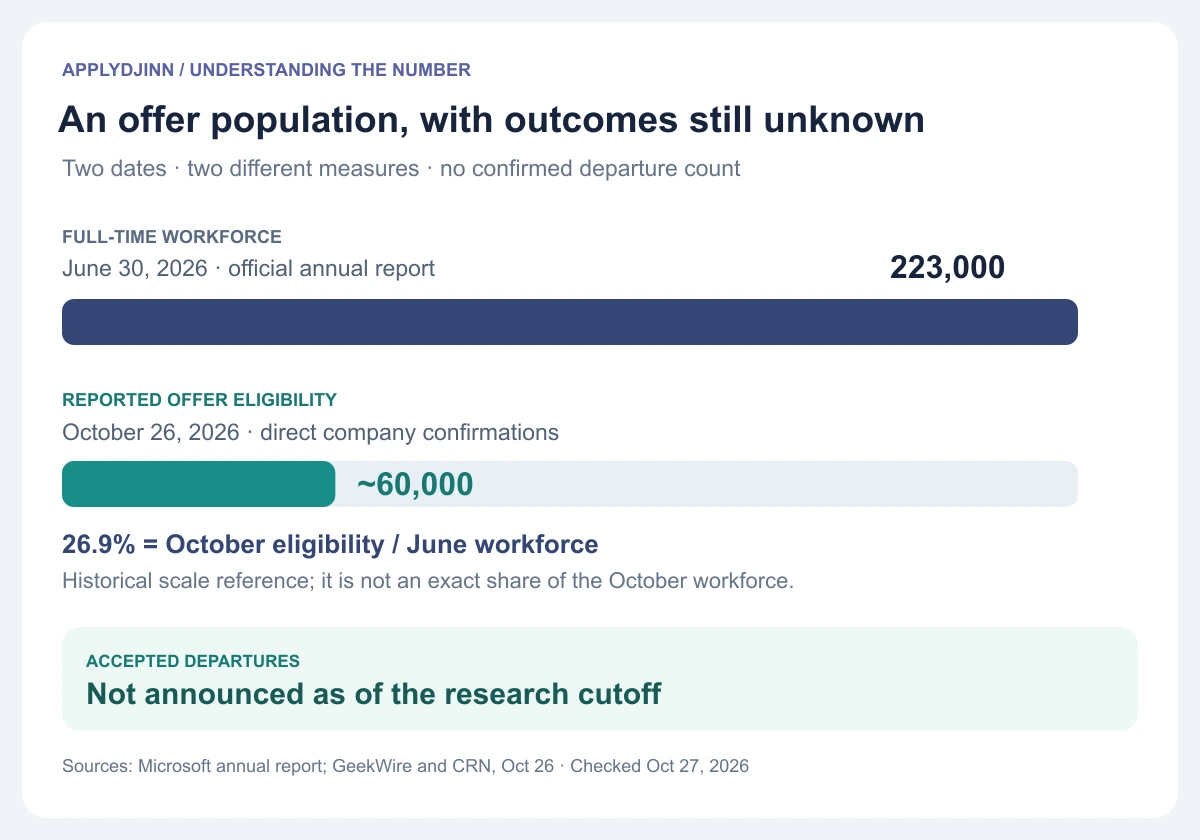
Microsoft’s annual report recorded 223,000 full-time employees on June 30, 2026. Comparing the reported offer population with that historical total produces approximately 26.9%. This gives a sense of scale, but June headcount is not an exact October denominator. It cannot establish the current number of employees excluded from the program. Microsoft 2026 Annual Report.
Which teams appear in the reporting?
Sky News, citing Reuters, reported participation involving AI experiences, finance and human resources, and exclusions involving marketing, commercial business and security. These are reported business-unit distinctions, not a complete official list of individual occupations or people selected for dismissal. Sky News report.
Read that list cautiously. An AI-related team appearing in an exit program does not prove that AI engineering has stopped being useful. A department excluded from this particular offer does not have a permanent employment guarantee. Business-unit boundaries can reflect product priorities, staffing decisions and customer commitments that an external observer cannot reconstruct from a short announcement.
For someone employed there, the decision-relevant document is the individual offer and the clarification provided by the employer. For everyone else, a more useful exercise is to examine responsibilities in current advertisements rather than rank entire professions as safe or doomed on the basis of department names.
A profitable company can still change its workforce
The financial backdrop is substantial. For the fiscal year ended June 30, Microsoft reported $331.8 billion in revenue and $155.2 billion in operating income. Its cash-flow statement shows additions to property and equipment of approximately $115.9 billion, compared with $64.6 billion in the previous fiscal year. Those figures describe company-wide cash investment; they are not a pure AI spending measure or the same measure as capital expenditure including finance leases. Microsoft FY2026 results.
Our interpretation is that revenue growth and workforce stability answer different questions. A company can earn more while changing which activities it funds, how teams operate and what capabilities it buys or develops. Strong results therefore offer limited reassurance about any particular job. Equally, a workforce adjustment does not by itself establish that an entire sector has stopped hiring.
There is no defensible calculation that converts those investment dollars into a corresponding number of people replaced by machines. Establishing that relationship would require information about tasks, team decisions, implementation costs and actual departures. The public figures support discussion of changing investment priorities; they do not support a precise automation casualty count.
What is confirmed about retraining and internal moves?
There is evidence of internal mobility, but no public destination list for the new offer in the material reviewed. In its separate July 6 workforce update, Microsoft announced around 4,800 role eliminations and said it had redeployed more than 4,000 employees over the preceding year. The periods and populations differ. Neither number is an outcome of the October offer. Official July workforce update.
Microsoft’s September account of its own AI transformation describes two concrete learning initiatives. PRAISE pairs emerging engineers with experienced preceptors and AI-assisted learning. Camp AIR helps cross-functional teams develop AI capabilities while redesigning real work together. These are internal development examples, not a promise that an employee considering departure will receive a particular new position. Microsoft’s transformation account.
That distinction makes the training discussion more useful. Internal mobility is an employer decision involving available work and selection. Learning is something a candidate can organize and demonstrate. A person may improve their options through training while still needing interviews, practical evidence and an eligible opening. A course certificate alone cannot resolve that gap.
A confirmed direction: customer-facing AI engineering
A more specific direction appears in earlier reporting. In a July interview with GeekWire, Coleman described reskilling engineers for customer-facing and AI-focused positions. That supports a concrete account of where some development effort is directed, although it does not establish destinations for recipients of the October offer. GeekWire’s July interview.
There is an official initiative behind that direction. On July 2, Microsoft announced Microsoft Frontier Company, backed by a $2.5 billion investment and an initiative to embed 6,000 industry and engineering experts with customers to design, deploy and improve AI systems. Its announcement discusses forward deployed engineering alongside industry expertise and organizational change. The figure is the initiative’s stated specialist scale, not 6,000 confirmed external vacancies or transfers from the October cohort. Microsoft Frontier Company announcement.
For a developer investigating this direction, our suggested preparation combines implementation with customer problem-solving. Practice clarifying a poorly specified request, integrating a solution into an existing system, evaluating the result and handing it over to people who must operate it. Search terms such as forward deployed engineering, AI implementation and customer engineering can help locate relevant descriptions; the actual responsibilities and qualifications still need checking in each advertisement.
What we found when checking Reddit
The October discussions contain personal experiences and speculation rather than a verified employee-to-occupation transfer table. One anonymous commenter claiming long Microsoft tenure describes a shift toward AI-generated code and human review. We cannot verify that identity or generalize the account across the company, so it is a possible interview question about changing work, not a measured workforce finding. Reddit discussion in r/Layoffs.
A different Reddit thread circulates a list of 40 occupations drawn from Microsoft research. It dates to July 2025 and is separate from this October exit offer. The post frames the list as replacement risk, which is stronger than the underlying measure supports. The earlier Reddit occupation-list thread.
The researchers’ own repository explains that its metrics describe AI applicability to occupational activities and must not be represented as the ability to replace jobs. The aggregate results cover 785 occupational codes and are published under CC BY 4.0. This is a useful research starting point for comparing tasks, with attribution and the stated limitations, rather than a list telling employees what to retrain into. For career planning, ask which activities change and which responsibilities you can demonstrate; do not convert an applicability score into an individual layoff probability. Microsoft’s research data and intended-use guidance.
Seven adjacent career routes worth investigating
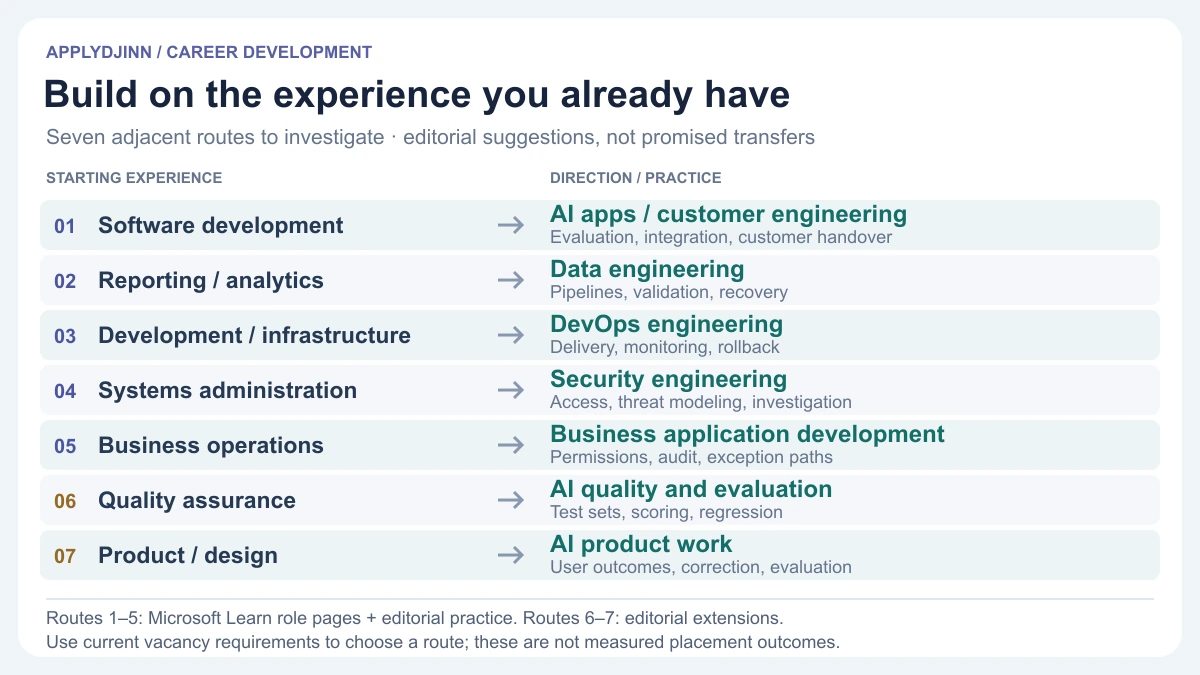
The following map is a proposed way to investigate a transition. It is not a ranking of demand, a list of Microsoft vacancies or a guarantee of employment. Five routes connect to official Microsoft Learn role pages; two extend the same approach to quality and product work. Choose the route that reuses your strongest existing experience.
1. Software development to AI applications or customer engineering
Microsoft Learn describes AI engineering as combining software development with data and model integration. Its AI engineer career path provides an official learning starting point. For an experienced developer, the practical question is which parts of an application become less predictable when a model participates in its decisions.
Our suggested portfolio project is a small retrieval application using material you have permission to use. Include an evaluation set, citations, a response-quality check and a fixed spending limit. Demonstrate what happens when retrieval fails or the model produces an unsupported answer. Explain the latency and failure tradeoffs. That evidence communicates more than attaching an AI label to an ordinary interface.
2. Reporting and analytics to data engineering
The data engineer learning route centers on integrating data and operating reliable pipelines and stores. Someone who understands business metrics already has useful context, although production engineering introduces additional responsibilities beyond producing a dashboard.
A proposed exercise is an incremental pipeline with a stable input contract, duplicate handling, validation and a documented recovery procedure. Use a public or synthetic dataset. Change its schema deliberately and show how the pipeline detects the change. A short explanation of data freshness, failed records and reconciliation demonstrates the gap between extracting a file once and maintaining a dependable service.
3. Development or infrastructure administration to DevOps
Microsoft’s DevOps engineer path covers delivery processes spanning code, infrastructure, testing, security and monitoring. It is an adjacent direction for people who already understand either application changes or system operations and want responsibility across the boundary.
Build a small service with a repeatable deployment, automated checks, observable health and a tested rollback. Explain the recovery procedure in a runbook that another person could follow. Include one intentionally failed release and the evidence used to detect it. The goal is to demonstrate operational judgment; a page of tool names does not show whether you can restore a working service.
4. Systems administration to security engineering
The security engineer route describes work protecting systems against vulnerabilities and threats. Prior administration experience can supply useful knowledge of access, networks and operational failure, but a credible transition still needs security-specific practice.
In an isolated environment you control, create an access review, a simple threat model and an investigation of a deliberately generated alert. Explain the permissions involved, the evidence collected and the limits of your conclusion. Include how you would reduce false alarms. Do not use an unauthorized production system as a practice target. A small, well-explained investigation is better evidence than an unsupported claim of expertise across every security domain.
5. Business operations to business application development
Microsoft’s app maker learning route covers solving business problems with Power Platform tools. It offers an approachable direction for people with process knowledge who want to build software-supported workflows, including those who have not followed a traditional engineering path.
Choose one process you understand, such as a request and approval flow. Build a prototype with clearly separated user permissions, validation, an audit trail and an exception path. Use synthetic records rather than employee or customer data. Document how the application would be owned and maintained. Knowing the process is an advantage when you can also explain how the resulting tool behaves when its happy path breaks.
6. Quality assurance to AI quality and evaluation
This is our editorial extension, not a Microsoft-announced transfer route. A tester’s experience with reproducibility, edge cases and regression already provides a useful foundation. The proposed additional work is to evaluate outputs that can vary even when the request appears similar.
Build a small test collection with expected properties, representative failure cases and a repeatable scoring procedure. Compare two versions of a system without changing the test population halfway through. Record human disagreements rather than hiding them in an average. Show which failures should block a release and which require review. Check real advertisements for the expected mix of automation, statistics and domain knowledge before adopting a new title.
7. Product management or design to AI product work
This is another proposed adjacent direction. Existing strengths in user research, prioritization, interaction design and stakeholder decisions remain relevant. The new challenge is to design around uncertain outputs, varying costs and situations where a person needs to inspect or correct the result.
Create a product brief and a clickable prototype for one bounded use case. Define the user outcome, an evaluation plan, a correction flow and a condition under which the feature should be disabled. Explain what the system must ask the user to confirm. A designer or product manager does not need to claim to be a model researcher to show good judgment about how an AI feature should behave.
Turn the map into a realistic search plan
Start with two search lanes: your current role and one adjacent direction. Collect a manageable set of advertisements and record location, level, responsibilities and hard requirements. Separate recurring requirements from a single employer’s unusual tool choice. Look for work you can already support with evidence before deciding that you must restart your entire career.
Then choose one missing capability that appears repeatedly. Use an official learning path for the relevant foundation and a small project to test whether you can apply it. Keep the output reviewable: a repository, a short demonstration, a technical note or a case study. Explain what you built, what failed and what remains incomplete. Completing a bounded exercise is a starting point for feedback, not a claim of instant professional seniority.
Use the ApplyDjinn vacancy catalog to investigate employers and compare requirements. Preserve the original vacancy link and check it before applying. Similar records at different locations may represent one requisition, so do not treat every representation as an independent hiring opportunity. Tailor your CV around relevant experience you actually have, with learning projects labeled as projects rather than employment.
What this means for our four priority markets
The official offer names the United States and Canada among its participating countries. It does not name Israel or Ukraine. That does not establish that either country is unaffected by all Microsoft workforce changes; it defines the geography of this particular public announcement.
For applicants in any market, employer location and work authorization conditions still need individual checking. Remote wording does not establish worldwide eligibility. A role advertised by a multinational in one country does not automatically accept an application from another. Use the location and arrangement stated in the current opening rather than the employer’s headquarters as your guide.
Readers can compare our recent US role analysis, Israel hiring mix, Ukraine technical roles and Canada search guide. Those articles disclose their catalog observation and coverage limits. Their counts describe advertisements in our sample, not a forecast of hiring or a measure of Microsoft employees entering each local market.
What to watch next
The useful follow-up evidence is an actual acceptance count, the timing and distribution of departures, and any subsequently published hiring or mobility information. Until those details exist, precise forecasts of additional candidates competing for a particular occupation or country would be speculation.
For your own career, keep a separate record of what you can influence: the jobs you verified, recurring skill gaps, the project you completed and the feedback you received. Large workforce headlines can provide a reason to review those decisions. The review becomes useful when it produces a clearer next action rather than a generalized fear that every technical role is disappearing.
Sources and scope
The reporting was checked against official Microsoft announcements, its annual report, its fiscal-year results, its published transformation account, and direct company confirmations reported by GeekWire and CRN. Sky News supplies separately attributed reporting on participating divisions. The earlier reskilling direction is attributed to the July interview and checked alongside the official Frontier Company announcement. Reddit is used only to identify discussion themes and the older occupation-list claim; it does not establish employee identities or company policy. Links appear next to the corresponding facts; the five Microsoft Learn pages provide the referenced role definitions and learning routes.
The three images are original ApplyDjinn illustrations. The scale figure uses a reported eligibility estimate and a separately dated official workforce count, with the difference stated explicitly. The career map contains editorial suggestions, not measured placement outcomes. No private employee information, copied news photographs, third-party charts or individual employment offers were used. This article will need an update when actual departure figures become available.